There is a quality that distinguishes the most accomplished surgeons from the merely skilled, and it is not found in diplomas or procedural volume. It resides instead in something harder to measure: the way a physician understands his own craft, the intellectual framework he has constructed around it, and the degree to which that framework holds under pressure.
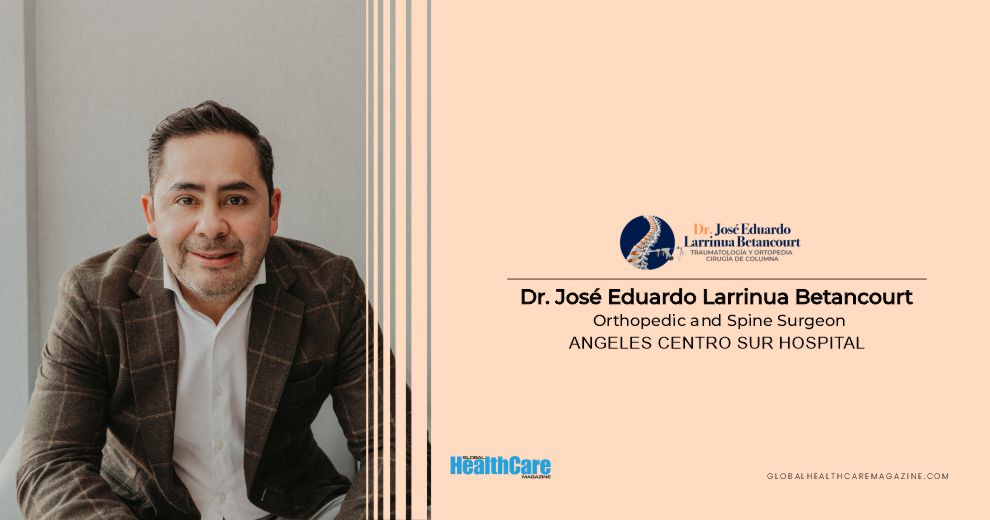
Dr. José Eduardo Larrinua Betancourt, orthopedic and spine surgeon at Angeles Centro Sur Hospital in Queretaro City, possesses that quality in uncommon measure.
Over more than a decade of practice at some of Mexico’s most demanding clinical institutions, he has established himself as one of the country’s foremost specialists in minimally invasive spinal surgery, a physician whose reputation rests not only on technical mastery but on a philosophy of care that is, at its core, deeply considered. To understand that philosophy, one must understand something that might, at first hearing, seem peripheral to a surgical career.
Dr. Larrinua is a serious equestrian. And when he speaks about what horsemanship has taught him about medicine, one quickly grasps that this is not an incidental detail. It is, in many respects, the organizing principle of his professional life.
The Formation of a Specialist
Dr. Larrinua’s professional formation reflects the kind of methodical, cumulative approach that characterizes physicians who intend to operate at the highest level. He completed his undergraduate medical education at the Autonomous University of Tamaulipas in 2008, returning to the same institution in 2014 to complete his specialization in Traumatology and Orthopedics.
That decision to deepen his foundation at home before pursuing advanced training abroad speaks to a particular temperament: one that values thoroughness over expediency.
The clinical years that followed were rigorous and consequential. He served for four years in the area of Traumatology and Orthopedics at the Regional Hospital of Ciudad Madero PEMEX, an environment that demanded breadth, adaptability, and sound clinical judgment under sustained pressure.
He then undertook a focused assignment in spinal surgery at the Central Military Hospital in Mexico City, one of the nation’s most exacting medical institutions, where the standards for both surgical precision and patient outcome are among the most stringent in the country.
Since 2016, Dr. Larrinua has been assigned to the orthopedic and spine service at Medica Sur Hospital, where his clinical scope encompasses lumbar and cervical disc herniation, back and cervical pain, lumbar disc fusion, spine pathologies, complex column surgery, and spinal deformities.
He holds membership in the Asociación Mexicana de Cirujanos de Columna AC, the North American Spine Society, and the Mexican College of Orthopedics and Traumatology AC, and has contributed to peer-reviewed medical journals and participated in professional conferences across the international medical community.
These affiliations and publications are not incidental. They are the marks of a physician who has chosen to remain in active, sustained engagement with the evolving frontiers of his discipline, rather than allowing his practice to calcify around techniques mastered years prior.
International Training, Refined Technique
The most consequential chapter in Dr. Larrinua’s development as a surgeon came through advanced training abroad, in two countries that represent, by any serious measure, the global vanguard of minimally invasive spinal technique: Germany and South Korea.
Each country contributed something distinct and essential.
In Germany, the emphasis was philosophical before it was technical. Dr. Larrinua is the kind of physician who, upon achieving competence, immediately seeks the next level of mastery, and what Germany gave him was a rigorous framework for surgical intention.
“In Germany, I learned the philosophy of meticulous planning. Every surgical movement must be deliberate and purposeful.”
The significance of that formulation should not pass unexamined. In a discipline where the consequences of imprecision can be permanent and severe, the commitment to planning every movement before incision represents not merely good practice but a form of professional ethics. It is a refusal to allow habit or routine to substitute for thought.
In South Korea, the training shifted from the philosophical to the technological.
“I mastered cutting-edge technologies including endoscopic procedures, percutaneous techniques, and navigation systems that allow for millimeter-level accuracy,” he explains.
The practical consequence of this international formation is a practice defined by a fundamental departure from conventional surgical methodology.
Where spinal surgery once required substantial incisions, extended operative times, and lengthy periods of postoperative recovery, Dr. Larrinua performs complex procedures through incisions of just a few centimeters.
His patients typically experience markedly reduced postoperative pain, accelerated recovery trajectories, and, in many cases, return home the same day or the following morning. His specific areas of surgical expertise include endoscopic discectomies, percutaneous screw fixation, minimally invasive decompressions, and advanced spinal deformity corrections.
Each of these techniques reflects the same animating principle: to perform precisely what the clinical situation demands, with maximum accuracy and minimum disruption to the patient’s anatomy.
The Equestrian and the Surgeon
To understand the intellectual architecture of Dr. Larrinua’s surgical practice, one must engage seriously with the parallel he draws between his work in the operating room and his long discipline as an equestrian. This is not a metaphor deployed for rhetorical effect. It is a framework he has developed through sustained reflection, and it is worth examining with the same rigor he applies to his clinical work.
He identifies three principles that govern both horsemanship and minimally invasive spinal surgery: precision, patience, and the capacity to read subtle cues.
In combination, these three qualities constitute what he regards as the essential character of a surgeon operating at the highest level. In terms of precision, he is specific and instructive. Skilled riding is not the product of dramatic interventions but of micro-adjustments, incremental and almost imperceptible corrections in weight, pressure, and position that, together, guide complex movement with apparent ease.
The same principle governs endoscopic spinal surgery, where the operative field is viewed through a lens and the instruments are guided through a passage of minimal diameter.
“Just as a jerky movement on a horse breaks the connection and creates confusion, an imprecise surgical movement can have serious consequences.”
On patience, his perspective is, within the context of contemporary surgical culture, both considered and quietly challenging. The dominant impulse in high-volume medical practice is toward intervention; the temptation to act, to offer a procedure, to respond to a patient’s suffering with a surgical solution, is persistent and not always well-examined.
“You cannot force progress when training a horse. You build trust incrementally and understand that rushing leads to problems.”
The clinical translation of this insight is direct: not every patient who presents with spinal pain requires surgical intervention.
The most clinically sophisticated response is sometimes to wait, to pursue conservative treatment, and to exercise disciplined judgment about when operative timing is genuinely appropriate.
“Sometimes the most skilled intervention is knowing when to wait, when to try conservative treatments first, and when the timing is right for surgical intervention.”
The third principle, the development of tactile and intuitive feel, is perhaps the most difficult to articulate and yet, in Dr. Larrinua’s account, the most clinically decisive.
Experienced equestrians develop an understanding of the horse that does not depend on visual confirmation, an integrated, physical knowledge that allows them to respond to subtle shifts in movement before those shifts become fully apparent.
He argues, with considerable conviction, that experienced surgeons develop a directly analogous form of tactile intelligence, built across thousands of hours of operative practice and not reducible to formal instruction.
“This intuitive knowledge often makes the difference between a good outcome and an excellent one.”
There is one further dimension to this parallel that deserves particular attention. Horses are acutely responsive to the emotional state of the rider. Anxiety communicates itself through tension in the hands, the seat, the posture, and the horse responds in kind.
Dr. Larrinua draws this parallel with the composed certainty of a physician who has tested it under genuine clinical pressure.
“In surgery, especially with delicate neural structures, maintaining composure and a steady hand is essential. The mental discipline from riding has made me a better surgeon.”
What emerges from this account is not the charming story of a surgeon who happens to ride horses. It is something more substantive: a coherent intellectual system in which two demanding disciplines have refined each other over the years, producing a clinician whose technical ability is inseparable from his capacity for composure, patience, and precision under pressure.
Advanced Care Without Compromise
In recent years, a growing number of patients from the United States and Canada have sought care at Dr. Larrinua’s practice in Querétaro City.
The reason is not straightforward and, for many patients, consequential: they are able to access the same standard of surgical expertise, technology, and clinical outcome available at leading North American medical centers, at costs that are typically 50% lower, with no reduction in quality or safety.
Dr. Larrinua is precise about the basis for this cost differential. It does not reflect diminished standards, inferior equipment, or attenuated expertise.
It reflects the structural economics of healthcare delivery in Mexico relative to the United States and Canada, a systemic difference in cost architecture that does not translate into any meaningful difference in the clinical encounter.
“We have access to the same advanced surgical equipment, implant manufacturers, and technological innovations used in the best hospitals in the world. Our operating rooms feature state-of-the-art navigation systems, high-definition endoscopic equipment, and all modern tools of minimally invasive spine surgery.”
For patients navigating high deductibles, inadequate insurance coverage, or extended waiting periods in their home healthcare systems, the practical meaning of this is not abstract.
“This can mean the difference between getting needed surgery or continuing to live with debilitating pain.”
His practice is structured to support international patients at every stage of the process: coordination with the patient’s physicians at home, assistance with logistical and travel arrangements, and comprehensive postoperative guidance to ensure a safe return.
The abbreviated recovery periods that characterize minimally invasive procedures make this international care model practically viable for the great majority of patients who undertake it.
The Standard He Holds Himself To
When Dr. Larrinua speaks about his relationship with his patients, the language he uses is instructive.
He does not speak of case volumes or procedural throughput. He speaks of individual human beings who have placed their trust in his hands, and of the obligation that trust creates.
“Every patient deserves the same level of precision, patience, and attention that I would want for myself or my family. Just as I wouldn’t rush a horse through training, I don’t rush patients into surgery or take shortcuts in the operating room.”
He characterizes minimally invasive spinal surgery as both a science and an art, and the distinction he draws between those two dimensions is telling.
The science resides in understanding: anatomy, pathophysiology, surgical technique, and the accumulated clinical literature of his field.
The art resides in execution: the capacity to translate that understanding into controlled, purposeful action under operative conditions, to adapt when the unexpected presents itself, and to maintain the composure that precise work requires.
His professional ambition, as he articulates it, is to serve as a destination for patients who require advanced spinal care and who deserve the full advantages that minimally invasive surgery can offer: reduced operative trauma, faster functional recovery, and an earlier return to the activities and relationships that constitute a meaningful life.
Whether that means returning to professional responsibilities, resuming physical activity, or simply being present for one’s family without the constraint of pain, the goal is the same.
“The lessons I learn from horses continue to make me a better surgeon. And maintaining this balance, this connection to a passion outside of medicine, ultimately makes me a better physician and a more complete person.”
In contemporary medicine, where the pressures of volume and efficiency exert constant force, a surgeon who has constructed a coherent philosophy of care grounded in discipline, humility, and the sustained pursuit of excellence represents something that deserves recognition.
Dr. José Eduardo Larrinua Betancourt has spent more than a decade building exactly that.
The operating room and the riding arena, disparate as they appear, have shaped in him a practitioner of uncommon depth, whose finest quality may be this: that after years of serious, consequential work at the frontier of his field, he continues, with characteristic deliberateness, to learn.
Dr. Larrinua is based at Hospital Angeles Centro Sur, Piso 11, Consultorio 1140. He welcomes inquiries at +52 442 149 9345 and dr.eduardolarrinua@gmail.com.
Quotes

Read More: Healthcare Leaders in Orthopedics: Shaping the Future of Spinal Surgery