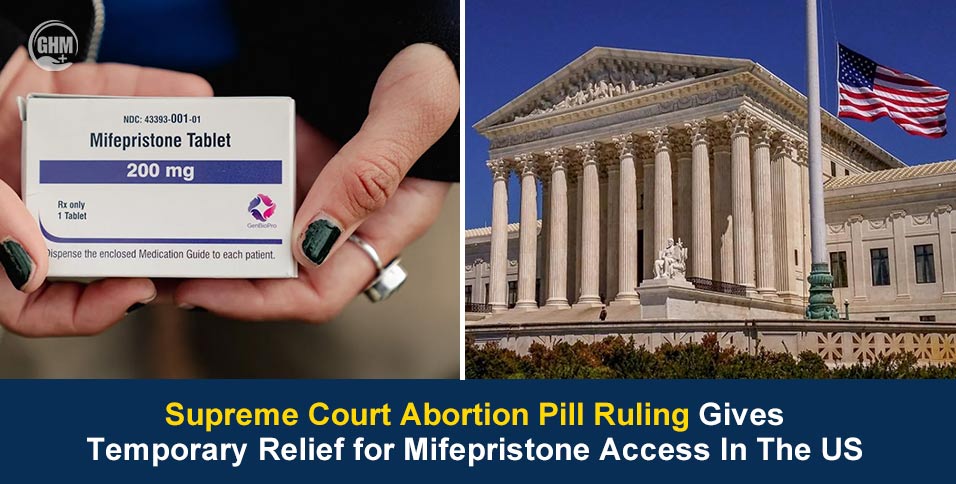
In an emergency move, the Supreme Court abortion pill ruling has temporarily preserved access to the abortion drug Mifepristone across the United States by mail-order, offering short-term relief to patients and healthcare providers.
The US Supreme Court issued a brief pause on lower-court restrictions, ensuring that telehealth prescriptions and mail delivery of the abortion medication remain available, for now.
This Court Ruling on Mifepristone comes after a lower court decision threatened to immediately limit the nationwide access of the abortion drug. While the ruling is not final, it could impact the growing legal battle over abortion access in the U.S. and the healthcare system.
What Happened In The Supreme Court Abortion Pill Ruling?
The latest US Supreme Court ruling on abortion pill centers on an “administrative stay,” a temporary pause issued by Justice Samuel Alito. The decision blocks a lower court ruling that would have required patients to obtain mifepristone in person.
The Supreme Court abortion pill ruling made major changes in the Mifepristone access. The telehealth abortion access in the US remains legal temporarily nationwide. The pause is valid until at least May 11. The Court is reviewing emergency appeals from drug manufacturers
The abortion pill ruling ensures that patients can still receive prescriptions through online consultations and have the abortion medication delivered by mail. Without this court ruling, access to Mifepristone could have been significantly restricted across all states.
The lower court’s decision had raised concerns about “immediate confusion and upheaval” in time-sensitive medical care. The Supreme Court decision prevents that disruption, for now.
Legal Fight Over FDA Abortion Pill Regulation
The Supreme Court abortion pill ruling originated from a lawsuit filed by Louisiana challenging the FDA abortion pill regulation. The state argued that allowing telehealth prescriptions undermines its strict abortion laws.
The case focuses on changes made during and after the COVID-19 pandemic, when the FDA allowed mifepristone to be prescribed remotely. This shift significantly expanded telehealth abortion access in US, especially in states with limited clinic availability.
A similar challenge was rejected in 2024, but on technical grounds. But the current abortion pill case is expected to have broader legal implications.
Why Mifepristone Access Matters In US Medication Abortion Laws
Mifepristone plays a central role in US medication abortion laws. It is typically used with misoprostol in a two-drug regimen to terminate early pregnancies.
Key facts:
- Medication abortions account for nearly two-thirds of all abortions in the U.S.
- Over 7 million patients have used mifepristone since its approval.
- It is approved for use up to 10 weeks of pregnancy.
The Supreme Court abortion pill ruling directly affects misoprostol and mifepristone access, which are essential components of modern reproductive healthcare.
Impact on Patients and Healthcare Providers
The regulations on abortion pills have immediate consequences for both patients and providers:
- Prevents sudden cancellation of telehealth appointments
- Ensures continuity of care in time-sensitive situations
- Maintains access for patients in rural or restrictive states
A large number of patients have become dependent on remote healthcare services, and the Supreme Court’s decision on abortion pills could be an essential shift for women.
Conclusion
The Supreme Court abortion pill ruling has, for now, preserved access to a widely used abortion medication and prevented immediate disruption to care. However, the issue is far from resolved.
The abortion pill ruling may influence future FDA abortion pill regulation. It could also affect the political landscape and shape national debates ahead of elections.
As the legal battle continues, the Supreme Court abortion pill ruling will remain central to discussions about healthcare access, regulatory authority, and reproductive rights in the United States.