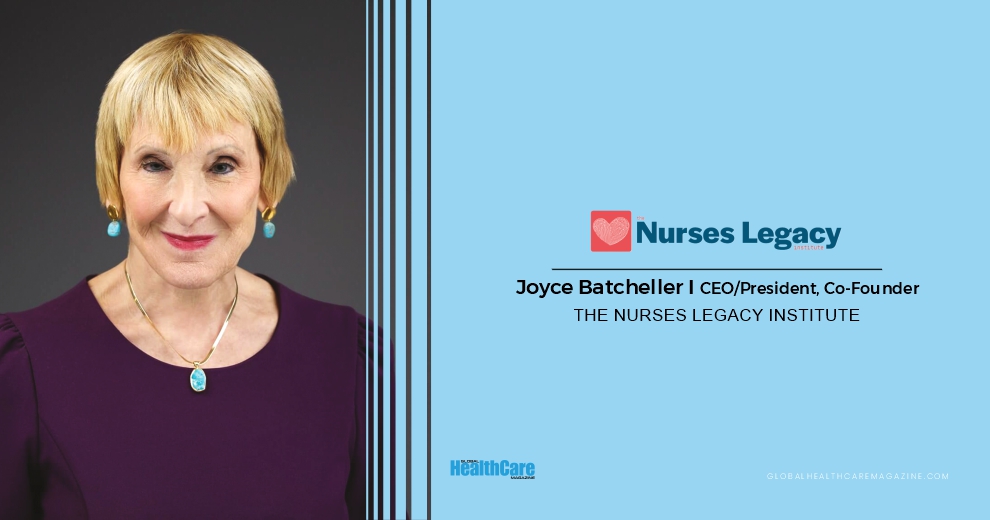
There is something deeply telling about the first image Joyce Batcheller reaches for when she talks about nursing leadership. She does not begin with statistics, though she has plenty of them. She does not open with the language of institutional reform or workforce policy, though she speaks both fluently and with authority. She begins, instead, with a joke.
“You get a magic wand over your head,” she says, describing what most hospitals tacitly expect of a newly appointed Chief Nursing Officer, “and then you know what to do.”
She smiles when she says it. But the smile carries considerable weight.
Joyce Batcheller has spent more than 40 years in healthcare, 19 and a half of them as a system Chief Nursing Officer for the largest healthcare system in central Texas. She has watched what happens when capable, talented nurse leaders are handed a title, pointed toward the door, and left to reconstruct the map as they go. She has, in fact, lived that experience herself. And it is precisely that experience, the difficulty of it, the isolation of it, the sheer improvisation it demanded, that eventually led her to co-found The Nurses Legacy Institute alongside Dr. Patricia Yoder-Wise, headquartered in Austin, Texas.
The Nurses Legacy Institute is not simply another professional development platform. It is, in the most meaningful sense, an act of institutional generosity: a place built deliberately so that the next generation of nursing executives would not be left to find their footing alone.
The Wand Nobody Gets
The gap that Joyce identified was neither subtle nor obscure. It was hiding, quite plainly, in the everyday architecture of how hospitals bring leaders into their most senior nursing roles.
She pursued her Doctor of Nursing Practice degree with a specific focus: to study the onboarding and enculturation of new Chief Nursing Officers. What she found was a striking contrast between onboarding staff nurses and executive nurse leaders.
For example, a bedside nurse completing clinical orientation moves through a structured, rigorous competency checklist before being cleared to care for patients. Every step is intentional and verified. The system is designed to confirm readiness before the nurse begins to care for patients.
For a newly hired CNO, the prevailing expectation was far less formal. The assumption, widespread and largely unexamined, was simply that the new leader would determine what needed to be done and proceed accordingly.
“It is generally expected,” Joyce notes, “that a newly hired leader will determine what needs to be done.”
Leadership development, as she came to understand it over decades of practice, is not a credential you receive or a skill set you acquire all at once. Leadership development is a journey. It requires intentional planning, a genuine commitment to growth, and self-awareness to recognize that the CNO role is considerably more expansive and complex today, and the competencies that are needed continue to evolve.
Today’s Chief Nursing Officer is not solely a clinical overseer. The role demands fluency in strategic planning, financial management, operational execution, workforce development, and developing strong relationships. No one begins already equipped with all of the competencies for this role. And the situations a CNO will encounter across a career will call for competencies that no training program could fully anticipate in advance.
Involvement in professional nursing associations, building a meaningful network of peers, and remaining genuinely open to mentoring are not, in Joyce’s view, optional enhancements to a leadership career. They are structural necessities.
A Problem With a Price Tag
There is a second dimension to the story of how The Nurses Legacy Institute came into existence, and it is both practical and familiar to anyone who has worked inside a healthcare organization.
Healthcare systems face persistent financial pressure. When budgets are reviewed, the funding earmarked for leadership development is, reliably and regrettably, among the first categories to be reduced. Joyce encountered this pattern directly in the early life of the Chief Nursing Officer Institute, TNLI’s flagship immersive program. Attendees wanted to participate. The value of the program was self-evident. But their employers would not provide the funding to support their attendance.
The solution she and Dr. Yoder-Wise arrived at was structural and strategic. By establishing The Nurses Legacy Institute as a 501(c)(3) nonprofit organization, they created an entity capable of accepting grant dollars and sponsorships. This made the work financially independent of any single institution’s annual budget decisions and removed the barrier that had been keeping aspiring leaders from the development they needed. Scholarship dollars are available to assist some attendees.
The structure enabled the mission. And the mission was unambiguous: to ensure that new and aspiring Chief Nursing Officers receive the kind of thoughtful, rigorous preparation the role demands, regardless of what their employer’s finance department decides in a given fiscal year.
What Four Days Can Change
The Chief Nursing Officer Institute is a four-day immersive program, and that specificity is intentional rather than arbitrary.
The first focus is self-knowledge. Participants are guided to examine who they are as leaders: their strengths, how they typically respond under pressure, and how much grit and determination they have. These are not supplementary additions to the curriculum. They are, in Joyce’s framework, the essential foundation on which everything else rests.
The second focus is the role itself: a clear-eyed understanding of what a CNO is actually responsible for, the full breadth of it, not merely its clinical dimensions.
The third focus is influence and execution: how to move people, shape culture, and lead necessary changes in environments that are complex, politically layered, and frequently resistant.
Over four days, participants engage with case studies and simulations that approximate the real-world conditions of executive nursing leadership. When they leave, they carry with them a concrete action plan, a toolkit of practical resources, and something equally durable: a network of colleagues they can continue to work with long after the program ends.
The transformation that Joyce most commonly observes is both visible and evaluable. Confidence, energy, and the other essential leadership capacities assessed during the CNOI all show measurable differences by the program’s close.
“It is extremely rewarding to see them leave the program smiling and ready to share what they have learned, knowing their challenge now has an action plan.”
The People Behind the Work
The faculty assembled to deliver this work reflects a deliberately wide range of expertise and perspectives.
Dr. Barry Dornfeld is a sociologist who brings an analytical lens to human systems and organizational behavior that is rarely present in clinical leadership preparation. Dr. Syl Trepanier serves as the Chief Nursing Executive of a large healthcare system, offering current, grounded insights into the contemporary demands of executive nursing roles. Dr. Patricia Yoder-Wise, TNLI’s co-founder, brings extensive executive nursing experience gained at the national and state levels.
And then there is Joyce herself, whose 19 and a half years as a system CNO form the bedrock of the institute’s practical credibility.
She describes her own earliest experience in the role with the kind of candor that comes only from having genuinely processed something difficult. She calls it learning through “the smacking syndrome.” She remembers being repeatedly and pointedly reminded of boundaries she had not known she was crossing. Three phrases, in particular, stayed with her: “Who said you can do that? What were you thinking? And who invited you to this meeting?”
She does not recount this with resentment. She recounts it because it explains, perhaps more than any other single thing, the reason The Nurses Legacy Institute exists at all.
When Everything Shifted
If there is a chapter of Joyce’s career that most sharply tested the qualities she now teaches, it began not with a catastrophe but with a routine transition.
She had relocated to Austin, Texas, to take on a Vice President role concentrated in cardiac care, critical care, cardiopulmonary services, and emergency services. These were areas of deep clinical experience and genuine personal passion. She was, by any measure, prepared for the work.
Then the organization’s CNO departed.
Her supervisor informed her she would be appointed as the new Chief Nursing Officer for both hospitals and clinics, while continuing to carry her existing Vice President responsibilities. She accepted this. And then, months into the new arrangement, came the news that two additional hospitals would be joining the system.
The CEO’s vision was clear and non-negotiable: nursing care would be consistent across every site, regardless of which facility a patient entered. That standard did not yet exist. It would need to be built.
“Since this wasn’t already being done,” Joyce reflects, “I realized I’d have to figure it out with my team as I went along.”
The further complication was structural. The nursing leaders at these sites did not report to her. There was no direct authority to leverage. Every step of the work would have to happen through influence, trust, and collaborative persistence.
She assembled a small team and began constructing a shared governance model for the system. Her first objective was not organizational. It was relational: to build a critical mass of nurses and leaders who were willing to take a leap of faith with her as the work moved forward. It required time, sustained effort, and a willingness to stay with the difficulty long after the initial energy had passed.
The results ultimately surpassed what she had initially imagined possible.
What the Numbers Say
There is a particular kind of credibility that only accumulates through results, and Joyce’s record of measurable achievement is both long and specific.
During her tenure as system CNO, four hospitals achieved Magnet Designated™ status under a single system application. At the time of those designations, only one other Magnet hospital existed in Texas. There were 60 Magnet hospitals nationwide. Her system’s four hospitals became numbers 61, 62, 63, and 64.
Five additional hospitals within her purview earned the Pathway to Excellence™ designation during her years in that role.
The milestone that perhaps most powerfully captures her approach to leadership is the work undertaken within a Triad leadership model beginning in 2005. With the system CEO and Chief Medical Officer aligned at the top alongside her, the Triad set a goal that might have sounded aspirational at the outset: zero preventable deaths and injuries, to be achieved by 2008. The triad at each hospital site was accountable for carrying that commitment through their organizations.
The goal was met for several of the organization’s focus metrics. For example, zero preventable cases of ventilator-acquired pneumonia.Zero central line infections and a great decrease in hospital-acquired pressure ulcers. The results were achieved across multiple critical performance metrics.
“The pride and ownership were amazing,” she says, and it is clear she is not speaking about the numbers themselves.
At the state and national level, Joyce has served on the Strategic Advisory Committee for the Texas Team Future of Nursing Initiative, previously co-led the Practice Committee for the same initiative, and served as chairperson of the Healthcare System Excellence Expert Panel of the American Academy of Nursing. She most recently served as the President of the Texas Nurses Association.
Building While Running
Today, as the CEO and President of The Nurses Legacy Institute, Joyce describes an organization that is growing rapidly and with deliberate intention.
The CNO Institute and CNO Roundtables continue as the anchor programs of the institute’s work. A senior executive nurse program is in active development and is planned for later in 2026.
Among the most significant recent additions is the launch of CNO How To: The First 90 Days, a self-paced eLearning and one-on-one coaching program designed specifically for nurse leaders stepping into the CNO role for the first time. Its purpose is direct: to provide a structured roadmap and consistent support so that a new CNO can lead with clarity from day one, rather than reconstructing the role through trial and error.
Running an organization in active growth while simultaneously building its long-term future requires a specific kind of executive discipline. Finding team members who genuinely fit the culture, who are not only skilled but also comfortable contributing to something still taking shape, is itself a form of leadership work.
“It is all very exciting,” Joyce says, “and keeps me very energized.”
The Larger Vision
When asked where The Nurses Legacy Institute is headed, Joyce does not gesture toward expansion metrics or organizational targets.
She reaches for something more durable.
The vision she articulates is to develop exceptional executive nurse leaders capable of transforming the healthcare system through improved patient outcomes and healthier communities. Not for the purpose of career advancement alone, but because nursing leadership, practiced with excellence and intention, changes the l conditions of people’s lives. That is the larger work, and it is the one she is building toward.
How She Stays Whole
There is a recognizable discipline in the way Joyce manages her own time and energy, and it follows the same logic she applies professionally.
Balancing competing demands across different roles and interests is, she acknowledges openly, an ongoing challenge. Her answer to that challenge is practical and familiar: the calendar.
Dance lessons. Bike riding. Walking with friends. Time with my family (especially my son and daughter). These are not occasional indulgences or aspirational additions to a schedule that is already full. They are booked commitments, protected with the same intentionality she brings to a program launch or a board meeting.
“I am more productive, effective, and joyful when I exercise and integrate these activities into my schedule,” she says.
The word “joyful” in that sentence is not incidental. It is, in fact, the point.
What She Believes
Beneath everything Joyce has built and continues to build, there is a guiding belief that is remarkably simple and consistently difficult to practice.
“My belief has always been, and remains, that staff members possess the solutions necessary for building a positive workplace.”
In her view, leaders are not the source of the answers. They influence the conditions under which answers can emerge. That means listening attentively, paying genuine attention to the staff, and creating healthy work environments where nurses at every level feel not merely permitted but actively invited to shape the future of their profession.
“When we collaborate,” she says, “countless opportunities arise.”
It is a straightforward idea. And like the best straightforward ideas, it turns out to be one of the hardest things to sustain in practice. Joyce Batcheller has spent more than 40 years sustaining it. She shows no sign of stopping.
Quotes
Read More: The Most Inspiring Women Leaders in Healthcare 2026