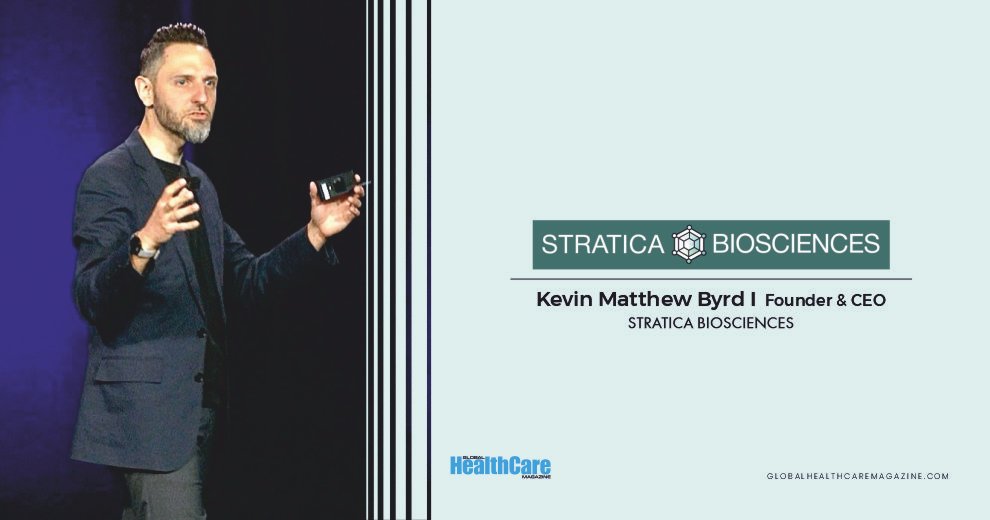
Kevin Matthew Byrd does not talk about disease the way most scientists talk about disease. He speaks about it the way a cartographer speaks about territory: as something to be mapped, rendered in precise coordinates, and ultimately understood not through its surface symptoms alone but through the structural logic of the landscape that produces them.
As Founder and Chief Executive Officer of Stratica Biosciences, and as an Assistant Professor and Associate Member of the Massey Comprehensive Cancer Center at Virginia Commonwealth University, Kevin is helping build something medicine has long needed and never fully possessed: a systematic, high-resolution map of human disease drawn at the scale of individual cells, within the tissues and biofluids where those cells actually exist. It is ambitious work and is also increasingly possible.
A New Model for Digital Medicine
The founding idea behind Stratica Biosciences is both elegant and radical. Kevin’s company is advancing what he describes as a new model for digital medicine, grounded in the systematic reconstruction of human disease using tissue- and biofluid-based multiomics.
The approach integrates multiple layers of biological data, including spatial biology, single-cell analysis, computational biology, and artificial intelligence, to generate high-resolution molecular maps of disease states. Those maps can then be used to identify therapeutic targets, predict patient response to treatment, and reduce the uncertainty that contributes so heavily to the cost and failure rate of clinical drug development.
The company works closely with life science and biotechnology organizations while simultaneously developing internal capabilities for therapeutic discovery and translational insight generation. It is a model that keeps one foot in the academic tradition of scientific discovery and the other in the commercial world of application, a tension Kevin has not attempted to resolve so much as make productive.
The long-term vision extends even further. Kevin describes it as a “digital disease” framework: virtual representations of human tissue capable of modeling therapeutic interventions before they are tested in patients, refining clinical trial design, and stratifying patient populations with a level of precision that current systems often cannot achieve reliably.
It is a vision that requires biology, artificial intelligence, computation, and medicine to operate in deep integration. Whether every dimension of that vision can be realized in the near term remains an open question. That it represents one of the most important directions in precision medicine increasingly does not.
Where the Academic and Entrepreneurial Worlds Converge
One of the most distinctive features of Kevin’s career is the way he has chosen to hold both academia and entrepreneurship simultaneously rather than selecting between them.
At Virginia Commonwealth University, he serves as an Assistant Professor and Associate Member of the Massey Comprehensive Cancer Center, where his laboratory develops and applies spatial and single-cell multiomics to uncover therapeutic vulnerabilities across cancer, fibrosis, and chronic inflammatory disease. These are not narrow research areas. Together, they account for an enormous share of global disease burden, healthcare expenditure, and unmet clinical need.
The laboratory work is not merely adjacent to the commercial work at Stratica Biosciences. It directly informs it. The questions explored in the academic setting, how cells interact within native tissue environments, how disease reshapes tissue architecture over time, and how molecular signaling changes spatially across disease progression, are precisely the questions Stratica’s platforms are designed to analyze at scale.
Kevin has constructed a career that refuses to separate discovery from translation. The result is a body of work that moves between the two more fluidly than most.
A Global Map of Human Biology
Perhaps the most expansive expression of Kevin’s scientific ambitions is his leadership within the Human Cell Atlas Oral and Craniofacial Bionetwork, a global consortium involving more than 80 laboratories collaborating to define the cellular architecture of oral and craniofacial tissues.
Through this effort, Kevin and his colleagues contribute directly to several of the most consequential international scientific initiatives currently underway, including the Human Cell Atlas, the NIH HuBMAP consortium, and the Human Reference Atlas.
These are not niche scientific programs. The Human Cell Atlas represents one of the most ambitious collaborative undertakings in modern biology, aiming to create a comprehensive reference map of every human cell type. To help lead one of its major bionetworks is to operate near the organizational and scientific center of that effort.
It requires more than scientific expertise alone. It requires the ability to coordinate across institutions, disciplines, and international research environments while maintaining a shared long-term vision as the underlying science continues to evolve rapidly.
The Practical and the Patented
Kevin’s work has generated multiple patents in spatial biology and diagnostic innovation, evidence that his contributions have been recognized as both scientifically novel and commercially applicable under standards intentionally designed to be rigorous.
He also advises biotechnology companies and collaborative scientific initiatives on precision medicine and translational strategy, with a recurring focus on converting complex biological systems into clinically actionable insight. His advisory work spans deep tech, biotech, computational biology, and biopharma, reflecting a professional range that is equally comfortable in discussions of molecular mechanisms and conversations surrounding investment, commercialization, and platform strategy.
The phrase “clinically actionable insight” appears frequently in discussions surrounding precision medicine, but in Kevin’s work, it carries particular meaning. The objective is not merely producing slightly improved average outcomes across large populations. The objective is enabling clinicians and researchers to examine a specific patient, with a specific disease, within a specific tissue context, and make a more confident, mechanism-informed prediction about what therapeutic strategy is most likely to succeed.
That is the aspiration. It is also a challenge. And it is increasingly becoming technically achievable.
Toward a Medicine That Sees More Clearly
There is a phrase that recurs throughout Kevin’s work: understanding how cells interact within their native environments. It is a quiet phrase for what is, in practice, a profound scientific commitment.
The history of biomedical research contains many discoveries that failed during translation from laboratory models into clinical reality because the biological context had been stripped away. Tissue architecture was disrupted. Cellular relationships were lost. Disease was simplified beyond recognition.
What Kevin is building, cell by cell, tissue map by tissue map, consortium study by consortium study, is an approach to medicine that begins with that architecture and refuses to simplify it away. It is a different theory of what it means to understand disease. And it may become one of the defining frameworks shaping the future of precision medicine.
Read More: Global Leaders Driving AI & High-Plex Tissue Analysis 2026