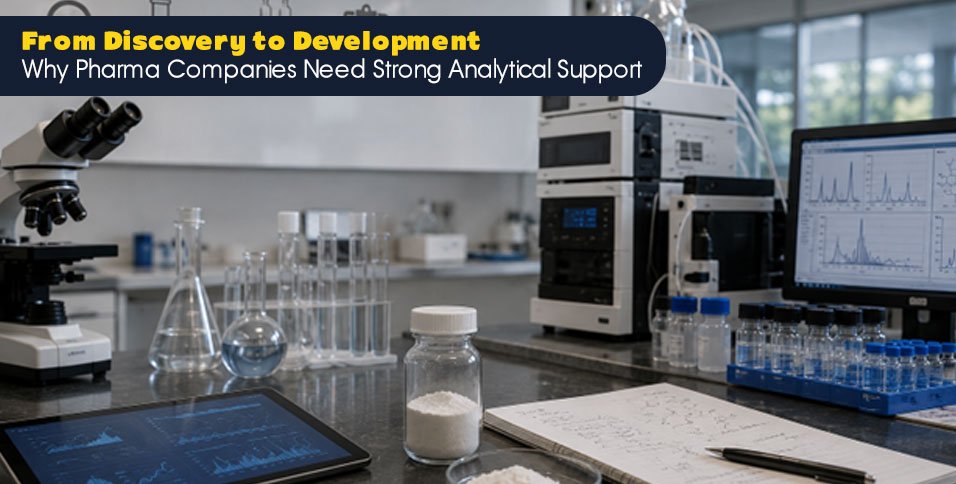
Bringing a drug from discovery to development is rarely a straight path. Promising molecules can fail because of stability concerns, formulation challenges, impurity issues, or inconsistent performance during scale-up. In many cases, the underlying problem is not the therapeutic concept itself; it is the absence of strong analytical insight early enough in the process.
As pharmaceutical innovation becomes more complex in 2026, analytical science is no longer just a support function. It is a strategic enabler of faster, smarter, and lower-risk drug development.
This is where Analytical Chemistry Services play a critical role.
Analytical Support Is No Longer Just a Late-Stage Requirement
A common misconception in drug development is that analytical work becomes important only during manufacturing validation or regulatory submission. In reality, analytical insight is essential from the earliest stages of development.
During discovery and preclinical work, teams need reliable analytical data to answer critical questions:
- Is the molecule stable?
- Are impurities emerging?
- How reproducible is the synthesis route?
- Does the compound behave consistently under different conditions?
- Is the formulation viable for further development?
Without clear analytical visibility, teams may advance candidates with hidden risks that become expensive problems later.
Strong Analytical Chemistry Services help identify issues before they escalate.
Better Characterization Leads to Better Decisions
Drug development depends on decision-making under uncertainty. Analytical science reduces that uncertainty. Accurate characterization allows teams to understand the physical and chemical properties of compounds with greater confidence. This directly improves candidate selection and development planning.
Strong analytical support helps assess:
- Purity profiles
- Structural identity
- Degradation pathways
- Solubility behavior
- Stability under stress conditions
- Batch-to-batch consistency
When teams have better data, go/no-go decisions become faster and more reliable.
Complex Molecules Demand More Sophisticated Analytical Expertise
Modern pharmaceutical pipelines are far more complex than traditional small-molecule programme. Companies are increasingly working with:
- Highly potent APIs
- Biologics
- Peptides
- Antibody-drug conjugates
- Specialty formulations
- Complex synthetic intermediates
These molecules present unique analytical challenges that often require specialized instrumentation and expertise. Generic analytical approaches may not be sufficient.
Expert Analytical Chemistry Services provide access to advanced methodologies and scientific expertise tailored to modern therapeutic complexity. This becomes especially valuable when internal teams face capability or bandwidth limitations.
Early Analytical Insight Reduces Development Delays
Many development delays can be traced back to issues that could have been identified earlier. Examples include:
- Unexpected impurity formation
- Method reproducibility failures
- Stability concerns discovered during scale-up
- Formulation incompatibilities
- Poor analytical transfer readiness
Late-stage surprises are expensive. By integrating analytical support early, pharmaceutical teams can proactively identify technical risks and avoid costly redevelopment cycles. In practical terms, early analytical rigor often accelerates timelines rather than slowing them.
Regulatory Expectations Continue to Rise
Regulatory scrutiny around data integrity, method validation, impurity profiling, and product characterization remains high. Analytical deficiencies can create major obstacles during development and submission.
Strong analytical support helps organizations prepare more effectively by ensuring:
- Scientifically sound method development
- Reliable validation strategies
- Clear documentation practices
- Consistent data quality
- Better regulatory readiness
In an increasingly regulated environment, analytical quality directly affects programme confidence.
Strong Analytical Support Improves Technology Transfer
Moving from discovery into development and eventual scale-up often introduces execution risk. Processes that work in research settings do not always translate smoothly into larger manufacturing environments. Analytical continuity helps reduce this risk.
Effective Analytical Chemistry Services support smoother transitions by enabling:
- Method robustness assessment
- Transfer-ready analytical procedures
- Comparative batch analysis
- Faster issue investigation
- Better process understanding
Strong analytical foundations make handoffs between teams significantly more efficient.
External Analytical Expertise Creates Strategic Flexibility
Not every pharmaceutical organization can justify building an extensive in-house analytical infrastructure for every programme need.
Advanced instrumentation, technical specialists, and evolving compliance requirements require substantial investment.
Strategic outsourcing provides flexibility.
External analytical partnerships can help organizations:
- Expand technical capabilities quickly
- Manage fluctuating project volumes
- Access niche expertise
- Reduce infrastructure burden
- Support accelerated timelines
For lean biotech teams and larger pharma organizations alike, this flexibility can be commercially valuable.
Conclusion
Analytical science sits at the heart of successful pharmaceutical development. From early candidate evaluation to process optimization, scale-up readiness, and regulatory preparation, strong analytical support improves decision-making, reduces technical risk, and accelerates execution.
As pharmaceutical innovation becomes more complex, Analytical Chemistry Services are no longer optional operational support. They are a strategic component of efficient drug development.
The companies that build strong analytical foundations early are often the ones best positioned to move promising therapies forward with confidence.