There is a particular kind of quiet that settles over a place where people are trying to put themselves back together. It is not the quiet of emptiness, but of effort: the hush of conversations being had, at times, for the first time in months, of children learning to trust again, of parents remembering who they were before the weight of trauma and addictions pressed down on everything. The Carter House, Saskatchewan’s first family-centered addiction treatment facility, carries that quality and integrity, driven by an objective to become accredited by Accreditation Canada. It is a place designed not just to treat, but to hold.
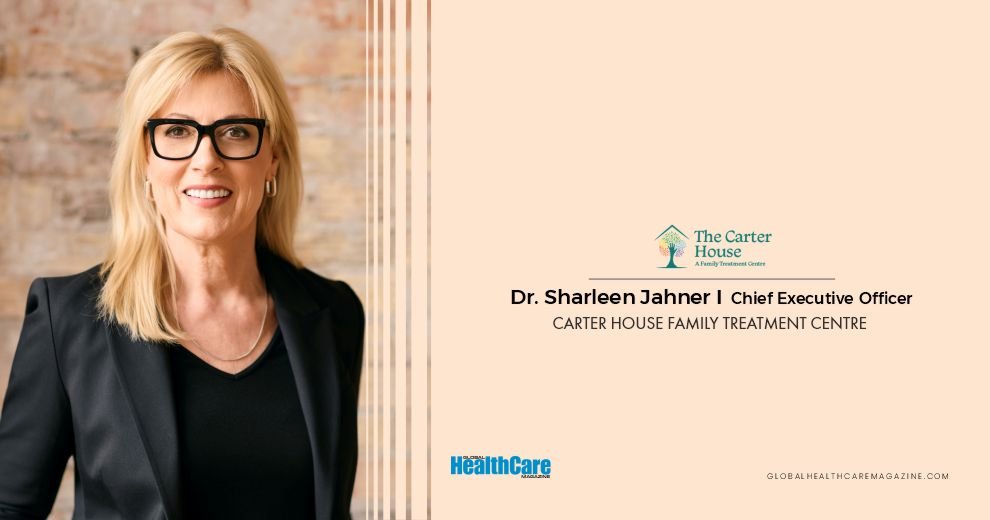
Dr. Sharleen Jahner, a registered nurse, a PhD, a Harvard-trained quality and safety expert, a former Coroner, a published researcher, a pilot, and now the Chief Executive Officer of The Carter House Family Treatment Centre. To speak of her career in a single breath is to risk making it sound tidy, which it is not. What it is, is cumulative: nearly four decades of healthcare practice layered so deliberately, and so broadly, that she has arrived at this moment with the rare ability to see the whole picture, and the rarer ability to act on what she sees.
The Long Road to a Starting Point
Dr. Jahner did not arrive at The Carter House by accident. She arrived by accumulation. Her career began in 1985, with a Nursing Diploma from the Saskatchewan Institute of Applied Arts and Science and a first posting at Wetaskiwin General Hospital in Alberta, where she worked in medicine, surgery, and the ICU. What followed was a working life that reads less like a résumé and more like a detailed map of the Canadian healthcare system: drawn by hand, from the inside. She moved across three western provinces, through urban centers, rural hospitals, and remote northern communities, working in acute care, community health, public health, occupational health and safety, maternal and child health, chronic disease management, and nursing education.
There were years when she worked three hospitals simultaneously, in 2 provinces, simply to secure full-time employment. She guided regional programs in Chronic Disease Management covering Cystic Fibrosis, Asthma, and COPD, as well as the provincial Saskatchewan Bleeding Disorders Program and provincial TB Prevention and Control Program. She served as a Coroner for the Saskatchewan Ministry of Justice from 2006 to 2011, investigating deaths, working alongside police and health professionals, learning in the most unsparing way what it means when systems fail the people inside them.
She managed Quality and Safety and Occupational Health and Safety for the Saskatchewan Health Authority from 2021 to 2024, departments that were accountable for the health and well-being of approximately 14,000 employees. She collaborated with the Public Health Agency of Canada on an immunization equity project and applied the International Health Institute’s Triple Aim Framework to improve the experience, population health outcomes, and per capita costs in Saskatchewan’s COPD population.
In parallel, she was building an academic life of equal depth.
She earned both her Bachelor of Science degree (completed between 2006 and 2008) and her Master’s degree (completed between 2011 and 2013) from the University of Saskatchewan. Her master’s studies focused on organizational leadership and succession planning. Her PhD, undertaken on a full scholarship from 2014 to 2020, explored the psychological impact of trauma on nurses working in rural and remote settings, a subject she understood not just intellectually but from the inside. Her thesis was submitted by her Academic Chair and Committee for both the University of Saskatchewan Thesis Award and the Doctoral Dissertation Award. She then completed a Postgraduate Certificate in Safety, Quality, Informatics, and Leadership at Harvard Medical School between 2023 and 2024.
Her scholarly honors are extensive. She was inducted into the Golden Key International Honour Society in 2008, a distinction extended by invitation only to the top fifteen percent of students across all fields of study. This academic recognition was matched by substantial institutional support throughout her educational journey, during which she received a total of 24 scholarships and bursaries. She received Bravo Awards from the Saskatoon Health Region in both 2006 and 2008. She took First Place in the Social and Cultural Aspects of Health category at the University of Saskatchewan Life and Health Sciences Research Day in 2016.
“I have an aptitude for systems thinking,” she says. “My work is centered on quality, collaboration, and evidence-informed practice.”
It is a description that, in its modesty, significantly undersells the scale of what she has built.
The Gap That Could Not Be Ignored
Saskatchewan has a problem that is not unique to it, but is perhaps more sharply visible there than elsewhere. When parents, most often mothers, struggle with substance use disorders and seek treatment, they are almost universally required to leave their children behind. The logic of this arrangement has always been presented as protective. The reality is considerably more complicated.
Ninety percent of children in foster care in Saskatchewan are there because of parental substance use. Of those children, 85% are Indigenous. These are not abstract statistics. They are evidence of a structural failure: a system that responds to addiction by separating families rather than healing them, and in doing so, may deepen the very trauma that gave rise to the addiction in the first place.
“The most significant gap,” Dr. Jahner explains, “is the structural separation between addiction treatment and family preservation. Traditional models require individuals, primarily mothers, to leave their children behind in order to access care. This creates a paradox: seeking help can directly contribute to family breakdown.”
Many women delay or avoid treatment altogether out of fear of losing their children. Others enter treatment, but experience heightened trauma due to separation, which undermines recovery. Children placed into foster care face disconnection from family, culture, and community, with consequences that are developmental, emotional, and intergenerational. The cycle reinforces itself, and the costs, both human and systemic, compound over time.
This gap, Dr. Jahner is careful to note, is not theoretical. It is not a policy problem awaiting its moment of political attention. It is the lived reality of families in Saskatchewan right now, and it demanded a response equal to its complexity. The Carter House is that response.
A New Anatomy of Recovery
The Carter House is not a traditional addiction treatment program with family support appended to it. It is a program restructured, from the ground up, around the family unit. That distinction matters more than it might initially seem.
The organization operates under Kamor Integrated Health Inc., a privately owned company founded by Dr. Morris Markentin and Katelyn Roberts, BSW, MPA, whose prior work in co-founding the Sanctum Care Group Inc. established a nationally recognized track record of outcomes with complex populations. The Carter House launched in late 2024, building directly on that legacy of proven success.
The program runs for three months. The first two months focus on stabilization and assessment: intake, medical and mental health stabilization, psychoeducation on addiction and trauma, and early family therapy. The third month moves into intensive treatment and skill building, with individualized care plans for each family member, trauma-specific therapy, parenting skills, relapse prevention, life skills training, and transition planning for reintegration.
Every family member, parent, and child alike receives their own individualized assessment and care plan, because everyone carries their own experience of trauma and their own set of needs. Children are not external to the healing process; they live and heal alongside their parents, including those returning from foster care. The program addresses mental, physical, emotional, and spiritual health in an integrated way, incorporating Elder guidance, ceremony, and teachings rooted in Indigenous knowledge systems alongside clinical best practices.
Aftercare extends for three months post-discharge. Dedicated staff maintain ongoing relationships with families, assist with securing housing, income support, and system navigation, and connect families to community-based supports to ensure continuity of care long after discharge.
Success at The Carter House is not measured by sobriety alone. It is measured by whether families remain intact, whether children attend school, whether housing and finances are stable, whether custody is maintained or regained, and whether engagement with healthcare and mental health services is sustained over time.
“Sustainable recovery,” Dr. Jahner says simply, “happens in the context of relationships, not isolation.”
A Team Built for the Whole Person
One of the clearest expressions of The Carter House philosophy is the composition of its multidisciplinary team, which supports adults and children from infancy through age twelve. The program brings together physicians and nurses, Care Aids, mental health and addictions specialists, a psychologist, Parent Aids, Early Childhood Educators, and Elders who provide cultural, spiritual, and ceremonial guidance.
This is not merely a staffing list. It is a statement of belief: that addiction is multifaceted, that families arrive carrying intersecting challenges of health, trauma, poverty, and child welfare involvement that cannot be addressed by any single discipline, and that healing, by its nature, is multidimensional.
Continuous quality improvement is not incidental to the work; it is built into it. Dr. Jahner applies established methodologies, including Plan-Do-Check-Act, Lean, SWOT Analysis, and Root Cause Analysis, to ensure that care delivery improves incrementally and with intention. The goal is not simply to operate a program. It is to build a learning organization, one that evolves alongside the needs of the people it serves.
In her daily work as CEO, she begins each morning with an informal walk through the facility. She connects with front-line staff and clients, models how people are to be treated, and sets the tone not by directive but by presence. The rest of her day moves constantly between what she describes as four altitudes: vision, strategy, systems, and people.
“No two days are identical,” she says. “I move between the big picture and the ground level, constantly balancing ideal care against real constraints.”
Biweekly, she leads a deeper review of client outcomes, including relapse rates and family reunification data. She coaches leaders, builds community partnerships, writes policy and work standards, and continuously refines the model. She is, in the truest sense, both builder and steward.
Keeping Faith with Reconciliation
The Carter House does not use the language of reconciliation as decoration. Its alignment with the Truth and Reconciliation Commission of Canada’s 94 Calls to Action is embedded in its design, not appended as a statement of intent.
The program’s focus is to keep families together, which aligns with the TRC’s child welfare priorities. It delivers holistic, trauma-informed healthcare. It embeds cultural teachings and traditional knowledge. It supports children’s educational development without interruption and may reduce pathways into the justice system. It advances reconciliation through measurable systemic change rather than symbolic gesture.
Dr. Jahner’s own professional history speaks to the depth of this commitment. She led fly-in TB Prevention and Control outreach clinics to seven northern Saskatchewan communities: Stony Rapids, La Loche, Pelican Narrows, Sandy Bay, La Ronge, Buffalo River, and Ile a la Crosse. She collaborated extensively with the First Nations Inuit Health Branch, the Northern Inter-Tribal Health Authority, Meadow Lake Tribal Council, Lac La Ronge Indian Band, Prince Albert Grand Council, and Peter Ballantyne, aligning provincial health strategies with community needs and advancing culturally informed service delivery across remote and Indigenous populations.
This is not new territory for her. It is the continuation of a commitment that has run through her entire career, across decades and geographies, before it had a name as polished as reconciliation.
The Woman Who Also Flies
There is something instructive about the fact that Dr. Jahner is a pilot. She has been flying since her twenties. She owns a Piper Cherokee 150. In 2024, she co-founded the Saskatchewan Chapter of the International Organization of Women Pilots. She sits on the executive board of the Saskatoon General Aviation Hangar Association and assisted in developing its bylaws and governance structure from the ground up. She’s been a board member of the Canadian Owners and Pilots Association COPA Flight 10 Saskatchewan Chapter. Between 2007 and 2011, she served as a spotter and search operator with the Canadian Civil Air Search and Rescue Association. She is involved in the “Girls Take Flight” initiative, which works to empower young women and girls in aviation.
She describes flying with a precision that reveals how deeply it informs her thinking.
“Piloting is a transferable decision-making discipline. Flying offers cognitive separation from the realities on the ground, protected time, a deep focus that restores perspective, literally and neurologically, and reorients priorities. It’s a controlled reset of attention and responsibility.”
The metaphor holds. A leader who can manage altitude, navigate by instrument when visibility disappears, and make clear decisions under pressure is exactly what a startup organization, introducing a non-traditional model into a skeptical and complex system, requires.
Her commitment to service extends broadly and runs deep. She served on the executive board of the Canadian Association for Rural and Remote Nursing from 2012 to 2023, and was an executive board member of the Global Rural Nursing Exchange Network from 2019 to 2025. She served on the Saskatchewan Board of Directors of the Children’s Wish Foundation of Canada for ten years while also serving for ten years as a camp counselor at Camp Circle O’ Friends, a camp for children living with cancer and their siblings. She served as Honorary Spokesperson for the Cameco Multiple Sclerosis Annual Bike Tour.
Her contributions to nursing scholarship are equally expansive. She co-authored a chapter in the Sixth Edition of Stamler and Yiu’s Community Health Nursing, published by Pearson Canada in 2024. Her peer-reviewed research has appeared in the Journal of Clinical Nursing, the International Journal of Mental Health Nursing, Workplace Health and Safety, the Online Journal of Rural Nursing and Health Care, the Australasian Emergency Nursing Journal, and the Rural and Remote Health Journal, among others. She has presented at international conferences in Nashville, Rapid City, Denver, Montreal, and submitted work to a conference in Breckenridge, Colorado. She also contributed to the development of both the National Rural and Remote Nursing Framework and the National Rural and Remote Nursing Practice Parameters Report in 2020.
In 1983, she was named Saskatchewan Junior Citizen of the Year by the Lieutenant Governor of the Government of Saskatchewan. In 2025, she received the King Charles III Coronation Medal, issued by the Office of the Secretary General of the Government of Canada, for significant contributions to her community and her country.
These are not a collection of honors accumulated passively. They are the record of a person who has consistently shown up in communities, in classrooms, in boardrooms, in cockpits, and in the policy rooms where the rules are made.
A Message That Carries
Dr. Jahner’s message to the families who come to The Carter House, and to those who are still deciding whether to come, is neither sentimental nor simple. It is something more honest than either.
“Families often underestimate the strength they are already demonstrating simply by staying engaged in the process,” she says. “Showing up to appointments, having difficult and honest conversations, setting and maintaining boundaries, or continuing to care in the midst of uncertainty are all meaningful acts of commitment.”
She is direct about what recovery can and cannot promise. It is possible, she says. Not guaranteed. Not simple. But possible, especially when families, providers, and communities continue to work together.
“There is no perfect way to navigate this journey. There is only the next appropriate step that promotes connection, safety, and ongoing support.”
She carries with her two guiding convictions, both borrowed from women who understood the relationship between action and consequence. The first, from Ruth Bader Ginsburg: “Women belong in all the places where decisions are being made.” The second, from Amelia Earhart: “The most effective way to do it is to do it.”
Dr. Sharleen Jahner has been doing it for nearly four decades. At The Carter House, she is doing it still, one family at a time, in a province where the need has never been greater and the model, at last, is equal to it.
Quotes
Also Read: The Most Influential Healthcare Leaders to Watch in 2026