Many parents of autistic children share the same concern: “My child knows what they want, but they cannot tell me.” Communication challenges are among the most common characteristics of Autism Spectrum Disorder (ASD), affecting how individuals express their needs, understand language, and interact socially. This is where speech therapy for autism can make a meaningful difference.
Speech therapy is not only about helping a child speak more clearly. It focuses on developing essential communication skills, including understanding language, expressing thoughts and emotions, using gestures, and building meaningful social connections.
The need for effective communication support is growing as approximately 1 in 31 children in the United States has been identified with ASD. Many of these children experience speech, language, or social communication difficulties that can affect learning, relationships, and everyday life.
Early intervention can significantly improve communication outcomes. The earlier children receive appropriate support, the better their chances of developing functional language and social communication skills.
In this guide, you’ll learn how speech therapy for autism works, its key benefits, common therapy techniques, and practical strategies families can use to support autism communication development at home.
What Is Speech Therapy for Autism?
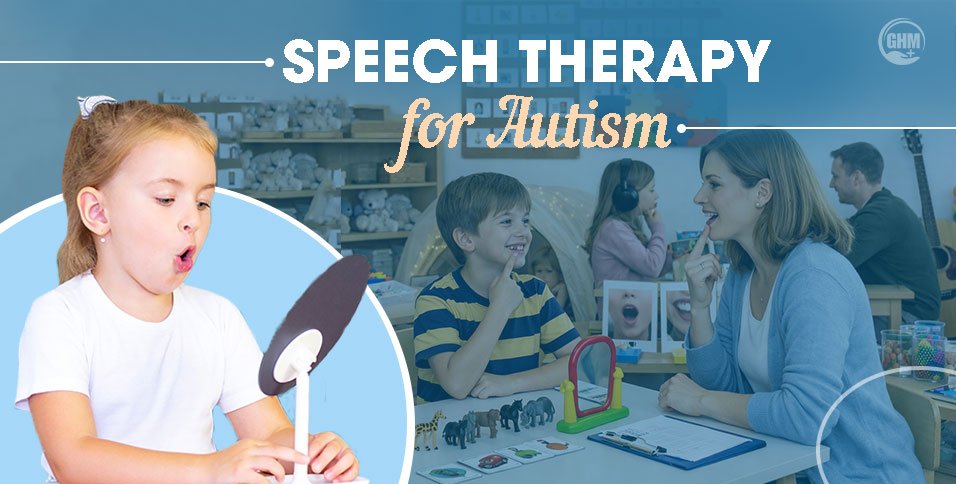
Speech therapy is a specialized healthcare field focused on improving an individual’s overall communication and language skills. Speech-language pathologists (SLPs) act as the primary experts who design and execute these interventions. However, a common misconception is that therapy only focuses on vocalizing words.
In fact, speech therapy for autism looks at communication holistically. Therapists tailor every program to the individual’s unique strengths and challenges. Because autism is a spectrum, interventions look different for verbal, minimally verbal, and nonverbal individuals.
The core approach of autism speech therapy targets several distinct domains:
- Speech Production: Improving oral motor skills, articulation, and structural clarity of spoken words.
- Language Comprehension: Helping individuals process, understand, and respond to instructions or conversations.
- Social Communication: Teaching the unwritten rules of interaction, such as conversational turn-taking.
- Alternative Communication: Introducing non-spoken systems for individuals who cannot rely on verbal speech alone.
What Are The Communication Challenges In Autism
Autism Spectrum Disorder directly impacts how the human brain processes language and social information. This does not mean learning is impossible, but it does mean that learning happens differently. The diverse levels of autism have communication associated with them.
An autistic individual may experience one or more of the following communication challenges:
- Delayed Speech Development: Many children experience a late start to talking or build a limited vocabulary compared to neurotypical peers.
- Receptive Language Difficulties: This includes struggling to understand spoken words, multi-step instructions, or context.
- Expressive Language Difficulties: Individuals often find it hard to vocalize their internal needs, thoughts, or emotions.
- Pragmatic Communication Challenges: This manifests as difficulty maintaining a conversation topic, reading social cues, or using an appropriate tone.
- Nonverbal Communication Differences: Autistic individuals frequently utilize alternative eye contact patterns, unique gestures, or distinct facial expressions.
- Echolalia: This is the repetition of phrases or words. While it may seem unusual, echolalia serves as a vital stepping stone in language acquisition.
The Benefits of Speech Therapy for Autism
Investing in speech therapy for autism as a treatment option provides wide-ranging developmental advantages. Because communication is the foundation of human interaction, these benefits extend far beyond speech clarity.
1. Clearer Expression of Needs
First and foremost, targeted speech therapy teaches individuals how to express their immediate wants and emotions. When a person can successfully say “help,” “stop,” or “more,” their internal frustration drops significantly.
2. Enhanced Social Interaction
Speech therapy equips autistic individuals with the tools to initiate conversations and make friends. SLPs break down complex social rules into predictable, learnable steps. For those seeking alternative creative outlets, combining this with music therapy can further boost peer engagement.
3. Reduced Behavioral Meltdowns
Many challenging behaviors occur with an autistic person simply because the individual feels trapped behind a communication barrier. By providing alternative ways to speak, autism speech therapy reduces behavioral resistance and anxiety.
4. Boosted Independence and Academic Success
Strong language skills directly support classroom learning and daily survival skills. According to data from the National Center for Education Statistics, roughly 12% of students receiving special education services are supported for speech or language impairments. Developing these skills allows individuals to navigate school, work, and community life with greater confidence.
How Speech Therapy for Autism Works
Professional speech therapy for autism relies on a highly structured, data-driven framework. It moves through distinct clinical phases according to the individual’s unique strengths and challenges:
| Phase | Clinical Purpose | Key Activities |
| Initial Assessment | Evaluates current communication profiles | Standardized tests, behavioral observations, parent interviews |
| Goal Setting | Establishes realistic, functional targets | Writing individualized treatment plans based on deficits |
| Therapy Sessions | Delivers targeted intervention | Interactive drills, structured play, physical exercises |
| Progress Monitoring | Tracks growth and milestones | Regular objective reviews and adjustment of strategies |
Throughout these phases of autism speech therapy, clinicians rely heavily on family-centered intervention. Because parents see their children every day, they serve as the ultimate partners in tracking real-world progress.
Common Speech Therapy Techniques Used for Autism
Speech-language pathologists utilize an array of modern, evidence-based techniques to accommodate different learning styles.
1. Augmentative and Alternative Communication (AAC)
For nonverbal or minimally verbal individuals, AAC for autism provides a functional voice. This technique spans low-tech options like physical communication boards to high-tech speech-generating devices. In the digital age, families frequently utilize specialized speech therapy apps to make communication portable.
2. Picture Exchange Communication System (PECS)
PECS is a specific form of speech therapy where individuals hand a picture card of an object to a partner in exchange for the item. This concrete system teaches the individual the foundational concept that communication can cause a direct, positive reaction in the environment.
3. Play-Based Language Therapy
Young children learn best when they are having fun. Clinicians embed language practice directly into interactive games and pretend play. By following the child’s natural interests, the SLP creates a highly motivating learning environment.
3. Social Communication Training & Visual Supports
The visual supports approach uses visual schedules, social stories, and sequencing activities to map out what to expect in daily life. In social communication training, individuals practice greetings, role-play conversations, and learn to interpret changing facial expressions.
4. Communication Exercises At Home
During early childhood, making animal noises with toy farms helps spark basic vocal replication. Also, place favorite snacks slightly out of reach but within sight, prompting the child to gesture or point.
For school-age children, reading short stories together and asking simple “Yes” or “No” questions about the pictures can help in speech therapy. To practice taking turns during a conversation, utilizing a child’s intense, specific interests, such as trains or dinosaurs, can support speech therapy for autism.
When Should You Consider Speech Therapy for Autism?
Every individual develops at their own unique pace, but certain milestones require professional attention. You should schedule a clinical consultation with an SLP if you notice:
- A total absence of babbling or gesturing by 12 months.
- No single words spoken by 16 months.
- Frequent frustration, tantrums, or meltdowns driven by an inability to express basic physical needs.
- A noticeable loss of any previously acquired speech or social skills.
- Significant difficulty following simple, everyday instructions.
End Note
In summary, speech therapy for autism serves as a vital bridge to independence, self-advocacy, and an improved quality of life. By focusing on individualized treatment plans, leveraging innovative tools like AAC, and maintaining consistency, we can help individuals on the spectrum thrive.
Looking forward, the landscape of speech pathology is rapidly evolving. Emerging technologies, such as artificial intelligence and virtual reality simulations, promise to make future speech therapy sessions even more immersive and personalized. Ultimately, the goal of therapy is not to erase neurodiversity, but to ensure that every unique voice is heard, valued, and understood.
Did you find these insights helpful? Share this article with parents, educators, and caregivers in your community to spread awareness about communication support for autism!
Frequently Asked Questions
1. Does every autistic child need speech therapy?
Not every autistic child requires speech therapy, but many benefit from it. Even children who speak fluently may experience challenges with social communication, conversation skills, understanding nonverbal cues, or expressing emotions appropriately. A speech-language pathologist (SLP) can assess individual needs and determine whether therapy would be helpful.
2. Can speech therapy help autistic children who already speak well?
Yes. Speech therapy for autism is not limited to speech production. Many autistic individuals can speak clearly but struggle with pragmatic language skills, such as maintaining conversations, understanding sarcasm, interpreting body language, or adjusting communication based on social situations. Therapy can help strengthen these abilities.
3. Is speech therapy covered by insurance?
Insurance coverage for speech therapy varies depending on the country, insurance provider, and policy. Some health insurance plans cover speech therapy when it is medically necessary, while others may offer partial reimbursement. Parents should check directly with their insurance provider for specific coverage details.
4. What qualifications should a speech therapist for autism have?
A qualified speech therapist should hold professional certification and experience working with individuals on the autism spectrum. Additional training in autism interventions, social communication therapy, AAC systems, or sensory-friendly communication strategies can be beneficial.
5. Can speech therapy be delivered online?
Yes. Speech therapy can be delivered online. Telehealth has become increasingly popular and can be effective for many autistic individuals. Virtual speech therapy sessions may include interactive activities, communication exercises, parent coaching, and AAC training.