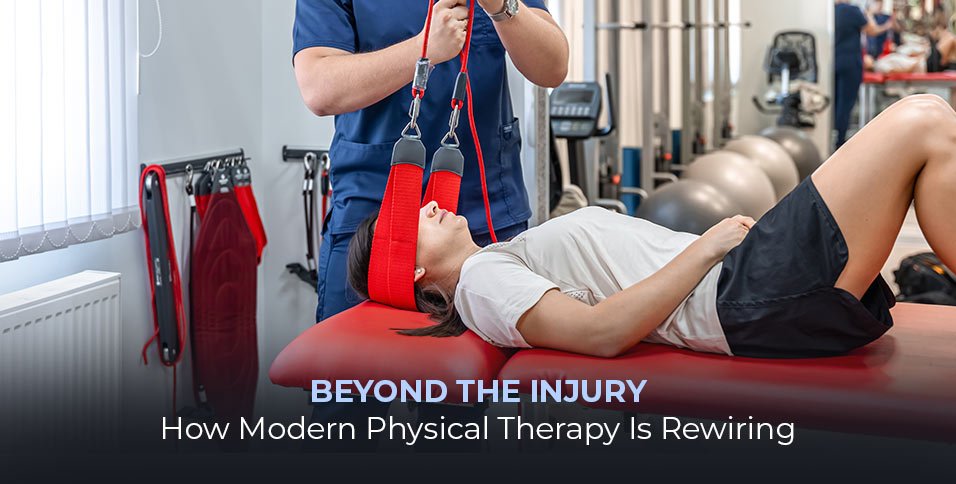
For decades, the popular image of physical therapy involved resistance bands, heat packs, and a clipboard of exercises to perform between sessions. That image is now obsolete. Across leading rehabilitation centers and academic medical institutions, a quieter revolution has been unfolding, one driven not by new equipment, but by a fundamentally deeper understanding of what injury, pain, and recovery actually involve a neurological level.
The shift is consequential. Physical therapists who once focused primarily on isolated musculoskeletal repair are increasingly working at the intersection of neuroscience, psychology, and movement science. They are treating pain systems, not just painful structures. They are addressing the brain’s role in sustaining or amplifying dysfunction long after tissue damage has healed. And the clinical results, increasingly documented in peer-reviewed literature, are forcing a re-evaluation of what effective rehabilitation can look like.
The Central Sensitization Problem
To understand why modern physical therapy has evolved so dramatically, one must first understand the phenomenon of central sensitization — a neuroplastic process in which the central nervous system becomes persistently hypersensitive to pain signals, independent of the original injury site or severity.
Research published in 2025 in Experimental & Molecular Medicine — one of the most comprehensive recent reviews of neuroplasticity and chronic pain — makes the mechanism strikingly clear. Chronic neuropathic pain involves maladaptive neuroplasticity across multiple brain regions, including the anterior cingulate cortex, prefrontal cortex, and the insula — areas responsible not only for pain perception but for emotional regulation, decision-making, and bodily self-awareness.
Gray matter volume in these regions decreases measurably in patients with chronic pain. Connectivity patterns among cortical networks reorganize in ways that reinforce the persistence of pain, even when peripheral tissue pathology is minimal or resolved.
This is not an abstract finding. It has direct, practical implications for how rehabilitation must be designed. A protocol that addresses only the mechanical source of pain — the herniated disc, the torn ligament, the inflamed tendon — while ignoring the central nervous system’s learned response is, in effect, treating a fraction of the problem.
Pain Neuroscience Education: Teaching the Brain to Heal
One of the most evidence-supported developments in contemporary physical therapy is Pain Neuroscience Education — a structured clinical intervention in which therapists teach patients the biological mechanisms underlying their pain experience. The premise is precise: if a patient understands that their nervous system has become sensitized, that their pain is partly a learned protective response rather than always a sign of ongoing tissue damage, they are significantly more likely to re-engage with movement and break the cycle of fear-avoidant behavior that perpetuates disability.
A landmark systematic review and meta-analysis published in Brain Sciences in June 2025 examined the combined effect of Pain Neuroscience Education with active physical therapy across randomized controlled trials drawn from six major academic databases. The findings were unambiguous: PNE combined with physical therapy significantly reduces pain intensity and enhances functional capacity in individuals with chronic musculoskeletal conditions. The effect was particularly pronounced in patients with chronic low back pain and chronic neck pain, populations who have historically shown inconsistent responses to exercise-only rehabilitation protocols.
What makes this finding clinically significant is not merely the statistical outcome, but the mechanism behind it. When patients genuinely understand that their pain does not always equate to harm, that movement, though temporarily uncomfortable, is not causing damage, their neurological threat response diminishes. The brain’s protective alarm system, calibrated too sensitively by prolonged pain experience, is gradually recalibrated through education combined with graduated physical exposure.
The Kinesiophobia Factor
Kinesiophobia — a pathological fear of movement arising from the belief that movement will cause injury or re-injury — is one of the most undertreated contributors to chronic pain disability. Traditional rehabilitation programs rarely addressed it explicitly. Modern evidence-based PT practices make it a primary clinical target.
Therapists trained in PNE and graded motor imagery techniques now incorporate explicit behavioral interventions alongside manual therapy and exercise, creating multi-dimensional treatment plans that address the cognitive, emotional, and physical dimensions of recovery simultaneously.
Neuroplasticity-Based Approaches in Clinical Practice
The same neuroplasticity that allows the brain to become maladaptively sensitized to pain can, with appropriate clinical intervention, be directed toward healing and functional restoration. This is the foundational principle behind the growing family of neuroplasticity-based treatments in physical therapy.
Advanced electrical stimulation devices represent one arm of this innovation. Where traditional transcutaneous electrical nerve stimulation units primarily work to mask pain signals, newer direct-current systems are designed to optimize neuromuscular re-education — retraining the neural pathways that govern movement patterns disrupted by injury, stroke, or progressive neurological conditions. The clinical applications span a wide range: post-stroke motor rehabilitation, complex regional pain syndrome, multiple sclerosis-related mobility impairment, and refractory cases of chronic musculoskeletal pain that have failed conventional treatment.
Graded motor imagery and mirror therapy — both derived from neuroscience research on body schema and phantom limb pain — are now being applied to orthopedic populations. These techniques address the brain’s motor representation of an injured limb, gradually restoring normal cortical maps before and during physical rehabilitation, reducing the neurological component of pain, and improving treatment tolerance.
CLINICAL SPOTLIGHT
Interdisciplinary care models are rapidly becoming the standard for complex rehabilitation cases. Clinics that integrate neurological, psychological, and physical therapy perspectives — rather than treating each in isolation — are demonstrating meaningfully superior outcomes for patients with chronic pain, post-surgical recovery, and sports-related injury. Practices like miraclerehabclinic.com exemplify this integrated, evidence-forward approach, combining hands-on expertise with the kind of individualized clinical reasoning that standardized protocols alone cannot deliver.
The Technology Layer: Precision Without Losing the Patient
Wearable sensors, AI-assisted movement analysis, and remote monitoring platforms have introduced an unprecedented level of precision into physical therapy assessment. Where a clinician once relied on visual gait observation and manual muscle testing, they can now access quantified, continuous biomechanical data that reveals compensation patterns invisible to even an experienced eye.
Motion capture systems used in elite sports rehabilitation are migrating into general clinical practice. Force plates are appearing in outpatient orthopedic clinics. Accelerometry-based wearables allow therapists to monitor patient activity and movement quality between sessions, enabling truly data-informed clinical decisions rather than reliance on subjective patient recall.
The integration of this technology requires important caveats, however. The therapeutic relationship — the human connection between clinician and patient — remains one of the strongest predictors of rehabilitation adherence and outcome. Data tools that inform clinical judgment are valuable; data tools that replace it are not.
The most effective modern PT practitioners are those who can interpret objective metrics while simultaneously reading the patient’s psychological readiness, movement confidence, and pain experience. These remain irreducibly human competencies.
Functional Restoration Over Symptom Suppression
Perhaps the most consequential philosophical shift in modern physical therapy is the move from symptom suppression toward functional restoration. The historical model of rehabilitation often had an implicit endpoint: the absence of pain. The contemporary model frames recovery around capability — what can the patient do? What movement quality, load tolerance, and physical confidence have they regained?
This reframe matters clinically. Patients who exit rehabilitation with resolved pain but residual movement dysfunction, fear-avoidance behaviors, or deficits in proprioception are at significantly elevated risk for re-injury and chronic pain recurrence.
True recovery requires retraining the entire movement system — muscle strength and endurance, neuromuscular coordination, balance and proprioception, and the cognitive-emotional dimensions of movement confidence. Physical therapists operating within a functional restoration model build these outcomes explicitly into treatment plans from the initial evaluation onward.
The assessment tools to measure these outcomes have also matured considerably. Validated functional performance tests, patient-reported outcome measures, and kinematic analysis allow clinicians to document not just pain reduction but genuine improvements in the variables that predict long-term musculoskeletal health. This evidence base increasingly allows physical therapists to make a compelling case for their role — not merely in the treatment of acute injury, but in the prevention of chronic disability.
What Patients Should Know — and Demand
For patients navigating injury or chronic pain, the evolution of physical therapy carries a practical message: the quality and approach of the therapist matters enormously. A practitioner who delivers a generic set of exercises with minimal education and no attention to central sensitization, movement psychology, or individualized functional goals is offering only a fraction of what evidence-based physical therapy can provide.
Patients should seek clinicians who conduct thorough initial evaluations encompassing both physical and psychological pain factors, who explain the neurological basis of their condition, who progress treatment based on objective functional milestones rather than arbitrary time-based protocols, and who treat the whole patient — the nervous system, the movement patterns, the beliefs about pain and recovery — rather than the isolated structural finding on an imaging report.
The evidence supporting this comprehensive approach is no longer emerging — it is established. The discipline is science. The question is whether individual clinical practices are applying it, and whether patients know to demand it.
“Treating the painful structure is necessary. Treating the nervous system that has learned to protect that structure — sometimes long after it has healed — is what separates adequate rehabilitation from genuinely transformative care.”
— GHM Editorial Analysis, 2026
The Road Ahead
Physical therapy is entering a period of exceptional scientific maturity. The neurological mechanisms of pain and recovery are better understood than at any prior point in the discipline’s history. The tools available to clinicians — from AI-assisted biomechanical analysis to validated pain neuroscience education curricula — have never been more sophisticated. The interdisciplinary bridges connecting physical therapy with neurology, psychology, regenerative medicine, and sports science are wider and better traveled than ever before.
What remains, as always, is the challenge of implementation — ensuring that the most current evidence reaches clinical practice at the level of the individual patient encounter, and that rehabilitation programs are designed with the full complexity of human pain and movement in mind. For the patients who receive it, this kind of care does not merely relieve symptoms. It restores the fundamental capacity to live, move, and engage without fear.
That, ultimately, is what modern physical therapy is becoming. Not a service that manages damage. A science that rebuilds the whole person.