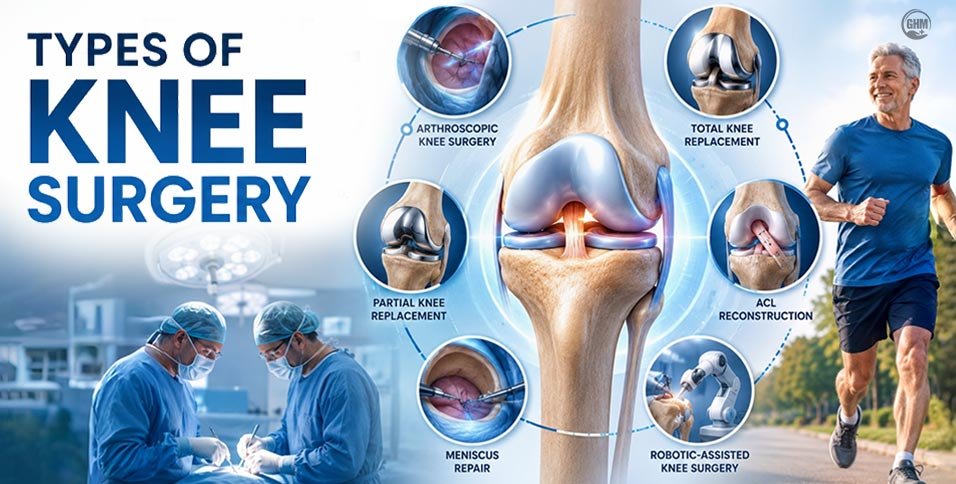
Knee pain affects hundreds of millions of people worldwide…and for many, it is not just discomfort. It chips away at independence, disrupts sleep, and turns everyday tasks like climbing stairs or standing up from a chair into genuine challenges.
Fortunately, modern medicine has come a long way. Today, different types of knee surgery are so precise and effective that most patients return to an active life within months. Whether someone is facing a sports injury, years of arthritis, or simply worn-out cartilage, there is likely a surgical option tailored to their exact condition.
In this guide, we will find more about all major types of knee surgery. It will explain what each procedure involves, who it suits, what the recovery looks like, and what risks to expect. Understanding the different knee surgery types can help patients make informed decisions about their treatment options.
When Are Knee Surgeries Needed?
Doctors do not recommend surgery as a first step. Most patients go through a progression of treatments such as pain relief medications, corticosteroid injections, physiotherapy, weight management, and lifestyle changes. Surgery typically enters the picture when these measures no longer provide meaningful relief.
Common reasons a surgeon may recommend knee surgery include:
- Severe, persistent knee pain that disrupts daily life or sleep
- Sports injuries such as ligament tears or meniscus damage
- Osteoarthritis (wear-and-tear of cartilage) or rheumatoid arthritis
- Difficulty walking, climbing stairs, or standing for extended periods
- Failed conservative treatments over several months
- Significant loss of mobility or quality of life
An orthopedic specialist evaluates imaging (X-rays, MRI), symptoms, age, activity level, and overall health before recommending the most suitable surgical approach.
7 Types of Knee Surgery Procedures: Common But Important
1. Arthroscopic Knee Surgery
Arthroscopic knee surgery, sometimes called “keyhole surgery,” is a minimally invasive procedure in which a surgeon inserts a tiny camera (arthroscope) and small instruments through two or three small incisions. This approach allows them to see inside the joint and address the problem without opening the entire knee.
Arthroscopic knee surgery is commonly used to treat:
- Torn meniscus (shock-absorbing cartilage between the bones)
- Loose cartilage fragments floating inside the joint
- Inflamed or thickened synovial tissue (the joint lining)
- Mild cartilage damage
Because the incisions in arthroscopic knee surgery are small, patients experience less post-operative pain, minimal scarring, and a significantly faster recovery compared to open surgery. Many arthroscopic procedures are done on an outpatient basis, meaning patients go home the same day. In fact, most modern knee procedures, including meniscus repair and cartilage treatments, are now performed arthroscopically.
2. Total Knee Replacement Surgery
Total knee replacement (TKR), also called total knee arthroplasty, involves removing the damaged surfaces of the knee joint and replacing them with artificial implants made of metal and medical-grade plastic. These components are designed to function just like a healthy, natural knee, restoring smooth, pain-free movement.
The best candidates for total knee replacement are patients with:
- Advanced osteoarthritis affecting the entire knee joint
- Severe, chronic knee pain that limits walking and daily activities
- Significant joint deformity or loss of mobility
According to a report by OECD, knee replacement rates have been rising steadily across member nations, reflecting growing demand driven by aging populations and higher rates of obesity-related arthritis.
Modern implants are built to last 15 to 20 years or more, depending on the patient’s activity level and body weight. Advances in robotic-assisted surgery have further improved implant positioning, which can extend implant lifespan and improve outcomes. Most knee replacement patients spend 2 to 3 days in hospital, followed by several months of physiotherapy before achieving full recovery.
3. Partial Knee Replacement Surgery
When arthritis or damage is confined to just one section (compartment) of the knee and the rest of the joint remains healthy, a partial knee replacement (also called unicompartmental knee replacement) may be an option. Instead of replacing the whole knee, the surgeon replaces only the affected compartment.
Advantages of partial knee replacement over a total replacement include:
- Smaller incision and less tissue disruption
- Faster rehabilitation and shorter hospital stay
- More natural knee movement post-surgery
- Less blood loss during the procedure
The partial knee replacement procedure tends to suit younger, more active patients with localized arthritis. However, it is not suitable for everyone. If arthritis has spread to more than one compartment, a total replacement is typically the better route. The surgeon will assess imaging results carefully before recommending this option.
4. ACL Reconstruction Surgery
The anterior cruciate ligament (ACL) is one of the key ligaments that keep your knee stable. A tear — often caused by a sudden twist, pivot, or collision during sports — can make the knee feel unstable and painful, significantly limiting athletic performance and daily activity. ACL is one of the most common orthopedic sports medicine surgeries worldwide. In the United States alone, an estimated 400,000 to 500,000 ACL reconstruction procedures are performed each year.
ACL reconstruction surgery replaces the torn ligament with a tendon graft, usually taken from the patient’s own hamstring or patellar tendon (called an autograft) or from a donor (allograft). The goal is to restore knee stability so the patient can return to full activity.
Recovery involves a structured physiotherapy program over 6 to 12 months. The time of returning to sport varies, but most athletes can resume competitive play within 9 to 12 months when rehabilitation is followed diligently.
5. Meniscus Surgery
The menisci are two C-shaped pieces of cartilage in the knee that act as shock absorbers, distributing weight and reducing friction between the thighbone and shinbone. Meniscus injuries are among the most common knee injuries, particularly in athletes and older adults.
There are three main types of meniscus surgery procedures:
- Meniscus Repair
When the tear occurs in a part of the meniscus that has a good blood supply, surgeons may stitch the torn tissue back together. This is the preferred option when feasible, as it preserves the cartilage.
- Partial Meniscectomy
If the torn section cannot be repaired, surgeons remove the damaged portion while leaving the healthy meniscus tissue intact. This is performed arthroscopically and typically has a quicker recovery than repair.
- Meniscus Transplant
In rare cases — usually in younger patients who have had most of the meniscus removed — a donor meniscus transplant may be considered to restore cushioning and reduce the risk of long-term arthritis.
Recovery time after a meniscus knee surgery varies widely depending on which procedure is performed, ranging from a few weeks for a partial meniscectomy to several months for a repair.
Other Types of Knee Surgeries
Beyond the procedures above, several other surgical options address specific knee conditions:
- Microfracture Surgery: Small holes are drilled into the bone beneath damaged cartilage to stimulate the growth of new cartilage tissue. Suitable for smaller areas of cartilage damage.
- Lateral Release Surgery: The tight band of tissue on the outer side of the kneecap is cut to correct tracking problems that cause pain when the kneecap does not move properly.
- Plica Removal Surgery: The plica is a fold of the joint lining. When it becomes irritated or inflamed, it can be removed arthroscopically.
- Revision Knee Replacement: This procedure replaces a previous knee implant that has worn out, loosened, or developed complications. It is more complex than a primary replacement, as the surgeon must also address bone changes around the old implant.
- Bilateral Knee Replacement: Both knees are replaced, either simultaneously (in a single operation) or in two staged procedures weeks apart. Simultaneous surgery means one recovery period, while staged surgery may be more manageable for patients with other health conditions.
Maintaining healthy joints through exercise and lifestyle habits plays a key role in reducing the need for these advanced interventions.
Robotic and Minimally Invasive Knee Surgery
Robotic-assisted knee surgery represents one of the most significant advancements in orthopedic care in recent years. Using computer imaging and a robotic arm, the surgeon plans the procedure in precise detail before making a single cut — and the system guides the instruments to millimeter-accurate placement during surgery.
Key benefits include:
- More precise implant positioning, which can improve long-term outcomes
- Less damage to the surrounding tissue and bone
- Reduced post-operative pain and a shorter hospital stay
- Faster recovery in many cases
In a robotic knee surgery, the surgeon remains fully in control at all times. The robotic system assists; it does not operate independently.
The global knee replacement surgery market is projected to grow up to USD 16.17 billion by 2030, driven in part by rising demand for minimally invasive and robotic procedures.
Recovery and Rehabilitation After Knee Surgery
Recovery after knee surgery depends on the type of procedure, the patient’s age, overall health, and how consistently they engage with physiotherapy.
Here are general timelines to set expectations:
- Arthroscopy (meniscectomy, cartilage repair): 2 to 6 weeks for light activities; full recovery in 3 to 6 months
- ACL reconstruction: 6 to 12 months before returning to high-demand sports
- Partial knee replacement: 6 to 10 weeks before walking without aids; 3 to 6 months for full recovery
- Total knee replacement: Most daily activities resume within 3 months; full recovery up to 12 months
Practical tips for a smoother knee recovery:
- Follow your physiotherapist’s exercise program closely — it is the single most important factor in recovery success
- Manage pain through prescribed medications and ice or heat therapy as directed
- Use walking aids (crutches, walker) as long as your surgeon recommends
- Maintain a healthy weight to reduce stress on the healing joint
- Attend all follow-up appointments to monitor healing and implant positioning
Risks and Possible Complications of Knee Surgery
All surgical procedures carry some degree of risk. Common risks of knee surgery include:
- Infection at the incision site or in the joint
- Blood clots (deep vein thrombosis), which can rarely travel to the lungs
- Nerve or blood vessel injury near the knee
- Implant loosening or misalignment (in replacement surgeries)
- Persistent pain or stiffness after surgery
- Limited range of motion
Choosing an experienced, board-certified orthopedic surgeon significantly reduces these risks. Discuss your full medical history, medications, and lifestyle with your surgeon before proceeding.
Final Note
Knee pain should not be accepted as an inevitable part of life. Modern orthopedic care offers a range of types of knee surgery. From minimally invasive arthroscopy to advanced robotic-assisted replacement, each knee surgery is designed to address specific conditions with precision.
Whether your need is a quick arthroscopic repair after a sports injury or a total knee replacement to reclaim freedom of movement, today’s procedures are safer, more precise, and more effective than ever before.
If knee pain is limiting your life, the most important step is to seek early evaluation. The sooner you consult a specialist, the more treatment options remain available to you… and the better your long-term outcome is likely to be.
Frequently Asked Questions
- Are there age limits for knee surgery?
No, there is no strict age limit for most knee surgeries. Younger patients may undergo ligament or cartilage procedures after sports injuries, while older adults commonly receive knee replacements for arthritis. Surgeons evaluate overall health and activity level rather than age alone.
- Can weather changes affect the knee after surgery?
Some patients report stiffness or mild discomfort in cold or humid weather after knee surgery, especially after joint replacement. Although the exact reason is unclear, changes in air pressure may temporarily affect surrounding tissues.
- What exercises should be avoided after knee replacement?
High-impact activities such as jumping, intense running, or contact sports are often discouraged after knee replacement because they may place excessive stress on the implant and shorten its lifespan.
- Is physical therapy always necessary after knee surgery?
Yes, physical therapy is considered a crucial part of recovery for most knee surgeries. Rehabilitation exercises help restore flexibility, strength, balance, and joint movement while reducing the risk of stiffness and long-term complications.
- Which knee surgery has the fastest recovery time?
Arthroscopic knee surgery generally has the shortest recovery time because it is minimally invasive and uses small incisions. Many patients return to light daily activities within a few weeks, although complete recovery depends on the exact procedure performed, such as meniscus repair or cartilage treatment.