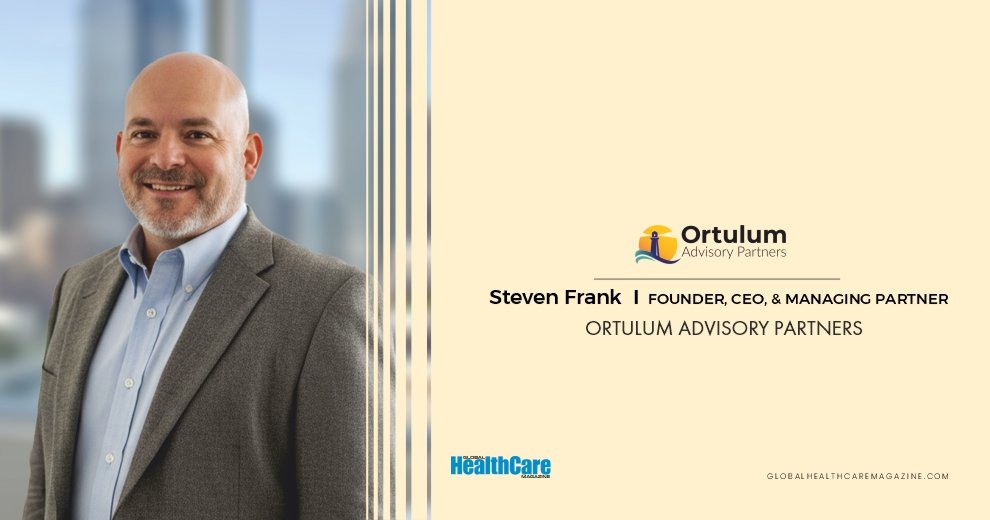
There is something quietly radical about a man who describes himself as his own Internet of Things device. Steven Frank, Founder, CEO, and Managing Partner of Ortulum Advisory Partners, says this without performance and without irony, because he means it literally and completely.
He wears a continuous glucose monitor every day. He tracks his biometrics through connected health devices. He was diagnosed with Type 2 diabetes, and subsequently lost one hundred pounds, a sequence of events that did not simply become a chapter in his personal story, but the compass by which he has navigated nearly everything since.
His firsthand experience with connected health coaching became the catalyst for his professional focus on healthcare technology. The technology had met him where he was. He decided to spend his career making sure it could do that for others.
“I build technology that improves lives,” he says, “and I have the receipts, both personal and professional.”
The receipts, it turns out, span three decades and two of the most consequential institutions in American technology and finance.
A Laboratory at the Start of Everything
Before Ortulum, before Watson Health, before the private equity boardrooms, there was Bell Labs. For anyone who has spent time in the technology industry, Bell Labs carries a particular and almost mythological weight: the place where the transistor was born, where Unix was written, where people who would eventually define entire industries were once young and restless and building things that did not yet have categories.
Steven arrived there as a member of technical staff at the Computer Science Research Center, embedded directly alongside researchers whose work was to turn pure invention into a real commercial application. He wrote proof-of-concept applications in Limbo, an early concurrent language that heavily influenced the evolution of Go, and in Java using the PersonalJava API, developing for what the industry then called “constrained consumer device platforms”: early smartphones and set-top boxes. He published technical work on embedded device architectures that, read today, look unmistakably like blueprints for the Internet of Things, drawn years before the term existed.
What Bell Labs gave him was not simply a résumé. It gave him a way of thinking about the distance between what a machine can do and what a human being actually needs it to do. That gap, and the discipline required to close it, would follow him for the next thirty years.
Two Decades Inside IBM
From Bell Labs, Steven moved to IBM, where he would spend nearly two decades supporting some of the largest technology transactions in the industry. As a deal technology lead within IBM Software Group, he supported more than 25 strategic acquisitions, each valued between $50 million and $5 billion. The crown jewel among them was the $5 billion acquisition of Cognos, the transaction that established IBM as the market leader in business intelligence and analytics software and reordered an entire product category in a single deal.
Inside those engagements, he was not modeling financials or negotiating covenants. He was the person walking into acquired companies’ engineering teams and asking the questions that most deal rooms do not know how to formulate: not whether a system works, but what it will cost to scale, and which risks arrive in ninety days versus which ones wait eighteen months to surface. The difference between those timelines is measured in capital, in credibility, and sometimes in the survival of the investment thesis itself.
He also led cloud architecture for multiple platforms at IBM that served millions of customers, a mandate of institutional scale that demanded both technical depth and the organizational clarity to deliver across it.
Clinical AI Before It Had a Name
Running alongside the IBM years was a parallel thread that was, in many ways, the most personal. Steven was among the early builders of Watson Health, working on clinical AI applications for chronic disease management, including Type 2 diabetes and cardiovascular disease, years before generative AI and modern clinical AI platforms entered mainstream healthcare conversation.
That work was featured in a video shown at the HIMSS Annual Conference and Exhibition in 2017, featuring his early applications at one of healthcare technology’s most prominent conferences at a pivotal moment in the field.
But behind the conference lights, a tension was developing that would prove irreconcilable. IBM was publicly positioning Watson as a transformative AI platform capable of dramatically reshaping oncology and clinical decision-making. He was building something categorically different: tools designed to augment clinical judgment, not replace it, tools that kept the physician and the patient at the center and used artificial intelligence to amplify human decision-making rather than displace it.
“The two visions were fundamentally incompatible,” he says.
He kept building what he believed was right. Within a few years after his departure from IBM, the broader Watson Health initiative collapsed, and in 2022, IBM sold the division.
“The most important leadership act,” he says, “is staying grounded in what you know to be true when the organization’s narrative is moving the other direction.”
That is considerably harder to do than it sounds. Institutional narratives carry real social and professional weight, and the pressure to align with them, especially when they come from the top and carry significant momentum, is constant and real. That Steven held his ground is not a minor biographical note. It is a through-line for how he operates.
The Wells Fargo Chapter
Another defining chapter emerged during Steven’s work at Wells Fargo. As chief architect of a $200 million governance, risk, and compliance product portfolio, he directed a multi-year modernization effort that delivered cloud-native architecture, API-driven domain services, and data governance capabilities that produced $5 million in documented cost savings.
What the Wells Fargo work added to his accumulated understanding was a precise and consequential insight: organizations consistently misread the value and the risk embedded in their own technology. Not from carelessness, but because the complexity is genuine and the gap between technical fluency and decision-making authority tends to be wide and rarely bridged. It was an observation that would become the foundation of everything he built next.
The Signal That Became Ortulum
In late 2021, Steven partnered with Crosslake Technologies, a specialized private equity technology diligence advisory firm. What he found in that collaboration was significant: an entire ecosystem of specialized firms had formed around exactly the kind of work he had been doing inside IBM for the better part of a decade. The market had taken shape. It had grown well beyond the Big 4. And the demand for genuine practitioner depth, technical expertise fused with strategic and business acumen, delivered at investment grade, was real and growing. The signal was clear. Ortulum was his answer.
“The unmet need was clarity,” he says. Private equity sponsors were acquiring technology companies without a clear picture of what they were actually buying: the architecture debt, the security gaps, the team capability shortfalls that would surface within twelve months of close.
Most diligence practitioners specialize in a single domain: architecture, security, infrastructure, or organizational assessment. The result is a collection of siloed opinions rather than an integrated picture. What investors and operators need is something different — a system-level view, integrated across all domains simultaneously, and communicated not as a technology lecture but as a clear map of business impact, timeline, and capital exposure.
What the Misconceptions Actually Cost
Steven is precise and direct about the beliefs that cost investors money. The first is that technical diligence is a checkbox exercise, a process step conducted to satisfy procedure rather than to surface anything that matters. It is not. “The questions that matter,” he says, “aren’t ‘does the system work?’ They’re ‘what will it cost to scale this?’ and ‘which of these risks surfaces in 90 days versus 18 months?’”
The second misconception is that technical findings do not affect valuation. They do, absolutely. Steven has seen well-documented technical risk reshape deal structure. He has seen it adjust the purchase price. He has, on more than one occasion, seen it stop a transaction entirely. The assumption that technology is a separate conversation from value is one of the more expensive beliefs a private equity sponsor can carry into a process.
Three Pillars, One Continuous Thread
Ortulum’s work unfolds across three interconnected practices: technical diligence, post-close value creation, and fractional CTO advisory. To understand why these three belong together, it helps to understand the particular way Steven thinks about the arc of a deal.
Most diligence work ends at signing. His work begins there. When he enters a deal, he is already thinking about Day 91. That means he can brief the sponsor on risk at the moment of close and hand a credible execution roadmap to incoming leadership within the first thirty days post-close.
“Diligence without a value creation context is just a risk inventory,” he says. “Value creation without diligence grounding is just advice.”
The fractional advisory practice extends that thread further, helping portfolio company leadership build the internal capability to sustain what has been set in motion, often serving as a bridge to a full-time hire once the organization is ready for that transition. The pillars compound each other. Each one makes the others more useful.
Ortulum operates lean by design and networked by necessity. He works with a network of domain specialists he has personally vetted, each bringing deep private equity and enterprise experience, and what he describes, with unmistakable feeling, as “the scars to show for it.” The model prioritizes quality of insight over volume of output.
The Engagements and the Work
Across his career, Steven has conducted more than 100 M&A engagements, on both the buy side and the sell side, for clients including KKR, TPG, Bain Capital, Blackstone, JP Morgan, and Goldman Sachs. The breadth of that record is not simply a credential. It is the evidence base that makes the system-level view possible.
No two days in his practice look the same, and he says this as though it is genuinely one of the things he values most about the work. A morning might be spent reviewing a virtual data room for a healthcare SaaS diligence engagement. An afternoon might be a strategy session with a portfolio company CTO. The part of the work he finds most compelling is what he calls the translation layer: the moment when a deeply complex technical picture resolves into something an investor or operator can see clearly enough to act on.
“That moment,” he says, “when complexity becomes clarity, is what drives me.”
The Longer Arc is Healthcare
Ask Steven where all of this is heading, and the answer is healthcare, not as a distant goal, but as an active and deliberate commitment. His market position today is M&A and private equity advisory, which is where his expertise is sharpest and where the demand is most clearly formed. But the work he says he wants to be defined by, a decade from now, is bringing that same practitioner rigor into HealthTech companies that are genuinely trying to change patient outcomes.
“The technology is ready,” he says. “The governance frameworks are ready. What’s needed is investment that can help propel us forward and scale as we connect strategy and execution.”
This is not an abstraction. Steven wears a CGM every day. He has lived the experience of a patient inside a fragmented healthcare system, and he has spent years building the tools designed to make that system less fragmented. The thread from Bell Labs to Watson Health to connected health platforms today is, in his account, unbroken. The mission — technology meeting people at the intersection of their health and their lives has not changed. Only the instruments have.
There is a concept he has written about that he calls the M-shaped mind: multi-domain professional expertise for an era when single-domain depth is no longer sufficient for the most complex and consequential problems. It is a useful frame for understanding how he operates. He is a technologist who speaks the language of investment. He is a healthcare advocate with an architecture background to support his convictions. He is a practitioner who published technical work, led billion-dollar transactions, and built clinical AI applications before the term had entered common usage. The domains do not merely coexist in him. They compound each other.
Outside the Work
Steven is careful to describe his relationship with work and life not as “balance,” a word he considers imprecise, but as integration. The line between work and learning blurs constantly, he says, because the curiosity that drives him professionally and the curiosity that drives him personally are not, in any meaningful sense, different.
Outside of work, he is drawn to anything that rewards that curiosity: music, photography, travel, mountain trails, corner bookstores, the sunrise at the beach. These are not the hobbies of someone performing leisure. They are the activities of someone who moves through the world the same way he moves through a complex technology system: with genuine interest in what might be discovered.
The advice he offers to young technology leaders reflects the same sensibility.
“Depth is your advantage,” he says, “but communication is your leverage. You can understand a system perfectly and still lose the room if you can’t translate what you know into terms that are understandable and that can drive a decision.”
And then the part that says the most about how he leads: “The leaders who change things aren’t always the smartest in the room. They’re the ones who make the smartest people in the room feel understood.”
What the Receipts Add Up To
Steven Frank has spent a career doing something genuinely difficult to name, because it crosses categories in ways that categories tend to obscure. He translates technical complexity into investment clarity. He turns a personal health crisis into a professional mission. He focuses not on what a machine can do, but on what a patient actually needs.
The work is ongoing. The story is still being written.
Quotes