We rarely think about our spine…until something feels off. Maybe you notice that one shoulder or hip sits higher than the other, or your back looks slightly uneven. What starts as occasional stiffness may gradually turn into persistent discomfort or even severe back pain.
While these symptoms can have several causes, one possible diagnosis is scoliosis, a condition in which the spine curves abnormally. When that curve bends to the right, it is called dextroscoliosis. It’s a term you may have never heard before, and hearing it for the first time can raise many questions: What does it mean? Will it get worse? Will I need surgery?
You’re far from alone in this. More than 4 million people in the United States alone are living with scoliosis, and most continue to lead full, active lives. When detected early, the condition is often manageable through treatments ranging from regular monitoring and physical therapy to bracing or, in some cases, surgery.
This guide is here to clear up the confusion. You’ll learn what dextroscoliosis is, what causes it, its symptoms, how it’s diagnosed, and the treatment options available. Whether you’re a patient, a parent, or a caregiver, this article will help you understand the condition and take the right next steps with confidence.
What Is Dextroscoliosis?
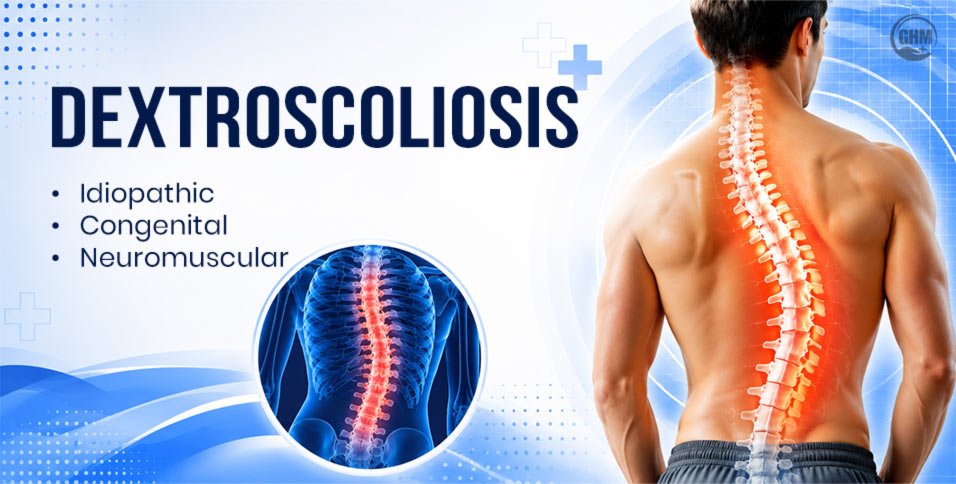
Dextroscoliosis is a type of scoliosis, a condition in which the spine curves sideways instead of running straight. The word “dextro” comes from Latin, meaning right, so dextroscoliosis specifically refers to a right-sided spinal curve, also called a dextrocurvature.
A healthy spine looks straight when viewed from behind. In dextroscoliosis, the spine bends to the right, forming a shape that looks like a “C” or, in more complex cases, an “S.” The S-shape happens when the spine compensates for the primary curve by forming a second curve in the opposite direction.
Dextroscoliosis most commonly affects the thoracic spine (the middle and upper back), but it can also occur in the lumbar spine (lower back) or the thoracolumbar region where these two sections meet.
The severity of the spinal curve varies widely. Mild dextroscoliosis, with curves under 20 degrees, often causes no symptoms at all and may only be discovered during a routine check-up.
However, moderate to severe curves in the spine can cause visible postural changes and, over time, physical symptoms.
Dextroscoliosis and Levoscoliosis: What’s the Difference?
Not all spinal curves go in the same direction. The spine that curves to the left instead of the right is levoscoliosis, the mirror opposite of dextroscoliosis. It is also known as levocurvature.
Understanding the direction of the curve matters clinically. Dextroscoliosis is more common and typically found in the thoracic spine. Levoscoliosis is less common and more often found in the lumbar or thoracolumbar region.
The direction also guides the diagnosis of scoliosis. Spine specialists note that a left-sided thoracic curve (thoracic levoscoliosis) raises more concern for underlying neurological abnormalities and often warrants an MRI, while a right-sided thoracic curve is more consistent with typical idiopathic scoliosis.
What Causes Dextroscoliosis?
Having the spine curved to the right does not have a single cause. Several factors can contribute, and sometimes no cause is ever found.
- Idiopathic (Unknown Cause): This is the most common type. Research shows that approximately 80–85% of scoliosis cases are idiopathic, meaning no specific cause can be identified. Genetics likely plays a role in idiopathic scoliosis, as the condition tends to run in families. Around 30% of people with scoliosis have an immediate relative with the condition.
- Congenital: Some children are born with vertebral abnormalities that cause the spine to curve from the start. This is called congenital scoliosis and is present at birth.
- Neuromuscular: Conditions that affect the nerves and muscles supporting the spine can lead to scoliosis. Examples include cerebral palsy, muscular dystrophy, and spinal muscular atrophy. In these cases, the spine curves because the muscles cannot hold it in alignment.
- Degenerative: In adults, the spine can develop curves due to wear and tear over time. Arthritis, disc degeneration, and age-related bone loss can all shift spinal alignment and contribute to degenerative scoliosis.
- Less Common Causes of Dextroscoliosis: Connective tissue disorders (such as Marfan syndrome), spinal tumors, and previous spinal injuries can cause a right-sided spinal curve, though these are rare.
What Are The Symptoms of Dextroscoliosis?
Dextroscoliosis symptoms vary widely depending on the degree of the curve. Mild dextroscoliosis often causes no noticeable signs at all.
Visible Signs of Dextroscoliosis:
These are the most common early indicators and are often spotted by a parent, teacher, or healthcare provider before the person with scoliosis notices anything themselves:
- Uneven shoulders (one sits higher than the other)
- Uneven hips
- Rib prominence on one side (the rib cage sticks out more on the right)
- Waist asymmetry (the waistline looks uneven)
- Head appearing slightly off-center
- Clothing hanging unevenly
Physical Symptoms of Dextroscoliosis:
As the curve progresses, people may experience,
- Back stiffness and reduced flexibility
- Fatigue after prolonged standing or activity
- Muscle imbalances (one side of the back feels tighter than the other)
- Pain: It is a common misconception that scoliosis always hurts. Many people with mild curves feel no pain. However, studies show that 63% of children with scoliosis report pain, nearly twice the rate of those without the condition. Pain tends to develop when the curve becomes moderate to severe or in adults whose curves progress with age.
Severe Symptoms of Dextroscoliosis:
In serious cases of Dextroscoliosis, a significantly curved spine can compress the lungs and nerves, leading to breathing difficulty, numbness or tingling in the limbs, and muscle weakness. These symptoms signal that a medical evaluation is urgent.
What Are The Complications In Dextroscoliosis?
For most people, dextroscoliosis is not dangerous, especially when it is mild and caught early.
However, severe or untreated curves can lead to complications over time, including:
- Chronic back pain and reduced mobility
- Breathing problems (when the rib cage compresses the lungs in thoracic curves)
- Nerve compression causing numbness, tingling, or weakness
- Reduced quality of life and difficulty with everyday activities
In Dextroscoliosis, early diagnosis and consistent monitoring dramatically reduce the risk of complications. A small dextrocurvature found at age 12 is far easier to manage than a large curve discovered at 25.
How Is Dextroscoliosis Diagnosed?
Diagnosing dextroscoliosis usually begins with a simple physical exam and, if needed, imaging.
- Medical History: Your doctor will ask about family history of scoliosis, when you or your child first noticed any changes, and whether there are any related conditions like muscular disorders.
- Physical Examination: The most well-known test for the diagnosis of dextroscoliosis is the Adam’s Forward Bend Test. The patient bends forward at the waist with arms hanging loose. From behind, the doctor checks for any asymmetry in the back or rib cage, which can indicate a spinal curve. Shoulder and hip alignment are also measured, and the doctor may check the patient’s range of motion and posture.
- X-Rays: If a spinal curve is suspected, an X-ray of the full spine confirms the diagnosis and measures the curve’s angle, known as the Cobb angle. This angle determines the severity of the curve. mild spinal curve is under 20°, moderate spinal curve is 20–40°, and severe spinal curve is above 40°.
- MRI or CT Scan: These are used when the doctor suspects an underlying cause, such as a spinal cord abnormality, tumor, or, in some cases, when the curve direction is unexpected (such as a left thoracic curve).
What Are The Treatment Options For Dextroscoliosis?
Treatment for dextroscoliosis depends on three main factors: The patient’s age, the size of the curve, and whether it is getting worse. However, not every case of a right-sided spinal curve requires aggressive intervention.
- Mild Dextroscoliosis (Curves Under 20°)
- Observation: For mild cases, the standard approach is watchful waiting. The doctor will schedule regular follow-up visits every 4–6 months during periods of growth to track any progression.
- Physical Therapy: Targeted exercises can strengthen the core muscles that support the spine, improve posture, and increase flexibility. The Schroth Method is a well-studied scoliosis-specific physiotherapy approach that uses personalized exercises to help correct posture, reduce pain, and potentially slow curve progression.
- Moderate Dextroscoliosis (20°–40°)
- Bracing: For children and adolescents who are still growing, a back brace is often recommended when the curve measures between 25° and 40°. Dextroscoliosis braces do not straighten an existing curve, but they help prevent further progression while the spine is still developing. The most commonly used Dextroscoliosis brace type is the TLSO (thoracolumbar sacral orthosis), worn for 16–23 hours per day.
- Medications: Pain relievers and anti-inflammatory medications can manage discomfort associated with the scoliosis curve when needed. They do not treat the curve itself but improve the quality of life during treatment.
- Severe Dextroscoliosis (Curves Over 40°–45°)
Surgery is considered in dextroscoliosis treatment when the curve is severe, rapidly progressing, causing significant symptoms, or affecting breathing.
The most common procedure is spinal fusion, where two or more vertebrae are joined together to stabilize the spine. Metal rods, screws, or hooks hold the spine in place while the bones fuse over time. To treat dextroscoliosis in very young children with progressing curves, growing rods may be used, allowing the spine to continue developing until a definitive fusion is performed.
- Recovery Period: Recovery from spinal fusion typically takes several months, with most patients returning to light activities within 3–6 months and resuming full activity within a year.
How Is Living With Dextroscoliosis?
A dextroscoliosis diagnosis does not mean your life changes dramatically. With the right approach, most people manage the condition well and stay physically active.
Some practical steps that help with dextroscoliosis:
- Stay physically active. Swimming, walking, and yoga are gentle on the spine and help maintain core strength.
- Maintain a healthy weight to reduce the load on the spine.
- Practice good posture awareness throughout the day.
- Follow your prescribed exercise routine consistently.
- Attend regular follow-up appointments, especially during growth spurts.
- Pay attention to new or changing symptoms and report them promptly.
For adolescents especially, the emotional side of scoliosis is just as important as the physical. Research shows that scoliosis patients are significantly more likely to experience concerns about body image and self-esteem. Support groups, counseling, and open conversations with family and healthcare providers can make a meaningful difference.
When Should You See a Doctor?
Some spine changes are easy to miss or dismiss. See a doctor promptly if you or your child notices any of the following:
- A visible spinal curve or changes in posture
- Uneven shoulders or hips that were not there before
- Persistent back pain, especially in children or teens (back pain in kids is not normal)
- Difficulty breathing during routine activity
- Numbness, tingling, or weakness in the arms or legs
- Rapid changes during a growth spurt
- Adults with a known curve that seems to be getting worse
Early evaluation gives you options. The sooner dextroscoliosis is identified, the more treatment choices are available and the better the long-term outcome.
Final Words
Dextroscoliosis is more than just a sideways curvature of the spine. It is a condition that requires proper evaluation, ongoing monitoring, and personalized treatment based on its severity and underlying cause.
While the diagnosis may feel alarming at first, the majority of cases are very manageable. Whether your path involves monitoring, physical therapy, bracing, or surgery, the goal is the same: a healthy, comfortable, and active life.
If you have noticed any signs of spinal curvature in yourself or your child, do not wait. Consulting a healthcare professional is the best way to determine the most appropriate course of action.
With the right approach, many individuals with dextroscoliosis can effectively manage their condition and continue to live active, fulfilling lives.
Sanskruti Jadhav
This blog is for informational purposes only. Always consult a healthcare professional for personalised advice.