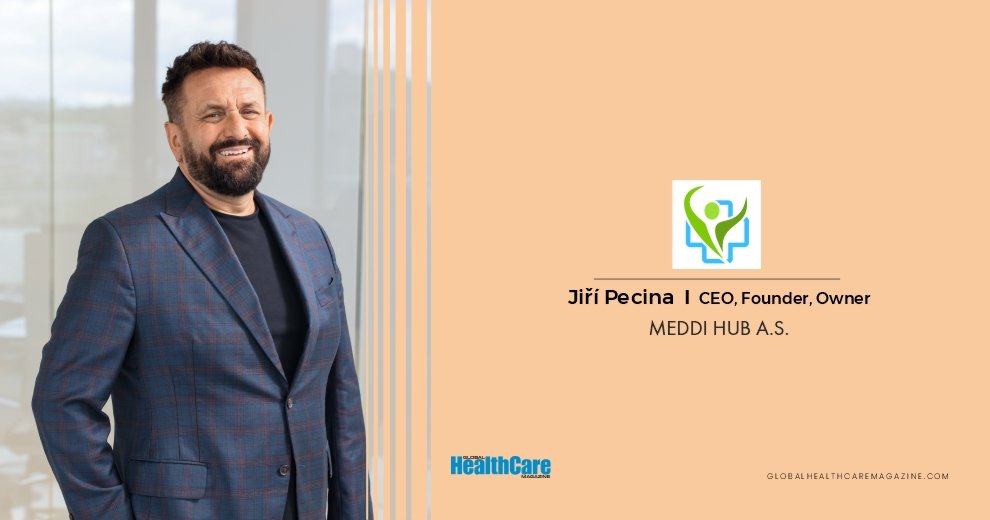
Jiří Pecina has never been someone who waits for permission to start. He launched his first business at 13, and the instinct that shaped him then, to look at the distance between what exists and what could exist and to close it, has defined everything since. Well before his thirtieth birthday, he had built and sold one of the largest car dealership groups in Central Europe, completing the transaction with one of the country’s largest investment companies. It was a remarkable early chapter. It was not, as it turned out, the one that would define him.
When Jiří returned to the Czech Republic after years spent in the United States, his restless attention turned toward healthcare not as a comfortable or obvious next step, but because he saw, with the clarity that comes from having built large and complex things, that a system touching every life was operating far below its potential. Technology has transformed communication, commerce, and entertainment. Healthcare remained largely unchanged. That gap was, to him, the most compelling opportunity he had encountered in decades.
“Healthcare stood out immediately,” he says. “It’s something that touches everyone, yet it often struggles with inefficiency and accessibility.”
He was not prepared to leave it that way.
Today, the company he built to change that, MEDDI Hub, operates in 16 countries across Europe and Latin America, serves more than 9 million people, and is preparing to enter its first market in Africa.
The Road That Led to Medicine
To understand Jiří Pecina, it helps to know that he has been building things since he was 13 years old. Entrepreneurship is not, for him, a career category so much as a temperament. A way of moving through the world that involves looking at what exists and asking whether it could be different, and then doing something about it.
That temperament produced results early. Well before his 30th birthday, he had built one of the largest car dealership groups in Central Europe, running it with the focus and organizational discipline that such an enterprise demands. When the time came, he sold it to one of the largest investment companies in the country and, together with his wife, Alena Pecina, left for the United States.
Those years in America were years devoted to family, children, education, and extensive travelling around the world, and to what he describes as “interesting investments and projects.” They were also years spent observing a different healthcare system, with all its own complexities and own familiar failures. They were years that widened a perspective already formed by decades of building from scratch.
After nine years abroad, he returned to the Czech Republic, his focus already fixed on healthcare and his thinking already turning over what a better system could look like.
The Idea That Became a Mission
The vision for MEDDI took shape from several directions at once. Among them was a personal experience that sharpened Jiří’s thinking considerably: a visit to a hospital where he and Alena brought their son in for what should have been a routine surgery. The medical professionals were skilled and attentive. What struck him was everything surrounding the care itself, the paperwork, the waiting, the administrative machinery of a system that had not yet caught up with the technology available to it. Where another person might have felt only impatience, he saw an architectural problem with a clear solution.
“We realized there was a clear opportunity to simplify access to healthcare, reduce bureaucracy, and give both doctors and patients more time for what really matters, care itself.”
MEDDI is, in the fullest sense, a joint vision. Jiří and Alena have built it together since 2016, and that partnership is woven into the company’s foundation. The mission they share is both precise and ambitious: healthcare accessible to everyone, from anywhere, at any time, not as an aspiration, but as a practical, daily reality.
A Platform Built for Every Patient
At the heart of MEDDI is not a single app but a comprehensive platform: a suite of specialized products and modules designed to enable meaningful communication between doctors and patients at every level of care, serving both individual users and medical institutions according to their specific needs.
The flagship product is the MEDDI app, which connects patients and doctors across all 16 countries in which MEDDI currently operates. Patients can consult via video, chat, or phone, manage their medical records, and receive prescriptions, all within a single interface, without the administrative overhead that typically surrounds even the most routine consultation.
Within the MEDDI app sits BioScan, a feature that allows users to measure certain health data using nothing more than their mobile phone. BioScan has just received EU MDR certification as a medical device group 1, confirming the accuracy and safety of its measurements. The intent is to give the public meaningful health data that they can bring to a consultation with their doctor, supporting more informed and proactive dialogue about their care.
The main difference between the MEDDI app and its competitors is speed by design. The average waiting time for a real-life board-certified doctor in the MEDDI app is under two minutes, and that’s globally, and that’s because doctors are paid by the hour and are waiting for the incoming patient traffic. So not an old, boring, and slow marketplace, where patients are waiting for a connection with the doctor, but ultra-fast and AI-driven, for planning a sufficient number of doctors per shift, so patients are being connected ultra-fast, so globally under 2 minutes.
The platform extends well beyond the flagship. MEDDI Diabetes provides tailored digital support for patients managing diabetes. MEDDI Baby accompanies expectant mothers through pregnancy with the specialist access and continuity of care this stage of life demands. MOU MEDDI was developed in close collaboration with the Masaryk Institute of Oncology in Brno, the largest oncology clinic in Central and Eastern Europe, to serve oncology patients with the precision their care requires. Each product is purpose-built for a specific medical reality, and each can be configured to the needs of the institution or patient population it serves.
The numbers that run through this platform are worth pausing on. Doctors on MEDDI respond to patients on average within 2 minutes. Psychotherapists are reachable within 17 minutes. Specialist appointments that might otherwise require weeks or months of waiting can be booked within days.
For someone managing a chronic condition far from a city center, a new mother uncertain about a symptom at midnight, or a worker who cannot afford to lose half a day in a waiting room, these are not marginal improvements. They represent a fundamental shift in what healthcare access actually means in practice.
“One of the biggest misconceptions is that telemedicine is somehow inferior to in-person care. In reality, it’s about using the right tool for the right situation.”
Jiří is not trying to displace the physician. The entire MEDDI platform is built on the conviction that technology should reduce the distance between patients and the doctors who care for them, not place a layer of automation between them.
From Prague to the World
Since 2020, MEDDI has been a supplier of telemedicine solutions to some of the most significant healthcare institutions in the Czech Republic. The Masaryk Institute of Oncology in Brno, the Institute for the Care of Mother and Child in Podolí, and the Faculty Hospital Brno are among its medical partners. Major employers, including VISA, VEOLIA, Tesco Stores, DHL, and Notino, have brought MEDDI to their employees.
In 2021, MEDDI expanded into Slovakia, where it now delivers solutions for health insurance companies serving millions of patients. LATAM was the next step with the introduction of MEDDI Diabetes, an application that brings together telemedicine and in-person patient examinations with the possibility of regular diabetes monitoring and provision of complete, integrated treatment.
“Our approach is global in vision but local in execution. We build flexible systems that can integrate into existing healthcare ecosystems rather than disrupt them blindly.”
Today, that vision encompasses 16 countries across Europe and Latin America, serving more than 9 million people through partnerships with insurance companies, employers, and regional governments.
The next chapter is already taking shape. Morocco is set to become MEDDI’s first market in Africa, to be followed by other countries across the globe. Each new geography represents a population of people for whom faster, easier access to care is moving from aspiration to reality.
The Classroom and the Alliance
Less visible in the public story of MEDDI, but no less central to who Jiří is, is his sustained commitment to building telemedicine as a recognized field, not only as a product.
He serves as Vice-Chairman of the Alliance for Telemedicine, Digitization of Healthcare, and Social Services, and participates in projects focused on the education and practical application of telemedicine within the Czech healthcare system. At the 1st Faculty of Medicine of Charles University, at Masaryk University in Brno, and at the P.J. Šafářik Faculty of Medicine in Košice, he collaborates in teaching telemedicine as a formal academic subject.
This is the work of someone who understands that technology adopted without comprehension is fragile. By working at the academic level, he is ensuring that the next generation of physicians enters practice already fluent in the tools that will define their profession.
“It is important to me that doctors have access to technologies that make their work easier and more efficient, so that they can devote more time to patient care. Thanks to modern technologies, it is also possible for everyone to have access to healthcare. Anytime and from anywhere.”
AI, Technology, and the Doctor Who Must Always Be There
Jiří is, at his core, a technological visionary. The MEDDI platform is already integrating AI and emerging technologies into its products, using them to sharpen diagnostics, personalize care pathways, reduce administrative burden, and make the experience of accessing healthcare faster and more intuitive for everyone involved. For him, AI is not a novelty. It is a core instrument for delivering on the promise that quality healthcare should be available to all people, everywhere, at any time.
But this commitment to technology is held in strict balance by a conviction that does not waver. Licensed doctors must be at the center of every meaningful healthcare interaction. Technology can guide, organize, and connect. It can reduce the friction between a patient and the care they need. What it cannot do, and what MEDDI is expressly designed never to allow it to do, is replace the clinical judgment of a qualified physician. The advice must always come from a licensed doctor. Never from a bot.
“Doctors will always be at the center. Technology should empower them, not replace them.”
The future he is building toward is one where healthcare becomes proactive rather than reactive, seamlessly woven into everyday life rather than something people must interrupt their lives to reach. It is an ambitious picture. It is also, given what has already been built in under a decade, an entirely credible one.
The Harder Lessons of Growth
Scaling a healthcare technology platform across multiple countries and regulatory environments is not a smooth or uninterrupted process. Jiří speaks about this with the measured candor of someone who has lived inside the difficulty.
“One of the biggest challenges has been scaling quickly while maintaining quality. Growth always brings pressure on systems, on people, on decision-making.”
There were moments when the right decision was counterintuitive: to slow down, to build stronger foundations rather than simply press forward. These choices are rarely comfortable at the time. They are, he has come to understand, essential.
“Leadership, for me, is about staying calm, making clear decisions, and trusting the team.”
The team he has built reflects this. MEDDI brings together people with backgrounds in medicine, technology, and business. The quality Jiří prizes most, however, is harder to credential: the genuine desire to improve healthcare, not merely to optimize it.
“That shared purpose,” he says, “creates a very strong culture,” across all the countries and healthcare systems MEDDI now serves.
The Simple Truth at the Center
There is a version of Jiří’s story that reads as a clean line of achievement: the serial entrepreneur who identified a gap, built a platform, and scaled it across three continents. That version is not wrong. But it leaves out the most interesting part.
What makes Jiří compelling is not the scale of what he has built but the clarity of why he built it. He looked at healthcare, one of the most essential and most complex systems in the world, and saw not a wall but an invitation. He brought to it everything he had learned from a lifetime of building: the patience to understand a system before improving it, the conviction to stay with a vision through the years required to realize it, and the genuine belief that technology, in the right hands, with real licensed doctors at the center, can change lives at scale, but remains Human-centered.
“If there’s one thing I’ve learned,” he says, “it’s that meaningful change comes from personal experiences. MEDDI started with a simple frustration, but it grew into a mission to improve healthcare access for millions.”
“My belief is that if you focus on solving real problems and stay persistent, you can build something that truly makes a difference.”
That is, in the end, exactly what he is doing.
Quotes

Also Read: Leaders Advancing Telemedicine & Digital Health Innovation 2026