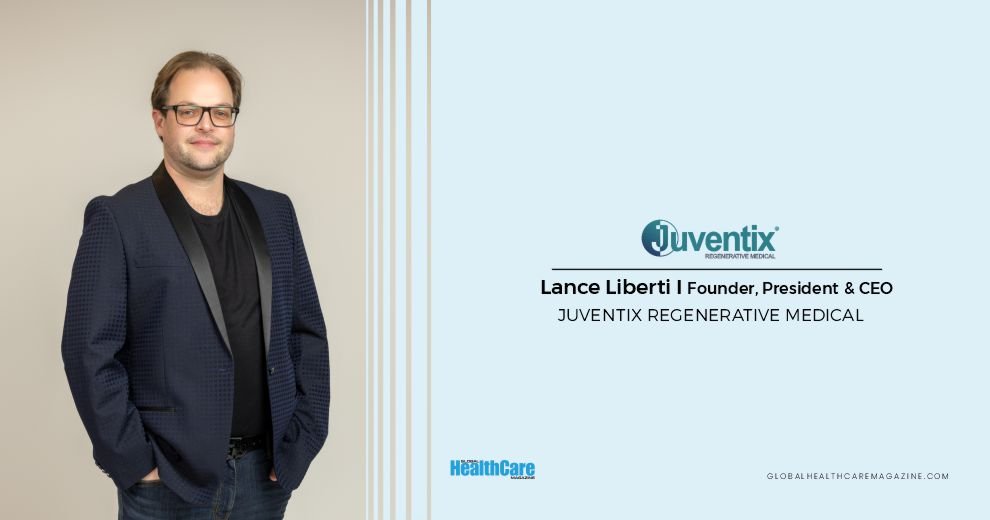
There is a particular kind of reckoning that arrives when a doctor sits across from you and says, matter-of-factly, that you may need your knees replaced. For most people, that conversation happens sometime in their sixties, maybe their seventies, when the cartilage has simply had enough of a long life. For Lance Liberti, it happened at twenty.
He had been a high school football player, the kind of sport that asks everything of a young body and sometimes takes more than it should. A catastrophic knee injury ended his athletic ambitions. It was the sort of wound that reshapes a person’s self-understanding, quietly and permanently.
Years later, while studying business and marketing at the University of South Florida, the damage caught up with him fully. Long before he became the Founder, President & CEO of Juventix Regenerative Medical, Lance was simply a young patient searching for a different path forward.
“If I were told knee replacement surgery was my only option, how many other people are being told the same thing when this treatment might work for them as well?”
That question, which arrived like a kind of personal emergency, would eventually become a company. But first, it became a journey to New Jersey.
A client of Lance’s told him about his father, an osteopathic physician who treated elderly patients with degenerative joint disease using hyaluronic acid, a viscosupplementation approach that was largely unknown in the circles he moved in. The client invited him to fly up, to stay with the family, and to let the doctor try. Lance accepted.
The first injection eased the pain. By the third, the pain had disappeared entirely. By the fifth, he was running and jumping on a knee he had been told was irreparable. Later, platelet-rich plasma therapy would further restore his mobility and reshape his understanding of what healing could look like. “That experience became a mission,” he said. The mission was clear: non-surgical biologic therapies existed, and far too few patients were being informed about them.
The Question That Became a Company
Lance did not leave that experience and go immediately to work. He sat with it, turned it over, and spent years building the infrastructure to understand it properly.
Through Integrative Practice Solutions, the clinical business model he co-developed with Dr. Robert McGrath, D.O., he observed firsthand what was happening inside non-surgical osteoarthritis clinics across the country. Physicians were genuinely excited about PRP and platelet-rich fibrin therapies. They could see the promise. But they were consistently frustrated by the practical realities: expensive kit systems, slow processing workflows, inconsistent protocols, limited education, and an almost complete absence of real implementation support.
Some systems required lengthy double-spin preparation workflows and carried high consumable costs, which made patient access difficult and practice economics hard to justify. The gap between regenerative science and practical clinical adoption was real, and it was widening.
Juventix Regenerative Medical was built to close that gap.
The goal, as Lance has always framed it, was never simply to sell a tube. It was to help physicians confidently build a regenerative medicine service line that was clinically credible and economically sustainable. The distinction matters. A product alone changes nothing. A system, supported by training, validated protocols, sales support, and practical implementation guidance, changes practices.
Setting the Record Straight
One of the more persistent frustrations in regenerative medicine is the mythology that surrounds it. Patients arrive having read breathless testimonials. Others arrive having been told, with equal conviction, that none of it works. Neither position is accurate, and Lance is precise about this.
“The greatest misconception is that all PRP is the same. It is not.”
Platelet recovery, leukocyte profile, red blood cell contamination, pH, activation method, preparation time, and operator consistency all matter. A poorly prepared PRP sample and a clinically validated one may share a name but very little else. The outcomes they produce reflect that difference.
The second misconception is more philosophical: that regenerative medicine must be either revolutionary or ineffective. He consistently pushes back on both extremes. The truth, as he sees it, is more disciplined. Proper patient selection, validated technology, realistic expectations, and evidence-based protocols determine outcomes. Not hype, and not dismissal.
Juventix addresses this through direct laboratory validation, published research, peer-to-peer training, and a transparent institutional commitment to discussing what PRP and PRF can and cannot do. It is, in a field prone to overclaiming, a notably measured posture.
From the Joint to the Jawline
The clinical reach of Juventix’s PRP and PRF systems spans a range of medical disciplines that might, at first glance, seem incongruous. Orthopedics and sports medicine practitioners use platelet-based therapies to support tissue repair, joint function, and recovery from injury. Aesthetic medicine providers use PRP and PRF for microneedling, skin rejuvenation, and natural bio-fillers, as well as procedure recovery. Hair restoration practices rely on the company’s patented biotin-enhanced PRP platform. Sexual wellness providers incorporate PRP into physician-directed tissue health protocols.
What connects all of these is not simply a product, but a preparation philosophy.
The Juventix system is built around an 8-minute, single-spin workflow that achieves high platelet recovery, a low red-blood cell (RBC) contamination profile, and consistency across operators. In a clinical environment where time and reproducibility are a form of currency, efficiency is not a minor feature. It is the difference between a technology a practice actually adopts and one that sits on a shelf.
The Hyaluronic Acid combined with PRP preparation tube is designed to support physician-directed aesthetic applications as an alternative approach to traditional chemically cross-linked facial fillers, while supporting tissue health and recovery. The growth factor activation strategies built into the system reflect an effort to optimize not just platelet concentration, but biological performance.
Science at the Edge
The most revealing indicator of where a company is headed is often found not in its current products, but in its patent portfolio. In that respect, Juventix offers a clear signal.
The company holds a patent for biotin-enhanced PRP in hair restoration, a meaningful innovation that recognizes hair loss as something more than a growth factor problem. Follicular health also depends on micronutrient support, keratin structure, and scalp biology. The biotin-enhanced tube was developed to support these factors simultaneously. It embeds 2cc of Biotin, also known as Vitamin B7, directly into the preparation device to support the keratin structure of the hair follicle, with the goal of enhancing follicular strength, sheen, and overall growth support.
Two additional innovations are patent-pending: LED photo activation and plasma bio-incubation. These are not incremental refinements. They represent a broader research effort to understand how preparation conditions influence platelet activation, fibrin architecture, and growth factor bioavailability.
“The future will be less about claiming ‘more cells’ and more about reproducibility, personalization, activation science, and clinically meaningful outcomes,” he says.
That sentence captures something essential about where regenerative medicine is actually going, as distinguished from where its louder promoters claim it already is.
The People Behind the Platform
Juventix is not a solo enterprise, and Lance is clear about that. The company is supported by a multidisciplinary team of physicians, clinical educators, researchers, consultants, operations professionals, and sales leaders.
Medical leadership, including Dr. Robert McGrath and collaborating clinicians, brings deep experience in non-surgical musculoskeletal care, regenerative protocols, patient selection, and the often underestimated complexity of practice implementation. Dr. McGrath’s clinical contributions extend through the Juventix editorial library and into the foundational architecture of the Advanced Arthritis Relief Protocol itself, the patented clinical model that has become one of the company’s most important contributions to non-surgical care.
That clinical perspective, he insists, is non-negotiable. It keeps the education grounded, the claims responsible, and the product development aligned with real-world clinical needs rather than marketing assumptions.
The company also produces regular live clinical training and certification events, and maintains a comprehensive library of written and video clinical instruction, ensuring that access to knowledge keeps pace with access to technology.
Forged in Crisis
If there is a theme that runs through Lance’s leadership, it is resilience shaped by adversity.
The first non-surgical clinic opened during the 2008 financial crisis. The company was undercapitalized, bootstrapping every detail. Securing a loan during the collapse was, as he describes it, close to impossible for a startup. They found a community credit union willing to believe in the idea and moved forward with half the funding they needed. Every limitation became a problem to be solved creatively, and every solution made the model stronger.
COVID presented a different kind of test. In-person care was disrupted. Physical therapy, which depends on proximity, became practically impossible. Elective procedures stopped. Regenerative medicine faced regulatory confusion, competitive pressure, and public misinformation all at once.
“In each case, the response was the same: stay transparent, protect patients, support physicians, adapt quickly, and keep improving the model.”
The discipline of that response, repeated across two distinctly different crises, says something about the culture Lance has built. Constraints, in his experience, often become the source of innovation when the mission is clear.
A Body of Evidence
The numbers that define Juventix’s reach are substantial. More than 1,400 clinics have been supported. More than 600,000 patients have been treated through related clinical models. The Advanced Arthritis Relief Protocol has been patented. The PRP systems carry FDA clearance. And the company’s regenerative protocols have also entered the peer-reviewed literature.
In 2021, a study titled “Platelet-Rich Plasma for Rheumatoid Arthritis: A Case Series” was published in Cureus, a peer-reviewed journal indexed through PubMed Central. The study explored the use of Juventix PRP in addressing symptoms associated with rheumatoid arthritis, contributing early clinical observations regarding its potential regenerative applications in a notoriously difficult-to-treat chronic inflammatory condition.
Independent laboratory testing has further supported the quality standard the company is building: strong platelet recovery, growth factor activation, and a low RBC contamination profile that holds up under scrutiny.
For Lance, though, the milestone that matters most is not any single data point. “The deeper milestone is access,” he has said. The goal was always to make regenerative medicine more practical for the everyday physician and more attainable for patients who want alternatives to drugs, corticosteroids, and surgery. The numbers are evidence that this is happening.
What Comes Next
Juventix is not standing still. The company is expanding beyond PRP into a broader regenerative ecosystem that includes PRF, photoactivation, bio-incubation, peptide therapeutics, exosomes for appropriate clinical applications, needle-free delivery systems, and advanced aesthetic technologies.
Lance frames the company’s next phase not simply as expansion, but as part of the broader maturation of regenerative medicine as a clinically respected category of care. He wants regenerative therapy to be evaluated with scientific rigor, delivered with clinical consistency, and made available to patients who have historically been offered only pharmaceutical or surgical paths.
“We want to contribute to a future where physicians have better tools, patients have better options, and biologic medicine is evaluated with both scientific rigor and entrepreneurial courage.”
Outside the office, he stays grounded through family, time outdoors, reading, and his dogs. He still loves football, the sport that set everything in motion, because it gave him something that no business school could: an early, irreversible education in discipline and resilience.
His leadership philosophy is one he states simply and without ornamentation: take the problem personally, then build the solution professionally. It is a principle he learned not in a classroom, but in a treatment room in New Jersey, when a physician he had never met injected something into his damaged knee and, injection by injection, gave him his life back.
That is the story underneath every tube, every protocol, every clinic, and every patient that Juventix now serves.
Quotes

Read More: Regenerative Medicine & Cellular Therapy Leaders 2026