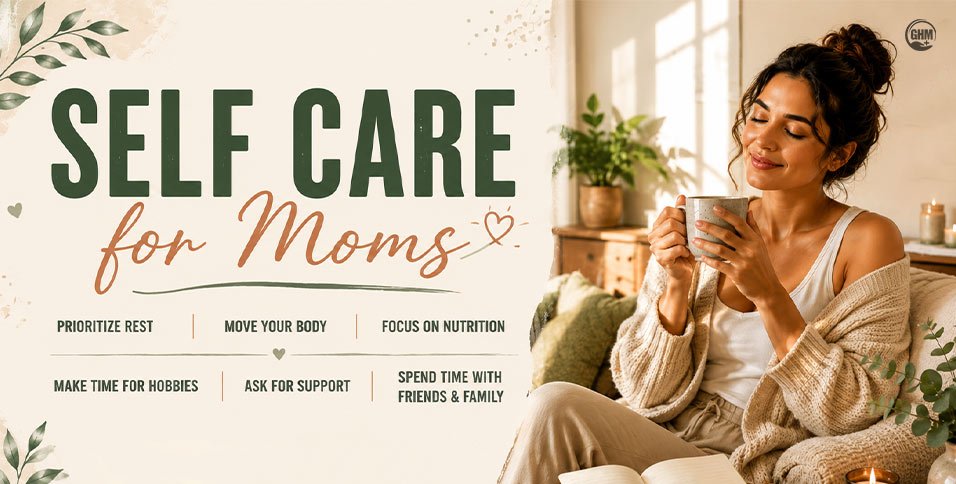
Motherhood comes with a workload that rarely shows up on a to-do list. Between school runs, meal prep, work deadlines, and bedtime routines, most mothers spend their entire day giving.
Maternal mental health conditions are the most common complication of pregnancy and birth, affecting 800,000 families each year in the U.S.
That invisible weight, combined with a culture that praises self-sacrifice in mothers, leaves many women feeling guilty the moment they consider doing something just for themselves. Somewhere along the way, self-care activities for moms got mislabeled as a luxury. In reality, it’s the opposite.
Self care for moms is simply the practice of setting aside small, intentional moments to protect your own physical, mental, and emotional health.
This guide will walk you through a few easy tips on self care for moms that you can start today, without adding guilt or a single extra hour to your calendar.
What Self Care For Moms Really Means?
Self care for moms means intentionally protecting your physical, mental, and emotional health through small, consistent daily habits.
Self-care is not the same as self-indulgence. But self-care for moms is the unglamorous, everyday stuff like drinking enough water, going to bed on time, saying no when you’re overextended. Self-care is proactive, not reactive; it’s meant to prevent burnout, not just recover from it.
Every mother’s version of self-care looks different. For one mom, it’s a quiet cup of coffee before the kids wake up. For another, it’s a Saturday morning run or a phone call with a friend.
There’s no single formula for motherhood and self-care; what matters is choosing habits that genuinely restore you, and repeating them consistently enough that they become part of your routine rather than an occasional treat.
Simple Daily Habits To Add In Self Care For Moms
The mental load of motherhood is real, and so are the risks of ignoring your own well-being. But you don’t need a total lifestyle overhaul to feel better. Small, consistent healthy habits for mothers add up to real change over time.
1. Prioritize Rest
Adults should aim for seven to eight hours of sleep nightly. Sleep affects your mood, energy, immune system, and ability to cope with stress. Therefore, try a consistent bedtime routine and go to sleep on time. As a mother, you deserve complete rest to face the day ahead. Do not compromise on that. A rested, emotionally regulated mom also communicates more patiently and models healthier coping habits for her children.
2. Move Your Body
As a mother, you will not get time to join the gym. However, roughly 150 minutes of moderate activity a week can give real benefits to your heart health, mood, and energy. To achieve that, you need to spend just 20 minutes of your day, and a brisk walk counts.
3. Focus on Nutrition and Hydration
Balanced meals and steady hydration keep energy and focus stable throughout chaotic days. Get nutrition on your plate with lean proteins, whole grains, fruits, and vegetables. Also, don’t forget to keep a water bottle within reach; six to eight cups a day is a reasonable daily target.
4. Make Time for Reading
Even ten minutes with a book can lower stress and give your mind a genuine break from parenting logistics. Keep a book on your nightstand, in your bag, or read an e-book for stolen pockets of time.
5. Make Time for Hobbies
Sometimes while being a parent, you forget that you are a whole other person outside of a mom. Reconnecting with something you loved before having kids, such as cooking, gardening, or sports, offers a sense of identity and joy.
You can also learn some new skills or hobbies unrelated to parenting, which can help build confidence and keep your mind engaged.
6. Take Regular Breaks
As a mother, you need your own space away from the child for some time. Short breaks throughout the day, even five minutes, prevent the slow burn of exhaustion. A short walk outside, even around the block, counts as meaningful self care for moms.
7. Journal Your Thoughts
Writing down your thoughts helps process emotions and spot patterns in what’s draining you. A few sentences a day, not just bad parts but also good, is enough to clear your mind and understand. Moreover, naming a few good things each day, however small, can shift your mood and outlook over time.
8. Set Healthy Boundaries
Learn to say no to extra commitments, favors, or events that don’t serve you. It protects your limited time and energy as a mother. A boundary isn’t a rejection of others, but a form of self care for moms that focuses your energy on what is important rather than what is draining you.
9. Learn Healthy Ways to Manage Emotions
Noticing difficult feelings instead of pushing them down is a part of self care for moms that should not be avoided. If you are feeling an emotion, then respond to it with self-compassion, rather than self-criticism, just as you’d do with your child. It can help you be resilient over time.
10. Try Deep Breathing Exercises
Slow, controlled breathing activates your body’s natural relaxation response. But, in the chaotic life of parenthood, a relaxed mind is hard to find. So, whenever you feel your stress spike, try inhaling for four counts, holding for four, and exhaling for four the next time. A few minutes of focused breathing can regulate stress hormones, improve focus, and build resilience in the middle of a busy day.
11. Ask for Support
Becoming a mother and parent can be so exhausting that you cannot always do it on your own. Most of the time, it requires a village to take care of a child. Get support from your partner, relative, or friend whenever needed. Normalize it in your household and do not feel guilty or ashamed about it. It’s a form of self care for moms.
12. Spend Time with Friends & Family
Isolation makes stress management for moms very difficult. Whether it’s a parenting group, neighbors, or a trusted circle of friends, having people to call during hard times makes motherhood feel manageable.
Spending time with friends and family can have a big impact on the mental and emotional health of a mother. Even a quick phone call or coffee catch-up can restore your sense of self outside the parenting role.
Meaningful conversations and shared moments with extended family and social circle strengthen your support network and remind you that you’re not carrying everything alone.
How Moms Can Make Time for Self-Care
The biggest barrier to self care for moms isn’t desire; it’s time. These strategies can make self-care for busy moms possible:
- Schedule self-care checklist for moms like any important appointment. If it’s on the calendar, it’s hard to skip.
- Start with 5–10 minute self-care breaks. Focus on consistency rather than perfection. Short and consistent self-care habits can go a long way.
- Pair self-care with existing routines. Stretch while coffee brews, or listen to a podcast during the school pickup drive.
- Delegate household responsibilities where you can, and let go of doing everything your way.
- Ask for help without guilt. Needing support doesn’t mean you’re failing. It is your first time too.
When to Seek Professional Support
When things get harder than daily stress, self-care can not be enough. It isn’t a substitute for professional care for a mother’s medical and mental health.
Reach out to a doctor or licensed mental health professional if you notice:
- Persistent anxiety or sadness
- Depression that doesn’t lift
- Severe burnout or exhaustion that rest doesn’t fix
- Ongoing sleep disturbances
- Emotional numbness
- Difficulty functioning in daily life
- Signs of postpartum depression or anxiety
Maternal mental health conditions are common and highly treatable, yet roughly 75% of women affected go undiagnosed or untreated. Recognizing the warning signs in mothers early and reaching out for support can prevent long-term burnout and protect both you and your family.
Final Thoughts: Progress Over Perfection
Self care for moms isn’t a reward you earn after everyone else’s needs are met—it’s what you deserve for providing for everyone. The mental load of motherhood is real, and so are the risks of ignoring your own well-being. But you don’t need a total lifestyle overhaul to feel better.
Small, consistent self-care habits like drinking more water, stepping outside for 20 minutes, and spending time socializing can make enough difference.
Pick one small habit from this guide and start today. Progress, not perfection, is what actually makes you a healthier, happier mother.
If you’re experiencing persistent feelings of anxiety, sadness, or emotional overwhelm, consider talking with a healthcare provider or mental health professional. Support is available, and reaching out is a sign of strength, not weakness.