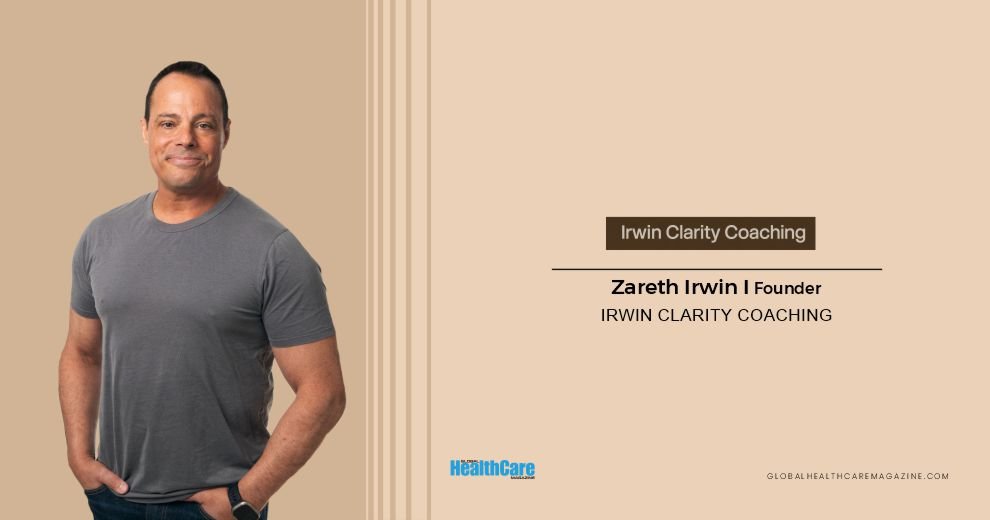
There is something almost too precise about the sequence of events that changed Zareth Irwin’s life. In October 2024, he broke his clavicle during a jiu-jitsu session. He did not think much of it. Injuries happen, and he had a clinical schedule to keep. He went back to work.
In the emergency department over the following days, he underwent imaging and lab work, the same kind of workup he had ordered for thousands of patients over twenty years. What those results showed was not a complicated fracture requiring extra rest. They revealed an undiagnosed cancer. A physician who had spent two decades holding space for others in their most frightening moments was suddenly facing his own.
The course of treatment, which included a bone marrow transplant and ongoing chemotherapy, made a return to clinical emergency medicine inadvisable. The career Dr. Irwin had built, the identity he had inhabited for twenty years, would need to transform entirely. What he chose to do next says everything about the kind of physician, leader, and human being he is.
The Emergency Room as a School of Leadership
Zareth Irwin, MD, MS, FACEP, is the founder of Irwin Clarity Coaching and one of the most distinctive voices in physician and executive leadership coaching today. His path to this work was built across two decades of clinical emergency medicine, beginning with his emergency medicine residency, completed in 2007 at UC Irvine, followed by a point-of-care ultrasound fellowship, known as POCUS, also at UC Irvine, in 2008.
Over the years that followed, Dr. Irwin practiced at West Anaheim Medical Center in Anaheim, California, from 2007 to 2010; at Legacy Good Samaritan Medical Center in Portland, Oregon, from 2008 to 2015; and at Legacy Emanuel Medical Center, also in Portland, where he was an attending physician from 2015 to 2025. He served as POCUS Co-Director at Legacy Medical System from 2009 to 2019, sat on the Board of Directors and Finance Committee of Northwest Acute Care Specialists from 2022 to 2025, and in 2025 stepped into the role of Medical Director at US Medical Directors, a position he holds today. Alongside his clinical career, he founded three ventures: Lotus Brand Chai Tea, MD Delivered, and Dr. Z’s Weed Cream.
None of this is simply a résumé. It is the map of someone who was always, at every stage, trying to understand what it costs to lead in medicine and what happens when that leadership goes without adequate support.
“Emergency medicine teaches you to make high-stakes decisions under pressure with incomplete information, while holding space and tenderness for your team and patients,” Dr. Irwin says. He loved it deeply. The clinical demands, as considerable as they were, were never the hardest part of the work.
“The hardest part was never the medical decision-making. It was the leadership,” he reflects. The self-awareness required to remain level-headed during life-and-death situations, to set personal beliefs aside and prioritize the patient, the family, and the team all at once, was, in his words, an acquired skill. That quiet observation carries the seed of everything he now does.
The Question He Answered at Eight
When Dr. Irwin was eight years old, someone asked him what he wanted to be when he grew up. He said he wanted to cure cancer. He did not fully understand what that meant at the time.
Years later, the weight of that answer would become one of the most defining details of his life. It was he himself who diagnosed his own cancer while working a shift in the emergency department. The childhood ambition and the adult reality arrived in the same room, in the most unexpected way possible.
It is the kind of detail that, in a lesser story, might feel too neatly symbolic. In Dr. Irwin’s telling, it simply illustrates how completely life can circle back on itself, and how a child’s instinct toward alleviating suffering can take forms you would never have thought to anticipate.
A Fracture, a Diagnosis, and a New Direction
When the recommended course of treatment made it clear that a return to clinical emergency medicine was inadvisable, Dr. Irwin was confronted with a kind of uncertainty he had spent his career helping others navigate, this time facing it entirely from the inside.
“My biggest concern, other than my family, was finding a place where I could continue to lean in for humanity,” he says. He reached out to the people who knew him best: friends, colleagues, and mentors. The answer that came back, again and again, was remarkably consistent. “You’re a coach.”
He was not immediately certain. But over time, and through formal training at the Hudson Institute, the conviction took hold. The unmet needs he had observed across twenty years in clinical medicine and medical leadership had never stopped being real. Coaching, he came to understand, was not a departure from his life’s work. “It was an extension of it.”
The Unmet Need at the Heart of Medicine
The physicians Dr. Irwin knows are, by his description, accomplished, self-sacrificing, and deeply committed. They have navigated extraordinary demands to reach the highest levels of one of the world’s most rigorous professions. And yet many of them are quietly struggling. Not from lack of skill. From a lack of a structured space to examine their assumptions and clarify what they actually value.
Medicine invests enormously in technical training. It invests very little in helping its leaders understand themselves and the dynamics of the teams around them. The evidence for physician and leadership coaching is strong, with documented and meaningful improvements in burnout, satisfaction, team cohesion, and leadership effectiveness. Yet access to coaching in medicine remains limited, and the stigma around it is persistent.
“Unlike many other fields where executives see coaching as a way to level up, many physicians see coaching as an admission of weakness,” he says. That cultural gap is precisely what Irwin Clarity Coaching was built to disrupt: creating a space where clinical credibility and rigorous coaching methodology exist together, to the direct benefit of clients, their teams, and ultimately their patients.
Reframing What Leaders Get Wrong
One of the most persistent misconceptions Dr. Irwin encounters, and one he is candid enough to admit he still wrestles with in his own life, is the belief that pushing harder is always the answer.
Leaders have a tendency to equate exhaustion with commitment. He reframes it plainly: exhaustion does not signal dedication. It signals depletion.
He is equally precise about a distinction that is frequently missed, and that carries significant practical weight. Burnout and moral injury are not the same condition. Burnout is the chronic depletion that results from being under-resourced in relentlessly demanding situations. Moral injury is a different wound entirely: it accumulates when a person is repeatedly required to act in ways that violate their values because the system demands it.
“Treating moral injury with a resilience workshop is like treating a fracture with cough medicine,” he says. Sustainable high performance, in his framing, requires resilience and self-awareness working together. Self-discipline on its own is not sufficient, and pretending otherwise only compounds the problem.
Four Pillars, One Direction
Irwin Clarity Coaching is organized around four pillars: Clarity, Authenticity, Resilience, and Equanimity. They are not simply a framework. In Dr. Irwin’s design, they are a sequence with its own internal logic, each one building on the last.
Clarity is the starting point. Understanding your values and priorities creates the conditions for authentic living. Authenticity, once grounded in that self-knowledge, produces coherence in how a leader engages with others. It earns genuine trust and becomes a sustainable source of energy.
From that foundation, resilience becomes accessible. Not the version that means returning to exactly where you were, unchanged, but something more durable: moving through difficulty without losing your direction.
And then there is equanimity, perhaps the most distinctive of the four. Dr. Irwin traces its roots to Stoic philosophy and to the lived experience of holding space in clinical crisis. He defines it as “the capacity to stay present and grounded in uncertainty.” In the emergency room, equanimity was a survival skill. In a leadership context, he says, it becomes a competitive advantage.
Meeting Leaders Where They Are
Dr. Irwin works with three distinct groups: C-suite healthcare executives managing high-stakes decisions and organizational complexity; senior leaders across industries who are high-performing but either reaching for the next level or running quietly on empty; and physicians navigating burnout or stepping into formal leadership for the first time.
The underlying human dynamics, he is careful to note, tend to be similar across all three. Identity, values, ego, and fear show up in every room. But context shapes the work considerably.
With executives, the focus is on what he calls the feedback gap: the way honest input narrows as a leader rises. His work involves helping them rebuild genuine internal feedback mechanisms, develop their emotional intelligence, and create space to test new ideas before bringing them to their teams.
With physicians, he works within the specific identity framework that medical training constructs: the belief that uncertainty equals incompetence, and that asking for help signals weakness. His aim is to help them reconnect with what first drew them to medicine, the joy of the practice, and the profound gift of being intimately involved in the health and well-being of others.
With senior leaders navigating transitions, he draws on the insights of Herminia Ibarra, whose work reframes upward leadership moves not merely as role changes but as opportunities for genuine self-transformation. “The move up is not just a role change,” he explains. “It is a self-change that allows unique opportunities for transformation.”
What Real Change Looks Like
There is a tendency to expect transformation stories to arrive fully formed: immediate, dramatic, and unmistakable. Dr. Irwin is candid that the work rarely looks that way, especially at the beginning.
Early sessions bring small shifts. They are not always obvious in the moment. But within a few sessions, the cumulative effect of those smaller changes becomes visible in ways that are difficult to dismiss.
A leader who used to react defensively begins to pause before responding. A physician on the verge of leaving medicine reconnects with the reason they entered it. An executive who had been managing from a place of fear starts leading from values, finding more authentic ways to connect with the people around them.
Clients have described the experience of working with him as “the conversation I didn’t know I needed” and “a reset for how I think about my work and my life.” What he watches for most closely is a particular kind of internal movement. “Clients begin to replace defensiveness with curiosity,” he says. They become more capable of sitting with uncertainty without being paralyzed. When a client can describe their own experience with genuine nuance and self-compassion, something real has shifted.
The Hardest Decision
If Dr. Irwin coaches leaders through identity reckonings, it carries a particular kind of weight because he has lived through one of his own, and it was not a small one.
Leaving clinical medicine after twenty years was, by his account, “the hardest decision I have made, and the most clarifying.” Medicine had been his calling, his professional structure, and the daily context in which he connected with his team and showed up for others. Stepping away from it was not a relief. It was a reckoning.
“I knew that being a long-term leader for my children and family required that I make a change,” he says. What carried him through was not certainty about what came next. It was a deep understanding of his values and a commitment to practicing in his own life what he now coaches others to do: staying present with discomfort without being consumed by it.
The Hudson Institute training added its own dimension to that process. For the first time in a long time, he was the learner in the room, not the authority. He describes it as humbling. “Learning to occupy that position gracefully,” he says, “was its own kind of growth.” For a man who had spent twenty years as the expert in the room, learning to inhabit the beginner’s perspective with grace is not a small thing. It is, in many ways, exactly the kind of growth he asks of his clients.
Early Chapters, Meaningful Results
Dr. Irwin is deliberate about the language he uses when describing where Irwin Clarity Coaching stands today. “We are in the early chapters of ICC,” he says, “and I want to be honest about that.”
The milestones that feel most significant to him are relational rather than quantitative. A physician who felt reconnected to their purpose for the first time in years. An executive who, working in collaboration with their team, found a new path to success that resulted in higher-than-expected financial performance. The completion of his Hudson Institute training is a rigorous standard that he is proud to have met.
What matters most to him, in his own framing, is that ICC treats physician well-being as a serious, evidence-based endeavor rather than a wellness afterthought. That distinction is not incidental. It is the entire foundation of the practice.
Where the Field Is Heading
Dr. Irwin describes the current moment in physician and executive coaching as an inflection point. The evidence base is maturing. Healthcare systems are beginning to recognize coaching as a serious lever for both retention and performance, not a peripheral addition to clinical operations.
The future he envisions will require both individual development and systems-level thinking. The work will not stop at helping a single leader understand themselves more clearly. It will extend to helping leaders understand themselves well enough to work within, and at times deliberately reshape, the structures that surround them.
His intended role in that future is clear to him: “a trusted bridge, bringing clinical credibility and coaching rigor together in a way that earns trust with skeptical, high-achieving professionals.”
A Practice Built From the Inside Out
On a typical working day, Dr. Irwin is coaching clients, developing content, and building the systems that allow people to actually find and access the practice. The coaching sessions are the core: there is, in his view, no substitute for excellent coaching done with genuine presence. He also loves what he calls the synthesis work, translating clinical experience and rigorous coaching methodology into something both accessible and evidence-grounded. And the structural work of building systems matters just as much as what happens inside a session. “You cannot serve people you cannot reach,” he says.
He applies the same intentionality to his own life. His daily practice includes meditation, journaling, and exercise. He spends time in nature and takes cold plunges regularly. His spouse is an obstetrician, which means their household shares a bone-deep understanding of what high-stakes human work actually demands. He reads broadly, works with a mentor, and, by his own telling, cuddles his kids every chance he gets. “I practice what I coach,” he says, and the evidence of his own life makes that entirely credible.
The philosophy that ties all of it together is also the one he brings into every coaching relationship. “Opportunity is everywhere, especially in adversity. You do not have to have everything figured out to lead well. You just have to be willing to keep looking and be open to finding answers everywhere.”
When Dr. Irwin was eight years old, he wanted to cure cancer. The road that brought him here, through emergency rooms in California and Oregon, through jiu jitsu and a fractured collarbone, through a cancer diagnosis he made on himself, a bone marrow transplant, and a complete professional reinvention, was not the road he would have drawn. But it is, unmistakably, the one he was built to walk.
Quotes

Also Read: The Most Influential Physician Leaders & Executive Coaches in 2026