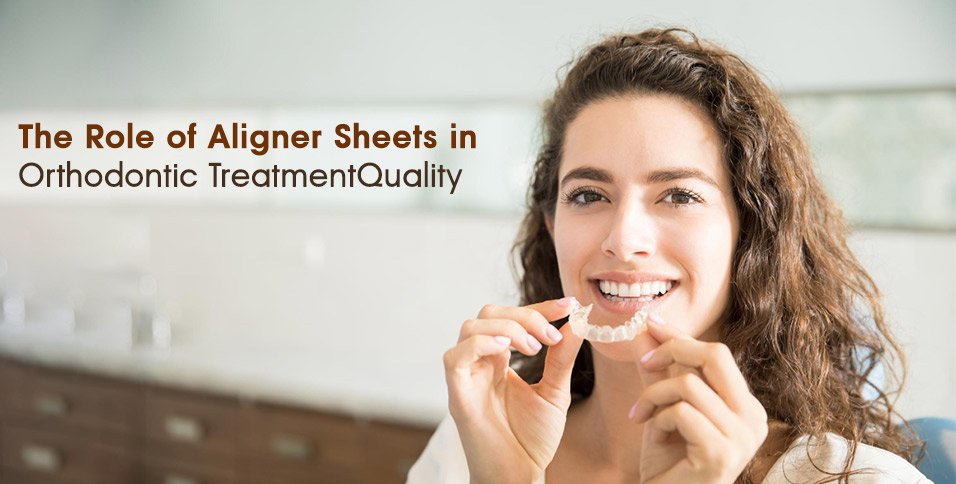
In today’s clear aligner market, the material sheet will play a much bigger role. Many people don’t realize this. It affects how the aligner will form, how it will perform during wear and how consistently the results will deliver. For dental labs, manufacturers and other brands, choosing the right aligner sheet is not only a technical decision but a business one as well. Let’s take a closer look at why the right sheet will make all the difference.
What are aligner sheets?
They are thermoformable multiplayer thermoplastic materials. They work by controlled orthodontic forces. This behaviour makes sure:
- Forces are delivered correctly and gradually.
- Stress is relaxed over time.
- It is crack resistant and durable.
- Flexible
- Optical clarity
This means your aligners have:
- No or reduced mid-course corrections
- Lower customer complaints
- Stronger loyalty
When the material gives you this, it improves clinical confidence. Some fluctuations in thickness, flexibility or stress retaining properties can affect the staging. Mostly in complex movement cases. Which involves rotation or extrusion.
Material composition: Why aren’t all sheets equal?
All transparent sheets may look identical. But there are differences at the molecular level.
1. Polyurethane (PU)
- Highly elastic
- Force retention is excellent
- Tear resistant
- Chosen for sustained force delivery
2. PET-G
- Superior in clarity
- Affordable
- Thermoforming is easy
- Force consistency is moderate
3. Multilayer composite
- Strength and clarity are combined
- Stress relaxation is optimised
- Increased durability
It has often been noticed that materials which are cost-effective can compromise on certain factors. Like crack resistance or transparency for a long time. They start fogging, deforming or whitening prematurely.
Material composition
At a basic level, transparency is in how the material reacts with the light. A material appears transparent when light passes through it without scattering. This depends on the internal structure. The molecular chains are arranged in a way that minimises irregularities. Key factors are:
- Polymer composition
- Most high quality sheets are made from polyurethane, PET-G, or multilayer copolyesters.
- They avoid scattering light.
- Controlled extrusion
- Even the best raw polymer can lose clarity during extrusion. High end extrusion process makes sure the thickness is uniform and internal stress is less.
- Surface finish and smoothness
- Sheets with a smoother surface allow light to pass easily. Rough surfaces cause interference.
Why does transparency in sheets matter?
At a basic level, transparency depends on how the material will interact with the light. A material which appears clear when light passes through it with minimal scattering. This is decided by the internal structure of the polymer and how consistently it is manufactured.
Key factors include:
- Polymer composition: High-quality sheets are usually made from polyurethane, PET-G, or multilayer copolyesters. They avoid light scattering.
- Controlled extrusion: Even a good raw polymer can lose its quality. If the extrusion process is inconsistent. Controlled extrusion will help maintain uniform thickness and internal stress.
- Surface finish: A smooth surface will allow the light to pass more easily. Rough material can reduce clarity.
Why should you choose transparent aligner sheets?
It’s easy to assume transparency is just for patient comfort. But it’s a clinical decision.
- Stronger positioning of the brand
- Patients often see invisibility with innovation.
- When aligners stay transparent even in the presence of saliva, temperature changes, and staining agents, it reflects positively on you.
- Reduced refinements
- Materials that have optical clarity also demonstrate better stress resistance and crack resistance.
- These reflect tracking accuracy.
- Better tracking means less refinement.
- Here, the operational costs are also saved.
- Improved patient compliance
- Patients are motivated to wear aligners when they are transparent.
- Staining, cracks or even whitening affects their confidence.
- Manufacturing efficiency
- A sheet that retains optical clarity even during formation shows it has better thermal stability and less stress internally.
- Remake cycles are reduced.
- Long-term wear
- Aligners should maintain transparency even when exposed to an oral environment.
- Poor quality sheets may absorb water and develop microfractures.
Advanced sheets in the market, like the ones provided by Taglus reduce these issues without affecting biomechanics.
Material choices shape market leaders
At the end of the day, success of aligner treatment depends on a lot of factors. The material chosen is one of them. For dental labs, aligner brands and orthodontists, transparent aligner sheets are a strategic investment. Not just a checkbox. The right material makes a lot of things easy. This includes brand credibility as well.
In a market where competition grows each year, material decides who thrives and who struggles. Make sure your decision is clear.
Also read: The Hidden ROI of Clinically Integrated Network (CIN) Accreditation