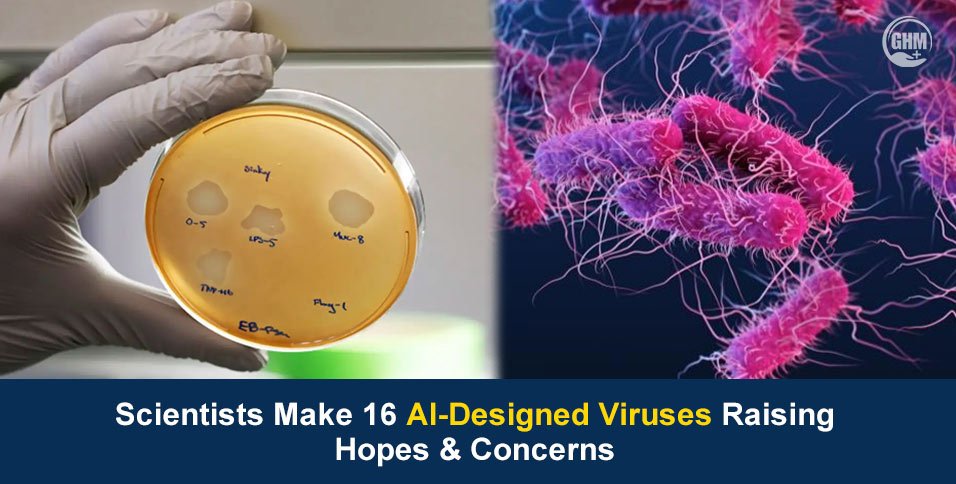
Stanford University and Arc Institute researchers have created 16 AI-designed viruses in the laboratory for the first time, marking a major step in AI in medical research. The researchers have used genetic sequences generated by artificial intelligence, genome language models to design bacteriophages (viruses that infect bacteria).
Research used two models, Evo 1 and Evo 2. and 16 of the designs proved viable in laboratory tests. Some also showed stronger activity against E. coli than the bacteriophage used as the starting model. The AI produced about 700,000 potential designs, from which researchers selected 285 for laboratory testing. Sixteen ultimately produced viable bacteriophages.
The Stanford AI virus research breakthrough could eventually support new approaches to antibiotic-resistant infections, but scientists say the technology also creates important safety and governance questions.
AI-Designed Viruses Could Help Fight Antibiotic Resistance
To create AI-designed viruses phage therapy is used. This approach uses bacteriophages to target bacteria and has long been investigated as a potential option for infections that no longer respond well to antibiotics.
In the study, some AI-designed bacteriophages were more effective against E. coli than the original ΦX174 phage. A cocktail of the new phages also overcame resistance in two E. coli strains during laboratory testing.
That could eventually make it easier to develop bacteriophages tailored to particular bacterial targets. However, the findings remain an early laboratory demonstration. They do not establish that AI-created viruses are ready for use as treatments in patients.
The development of AI-designed viruses adds to growing research into AI in healthcare, including efforts to use artificial intelligence for drug discovery, biological design and infectious-disease research.
Scientists from University of Cambridge had previously created an AI-designed vaccine to fight viruses which provides broader protection against entire virus families rather than targeting a single strain.
AI-Generated Viruses Raise Biosecurity Concerns
The researchers in this studay took several precautions while creating viruses designed with AI. Their models excluded genetic information from viruses known to infect humans and animals, while the experiment focused on a bacteriophage that targets E. coli. The work was also performed in a secure laboratory.
Even so, experts warned that the underlying capability could create risks if similar technology were applied to pathogens affecting humans, animals or plants.
In a commentary published alongside the study, Johns Hopkins University experts Thomas Inglesby and Moritz Hanke said, “Although this is promising for life sciences applications, it also raises urgent biosafety and biosecurity questions.” They added that “the ability to compose viral genomes using generative AI now exists; the governance to safely steer it does not.”
Those concerns extend beyond AI-made synthetic viruses themselves. Scientists are also considering safeguards around model access, research oversight, DNA synthesis screening and laboratory safety.
The Future of The Breakthrough AI-Designed Viruses
The Stanford study on AI-generated viruses does not show that AI can independently create dangerous human viruses, and researchers stressed that their work was limited to bacteriophages. Whether the same approach could reliably produce more complex viruses remains unknown.
Experts have also emphasized that the current technology still requires laboratory construction and testing to determine whether the AI-designed viruses are viable. This means the immediate public health risk remains limited, but future advances could change the risk landscape.