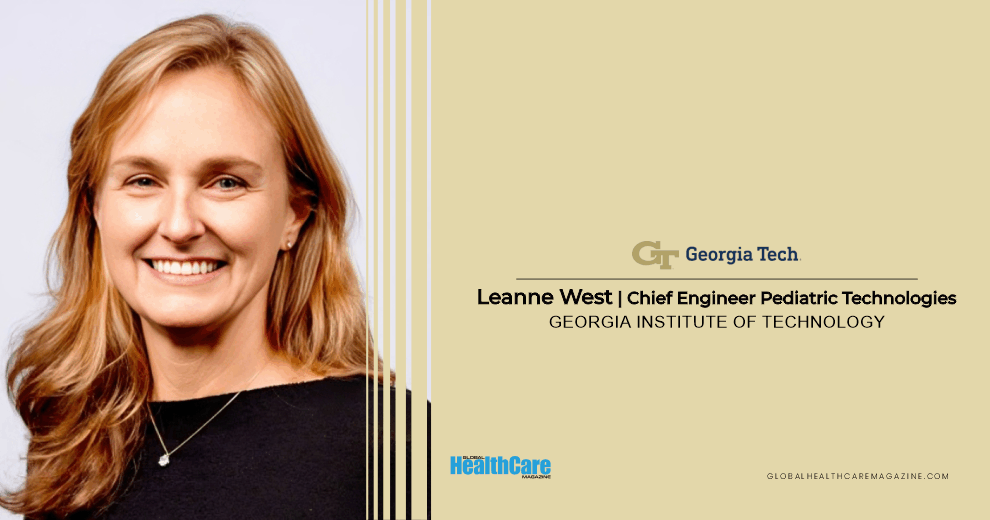
A wireless microphone clipped to a lapel, a private stream of text scrolling across a small handheld screen, and somewhere in a crowded auditorium, a teenager who is deaf can finally follow every word of her own graduation speech. That small mechanical miracle, a personal captioning system built from equal parts stubbornness and curiosity, was patented and brought to market by an engineer who has spent more than twenty-five years treating hospitals the way most people treat their own kitchen: as a place to walk in, look around, and figure out what is missing. Her name is Leanne West, and the wireless captioning device is only one line on a résumé that reads like an inventory of problems nobody else thought to fix.
An Engineer Who Never Left the Building
West’s title today is Chief Engineer of Pediatric Technologies at the Georgia Institute of Technology, alongside her role as Principal Research Scientist at the Georgia Tech Research Institute. She joined Georgia Tech as a Research Scientist in 1994 and later became Principal Research Scientist at the Georgia Tech Research Institute in September 2007. She has served as Chief Engineer of Pediatric Technologies since November 2013.
Today, her work through the Pediatric Innovation Network centers on connecting researchers, engineers, and clinicians to identify unmet pediatric needs and move solutions toward clinical impact. Across that stretch of time, she has led multimillion-dollar programs and teams of researchers who build products for government and industry partners, the unglamorous machinery of innovation that rarely makes headlines but keeps hospitals years ahead of what patients ever see.
Before any of that, West taught physics at Brandon Hall High School from 1992 to 1993, working, in the words she uses to describe her own former students, with “academic underachievers.” She has been candid about the fact that the job does not fit neatly into the box LinkedIn labels ‘higher education,’ a small, wry detail that says something about how literally she takes the task of describing her own work. Her education traces back further still, to six years as a student at the Harpeth Hall School, from 1981 to 1987. She later earned a bachelor’s degree in physics and mathematics from Vanderbilt University and a master’s degree in physics and electrical engineering from Georgia Tech.
The Company Born From an Idea
Between 2009 and 2018, West stepped outside the university to become President and CEO of Intelligent Access, the startup she built around her own invention: a wireless personal captioning system designed to help venues provide real-time captions for people who are deaf or hard of hearing. It is the kind of founder story that rarely gets told in full: an engineer who did not simply publish a paper about accessibility, but built a company to put the technology into public spaces where it could actually be used.
Where the Hospital Meets the Laboratory
For more than a decade, West has functioned as the technical liaison between Georgia Tech and pediatric hospitals around the world, with Children’s Healthcare of Atlanta and Shriners Hospitals standing as her main partners. Her job, in her own description, is to work closely with clinicians to understand and identify the problems that need solving, so that doctors and nurses can take better care of their patients.
That clinician-driven approach remains central to the Pediatric Innovation Network, where every funded project begins with a clinical need and brings pediatric clinicians together with Georgia Tech engineers or scientists. She is also an invited judge for numerous medical device pitch competitions and sits on several boards across the healthcare and technology industries, a schedule that would exhaust most people working a single job.
A Global Voice for Young Patients
Since January 2017, West has served as President of the International Children’s Advisory Network, known as iCAN, which has worked since 2014 to foster a greater global understanding of the importance of the pediatric patient and caregiver voice in healthcare, clinical trials, and research.
Through iCAN, young patients and their families are given the chance to share their stories directly in front of organizations including the FDA, the American Academy of Pediatrics, and the CDC, and at conferences around the world. iCAN is an official partner of the FDA’s Center for Devices and Radiological Health through the Patient and Caregiver Connection Partner program and the Total Product Life Cycle Advisory Program, formal recognition of the kind of access iCAN has built for children who are so often discussed in medicine but so rarely asked to speak for themselves.
Living the Advocacy She Practices
West’s commitment to patient advocacy is not an abstraction borrowed from her job description. She is also a patient living with two rare diseases, and for one of them, sarcoidosis, she has become an advocate in her own right, serving on the Patient Advisory Council and Speakers Bureau of the Foundation for Sarcoidosis Research.
A Long Record of Recognition
The honors attached to West’s name span two decades. She was twice elected Chair of the Georgia Tech Executive Board, in 2007 and again in 2008, and she chaired Georgia Tech’s State Charitable Campaign in 2017. Georgia Trend magazine named her one of Georgia’s ‘40 Under 40’ in 2004. She was selected for Leadership Georgia in 2008. In 2012, she was part of the team awarded the international Optical Society’s Paul F. Forman Engineering Excellence Award.
Georgia Tech recognized her with its Outstanding Achievement in Research Enterprise Enhancement Award in 2014, the same year Women in Technology named her its Woman of the Year. In 2017, the late Speaker of the Georgia House of Representatives, David Ralston, appointed her to the board of the Georgia Technology Authority, where she serves as a Board Member. In 2024, the University System of Georgia recognized her as a Regents’ Researcher. In 2026, the Atlanta Business Chronicle named her an Innovator of the Year in Pediatric Health.
A New Chapter at Shriners
Most recently, in January 2026, West added another title to an already crowded résumé, becoming Chief Research and Innovation Officer at Shriners Children’s, where she is helping advance research and innovation across the organization. It places her, once again, at the exact intersection where she has spent her career: standing between the people who build the technology and the children who need it to actually work.
Taken together, West’s career resists easy summary. She has been an engineer, an entrepreneur, a patient advocate, a physics teacher, a board member, and now, once more, a hospital innovation chief. But one thread runs through all of it without a single break.
For more than thirty years, she has insisted that the people closest to a problem, whether a person who needs accessible communication or a child undergoing treatment in a pediatric hospital, deserve a say in the solution built for them. Her career has repeatedly brought together clinical needs, engineering expertise, patient voice, and the resources required to move ideas from research toward real-world care.
Read More: Leaders Advancing Pediatric Care & Health Tech Innovation 2026