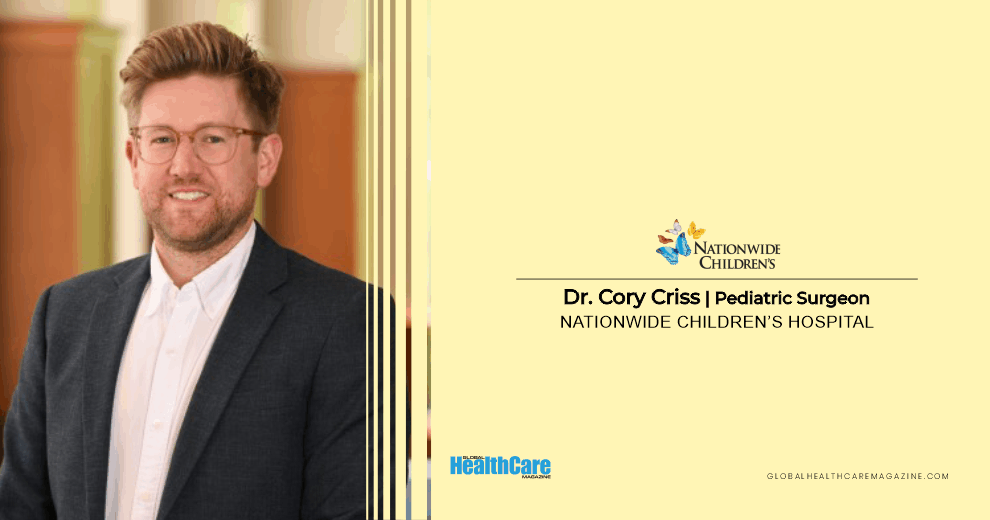
Six point nine five million dollars, distributed over five years, is not the kind of number that appears on a hospital directory without years of grant applications, site visits, and quiet negotiation behind it. It is the size of the FDA grant supporting a federally funded consortium built to move pediatric medical devices out of a sketch and into clinical use, bringing together institutions and partners across Ohio. Its co-principal investigator and Chief Operating Officer is Dr. Cory Criss, a pediatric surgeon whose résumé reads like a decade-long argument that operating on children and developing better tools to treat them are not two separate careers, but one.
A Long Apprenticeship, From Cleveland to Ann Arbor
Dr. Criss’s training was long even by the standards of surgery, a field that already asks more years of its trainees than almost any other. He spent seven years as a General Surgery Resident at University Hospitals in Greater Cleveland, from July 2013 to June 2020, the kind of stretch that turns a young doctor’s twenties into a single long rotation of call schedules and operating rooms.
In the middle of that residency, from July 2016 to June 2017, he took a year to serve as a Surgical Innovations Fellow in the Pediatric Surgery Department at the University of Michigan Health System in Ann Arbor, an early signal of where his interests were already heading, well before ‘innovation’ became a title he would hold himself.
He returned to Michigan Medicine the following year, from August 2017 to July 2018, as a Clinical Fellow specializing in surgical critical care, adding a second layer of subspecialty training on top of general surgery. Two years later, in August 2020, he came back to Ann Arbor once more, this time as a Surgery Fellow working full time as a Pediatric Surgeon at Michigan Medicine, a position he held until September 2022.
By the time he left Michigan, he had spent nearly a decade moving between the operating room and the fellowship programs built to expand what a surgeon is trained to do, a long apprenticeship that reads, in hindsight, like preparation for a job that did not exist yet.
Building an Innovation Center From the Ground Up
In September 2022, Dr. Criss moved to Nationwide Children’s Hospital and became the Founder and Director of its Innovation Center, a program he has directed ever since. The Center is an internal hospital accelerator with a full-time biomedical engineering team focused on identifying unmet clinical needs, developing devices, and moving innovative projects forward.
It has expanded into a hospital-wide innovation platform, supporting project development, prototyping, technology commercialization, educational programming, and the cultivation of new medical innovators. Its programs include an innovation fellowship, an Advisor in Residence network, and an innovation bootcamp, creating a pipeline for clinicians and other innovators to develop ideas into practical solutions for pediatric care.
What stands out about that list is how little of it resembles a traditional surgical department. Project evaluation and market guidance are the language of business incubators, not operating rooms, and yet he has folded them into a hospital that also happens to employ him as a full-time surgeon. The bootcamp and the fellowship suggest something more than a side project: an attempt to train the next generation of clinicians to think like inventors before they ever pick up a scalpel.
Life in the Operating Room
Alongside that innovation work, Dr. Criss has practiced as a Pediatric Surgeon at Nationwide Children’s Hospital since September 2022. He serves as Co-Director of the hospital’s ECMO program and as Program Director of Surgical Critical Care, and his clinical practice includes esophageal and thoracic disease, ECMO, critical care, and pilonidal disease. It is worth pausing on that combination. Few surgeons run a critical care program, co-direct an ECMO service, operate on children with complex esophageal and thoracic conditions, and direct a hospital-wide innovation center in the same working week.
Leading a Six Point Nine Five Million Dollar Consortium
In 2023, Dr. Criss became Principal Investigator, Chief Operating Officer, and co-principal investigator of the Midwest Pediatric Device Consortium, an FDA-funded initiative supported by a $6.95 million grant distributed over five years. The consortium is led by Nationwide Children’s Hospital and The Ohio State University and includes Cleveland Clinic Children’s, Cincinnati Children’s Hospital, Ohio Life Sciences, Rev1 Ventures, and other regional healthcare, academic, and industry partners.
The consortium exists to support pediatric device development, evaluation, funding, regulatory progress, clinical partnerships, and commercialization, the entire chain of work standing between a good idea for a child’s medical device and a device a surgeon can actually use on a child.
As Chief Operating Officer, he helps lead operations, strategy, and collaboration across the consortium. Coordinating multiple institutions and industry partners, each with its own leadership, its own review processes, and its own priorities, is its own kind of work, one performed through meetings and memoranda instead of instruments, and it demands the same patience for slow, exacting process that the operating room requires.
The scale of the opportunity is significant because pediatric medical devices remain comparatively underserved. The MPDC was created specifically to increase the number of medical devices developed for children and to provide inventors with funding, resources, networking, clinical-trial infrastructure, and commercialization support.
Three years into building the consortium and four years into leading an innovation center, Dr. Criss now holds a rare position in pediatric medicine: a surgeon who still operates, still directs a critical care program, and still helps run a multi-million-dollar pediatric device consortium. It is a career built the same way his training was: one fellowship, one program, one hospital at a time, until the individual pieces added up to something considerably larger than a single operating room.
What began as a residency in Cleveland and a curious detour into a Michigan innovation fellowship has become a broader effort to make sure the next generation of pediatric devices reaches the children who need them, with surgeons and clinicians having a meaningful voice in how those devices are designed and developed.
Read More: Leaders Advancing Pediatric Care & Health Tech Innovation 2026