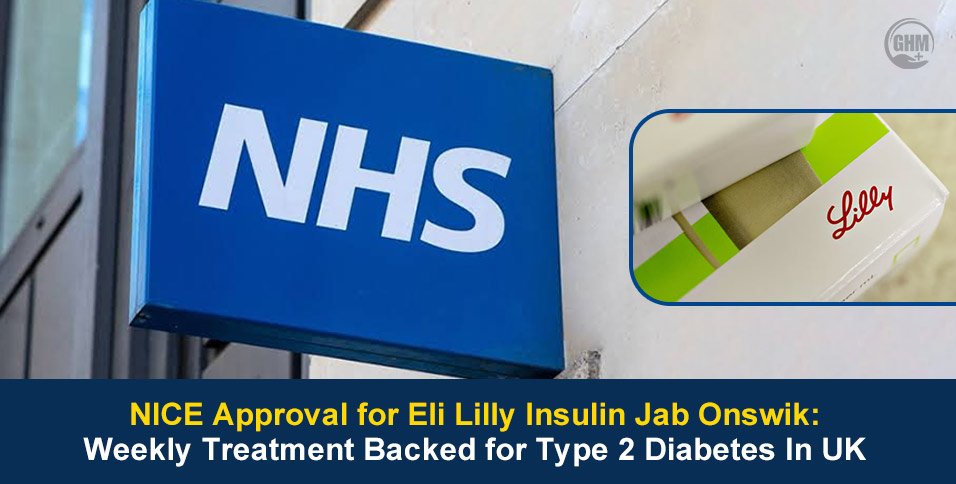
The National Institute for Health and Care Excellence (NICE) has recommended Eli Lilly’s Insulin jab, Onswik, once-weekly treatment for adults with type 2 diabetes. The NICE approval for Eli Lilly insulin jab has moved approval in the United Kingdom a step closer.
Eli Lilly’s Onswik treatment, known scientifically as insulin efsitora alfa, could offer an alternative to daily basal insulin injections. However, patients cannot access it through the NHS yet. The Medicines and Healthcare products Regulatory Agency (MHRA) approval for Onswik is still required before the treatment can receive final regulatory clearance and move toward NHS availability.
In its final draft guidance, NICE said the Eli Lilly once-weekly insulin could reduce the number of injections for people switching from a daily basal insulin regimen from 365 to 52 per year—an approximately 85% reduction. The treatment is administered once a week under the skin using a pre-filled pen and can be used alone or alongside other diabetes medicines.
What is Eli Lilly Once-Weekly Insulin Onswik?
The Eli Lilly Onswik insulin Injection contains insulin efsitora alfa, a long-acting insulin designed for once-weekly use.
It belongs to a category called basal insulin, which provides a steady background level of insulin to help control blood glucose. For people with type 2 diabetes, insulin treatment may become necessary when the body does not produce enough insulin or does not use it effectively.
The proposed Eli Lilly once-weekly insulin for type 2 diabetes could simplify treatment for eligible adults by replacing a daily basal insulin schedule with one injection each week.
NICE’s recommendation for Onswik currently applies to adults with type 2 diabetes and remains conditional on regulatory authorisation from the Medicines and Healthcare products Regulatory Agency (MHRA).
Could Approval For Weekly Insulin Injection Reduce Treatment Burden?
The most significant potential benefit of the NICE approval for Eli Lilly insulin jab is the reduction in injection frequency.
For someone taking one basal insulin injection every day, moving to weekly dosing could mean:
- 365 injections per year falling to 52
- Approximately 85% fewer injections
- Less disruption to daily routines
- Potentially fewer visits from carers or healthcare professionals for people who need help with injections
Helen Knight, NICE’s director of medicines evaluation, commented that “ This recommendation is the result of rigorous, evidence-based decision making, striking a balance between the benefits to patients and the best use of limited NHS funding.”
Who Can Benefit From Eli Lilly’s Once-Weekly Insulin?
According to NICE, the Eli Lilly Onswik insulin injection treatment may be particularly useful for people who face difficulties with daily insulin administration.
Potential beneficiaries of Eli Lilly once-weekly insulin could include adults who,
- Are frail
- Have limited manual dexterity
- Experience visual, cognitive or sensory impairments
- Have learning disabilities
- Struggle to follow a daily treatment routine
- Require support from a carer or healthcare professional
Some younger adults with early-onset type 2 diabetes may also benefit if a weekly schedule helps them balance intensive treatment with working life.
However, clear guidance, staff training and fair access will be necessary if the treatment reaches the NHS.
What Do the Eli Lilly Onswik Drug Clinical Trials Show?
The NICE approval for Eli Lilly insulin jab is supported by evidence from three phase 3 clinical trials: QWINT-1, QWINT-3 and QWINT-4.
These studies compared insulin efsitora alfa with commonly used daily basal insulins.
Key findings from QWINT-1
In the Onswik clinical trial, QWINT-1 involved 795 adults who had not previously used insulin. Here, HbA1c—a blood test that reflects average blood glucose levels over time—fell by 1.19 percentage points with weekly efsitora compared with 1.16 percentage points with daily insulin glargine.
The trial demonstrated non-inferiority, meaning the Eli Lilly once-weekly insulin treatment was shown to be not meaningfully worse than the comparison treatment for blood glucose control. Clinically significant or severe hypoglycaemia, or dangerously low blood sugar, occurred less frequently with efsitora in this study.
Evidence from QWINT-3 and QWINT-4
QWINT-3 and QWINT-4 Onswik clinical trials also found that weekly efsitora delivered blood glucose control comparable to daily insulin degludec and insulin glargine in different patient groups. NICE said the overall evidence showed comparable glucose control, although some groups most likely to benefit were underrepresented in the clinical studies.
What Does MHRA Approval for Onswik Mean for NHS Access?
Despite the positive NICE approval for Eli Lilly insulin jab, Onswik has not yet completed the United Kingdom’s regulatory pathway.
The MHRA must first grant marketing authorisation. NICE’s final draft guidance is also subject to the completion of its appeal process.
If the final guidance is published following MHRA authorisation, NHS England would be required to fund the treatment within 90 days.
NICE’s cost analysis suggested that the overall cost of Onswik could be similar to or lower than that of basal insulin administered once or twice daily.
How Will The New Eli Lilly Diabetes Treatment Affect UK Patients?
The NICE approval for Eli Lilly insulin Jab could significantly change how some adults manage type 2 diabetes treatment in the UK.
However, the NHS weekly insulin jab will not necessarily replace daily insulin for everyone. Healthcare professionals and patients will need to consider individual treatment needs, dosing requirements, administration costs and the suitability of available options.
For patients, the main advantage could be a simpler treatment schedule. For carers and healthcare services, fewer injections may reduce the time needed to support insulin administration. If authorised, Onswik could provide eligible adults with a new once-weekly basal insulin option.