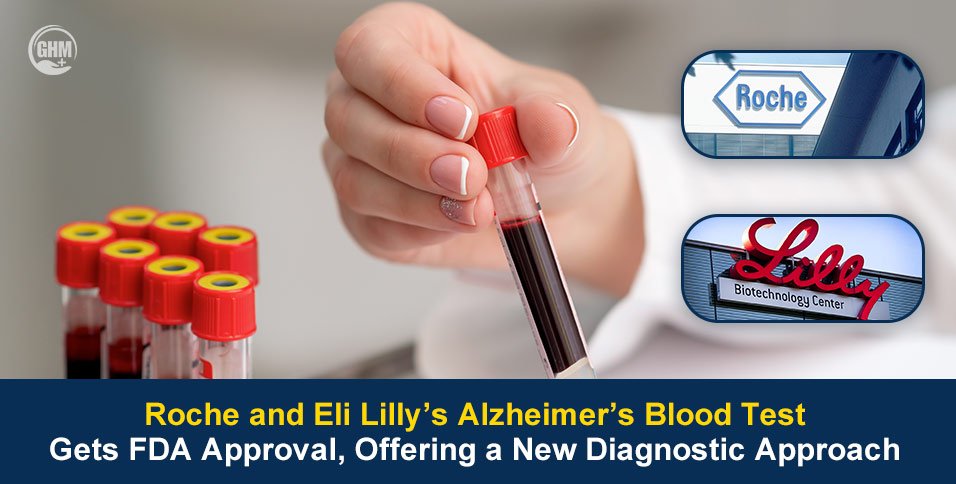
The U.S. Food and Drug Administration (FDA) has approved the Roche and Eli Lilly’s Alzheimer’s blood test. This FDA approval is another major development in efforts to make Alzheimer’s disease assessment less invasive and more accessible. The new Alzheimer’s blood test, called Elecsys pTau217, is designed for adults aged 55 and older who show signs, symptoms, or complaints of cognitive decline.
Roche describes the blood test as the first and only FDA-cleared single-biomarker test that supports both rule-in and rule-out Alzheimer’s assessment of amyloid pathology across primary and specialty care. The Alzheimer’s Association said it is the fourth blood-based biomarker test for Alzheimer’s cleared by the FDA and the second cleared within the past week.
What Is Roche and Eli Lilly’s Alzheimer’s Blood Test?
Roche and Eli Lilly’s Alzheimer’s blood test, known as Elecsys Phospho-Tau (217P) Plasma, measures a biomarker called pTau217.
The new Alzheimer’s biomarker test provides positive, intermediate, or negative result categories to help clinicians evaluate the likelihood of amyloid pathology. However, the test does not independently diagnose Alzheimer’s disease. Doctors must interpret the results alongside symptoms, medical history, cognitive assessments, and other relevant clinical information.
The FDA-approved Alzheimer’s blood test is intended for:
- Adults aged 55 years and older
- People with signs or symptoms of cognitive decline
- Patients being evaluated for possible Alzheimer’s-related brain changes
Roche and Eli Lilly’s Alzheimer’s blood test is not designed as a routine screening tool for people without symptoms. Roche has also emphasized that Elecsys pTau217 should not be used as a standalone diagnostic test.
How Will The New Alzheimer’s Blood Test Transform Diagnosis?
The FDA approval for new Alzheimer’s blood test could shift the blood-based tools for evaluating Alzheimer’s disease. Traditionally, clinicians have relied on amyloid PET scans or cerebrospinal fluid testing to assess amyloid pathology. These methods can be costly, invasive, or difficult for some patients to access.
A new blood test for Alzheimer’s diagnosis could provide a simpler step in the diagnostic pathway and help doctors determine whether further testing or a specialist referral may be appropriate.
“For decades, clinicians have faced significant challenges in accurately diagnosing Alzheimer’s disease in its early stages,” said Dr. Jared R. Brosch, a neurologist at Indiana University Health, in the press release. He added that blood-based biomarkers could expand access to Alzheimer’s evaluation across different care settings.
Why Does the Roche Alzheimer’s Blood Test Stand Out?
One of the key features of the Roche Alzheimer’s blood test is its ability to support both rule-in and rule-out assessment using a single biomarker and the same validated clinical cutoffs across primary and specialty care.
The test is also designed to run on more than 4,500 Roche cobas laboratory instruments already installed across the United States. Reuters reported that Labcorp and Quest Diagnostics plan to offer the test through their laboratory networks, potentially expanding patient access.
This existing laboratory infrastructure could make implementation easier for health systems without requiring entirely new testing equipment.
New Blood Test for Alzheimer’s Diagnosis Has Important Limits
Despite the potential benefits, Roche and Eli Lilly’s Alzheimer’s blood test has important limitations. A positive result does not independently confirm that a person has Alzheimer’s disease, while a negative result does not replace a full clinical evaluation.
The Roche and Eli Lilly’s Alzheimer’s blood test has also not been established for:
- Predicting who will develop dementia
- Predicting other neurological conditions
- Monitoring how a patient responds to Alzheimer’s treatment
The Alzheimer’s Association stressed that no single test can diagnose Alzheimer’s disease on its own and that blood-based biomarkers should be incorporated into a broader clinical evaluation.
What the New Test Means for Alzheimer’s Care?
Roche and Eli Lilly’s Alzheimer’s blood test adds another tool to the expanding Alzheimer’s diagnostic landscape. The FDA cleared its first blood test to aid in Alzheimer’s assessment in May 2025, and the number of cleared blood-based biomarker tests has continued to grow.
The FDA approval for the new Alzheimer’s blood test follows the approval of the test in Australia, making blood-based biomarker testing a new diagnostic tool.
For patients and families facing uncertainty about memory loss and cognitive decline, a less invasive new blood test for Alzheimer’s diagnosis could help bring assessment closer to primary care and existing laboratory systems.