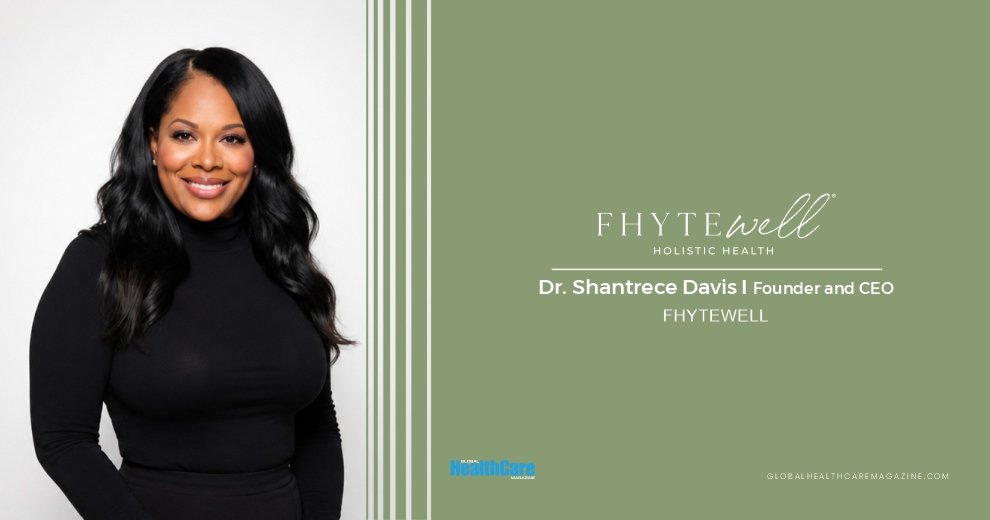
It happens in a meeting, usually. A word that should be there is not. A decision that used to arrive instantly now takes a beat too long, and a woman who has spent her whole career being the sharpest person in the room starts, quietly, to wonder if something is wrong with her. Dr. Shantrece Davis has built an entire practice around that exact moment.
Dr. Davis is the Founder and CEO of FhyteWell®, a functional health and midlife brain performance company focused on helping high-achieving midlife women protect brain health and cognitive performance. She holds a Doctor of Nursing Practice degree, is a board-certified Nurse Practitioner with more than a decade of clinical experience, and brings a background in both psychology and functional health to a specialty she describes, simply, as protecting cognitive performance during a transition most workplaces still misread entirely.
What HR Gets Wrong
Dr. Davis’s core argument is a direct challenge to how most organizations respond to a struggling midlife employee. Human resources departments, she notes, tend to offer time management apps and resilience training. What is actually happening, in her assessment, is that a woman’s brain and cognitive systems may be affected by biological and hormonal changes during midlife, and no app addresses that alone. Sleep destabilizes. Stress signaling ramps up. Cognitive load stays maxed out. The nervous system stops compensating the way it once did.
She treats brain fog, fatigue, anxiety, and subtle changes in executive function not as vague complaints but as experiences that can accompany neurobiological and hormonal shifts, changes that are rarely random and, in her framing, are almost never addressed head-on.
The FhyteWell® Loop
To address that gap, Dr. Davis developed The FhyteWell® Loop™, a framework for midlife brain health and cognitive vitality built on a single premise: midlife is not inevitable cognitive decline; it is a period of neurobiological change that can be understood and supported intentionally. The framework moves clients through a progression that includes clarity and regulation, cognitive confidence and identity recalibration, and leadership and life expansion. Underneath all three sits her guiding belief that when biology stabilizes, performance follows, not the other way around.
That approach translates into a handful of concrete offerings. The FhyteWell® Mapping Session is a ninety-minute coaching and consulting engagement that maps the patterns behind a client’s brain fog, fatigue, and cognitive changes across body, mindset, and daily systems, and ends with a personalized thirty-day brain performance plan. For clients who want to go deeper, there is a Three-Month Brain Performance Intensive, run as a private one-on-one consulting container.
And for companies, she offers organizational partnerships and corporate workshops focused on protecting leadership retention and cognitive performance, aimed specifically at helping organizations better support high-achieving women experiencing midlife brain-health challenges that may otherwise be labeled “burnout.” A newer offering, The FhyteWell Protocol™, is currently enrolling for 2026, a twelve-week brain and body recalibration container presented through the FhyteWell ecosystem.
Dr. Davis has carried this message beyond her own client roster as well, including through speaking and podcast appearances focused on functional nursing, women’s wellness, and midlife health.
Two Decades Inside the System, Before Building Her Own
Before FhyteWell®, Dr. Davis spent years working inside different areas of the healthcare system she now critiques from the outside. From August 2022 to August 2023, she served as the sole provider in an outpatient acute injury care clinic at Nova Medical Centers in Indianapolis, specializing in occupational medicine and workers’ compensation cases, conducting DOT and non-DOT physicals, drug screenings, and functional capacity evaluations, and managing orthopedic injuries alongside diagnostic imaging and procedures like laceration repair.
From 2020 to 2021, she worked as an Advanced Practice Provider at Aspire Health, Inc., specializing in palliative and end-of-life care, facilitating sensitive conversations with patients and families about goals of care and the transition to hospice. Between 2019 and 2020, she was a Clinical Instructor at Chamberlain University’s College of Nursing, supervising nursing students in hospital settings and using simulation technology to sharpen their clinical decision-making.
Earlier still, from October 2014 to June 2019, nearly five years, she worked as a Registered Nurse and Staff Nurse II at Eskenazi Health in Greater Indianapolis, a major public healthcare system serving diverse patient populations, and from August 2014 to April 2017 she also held a Registered Nurse role at Indiana University Health, where she specialized in transplant ICU care for liver, kidney, and multivisceral transplant patients.
Long before any of that, from 2000 to 2005, Dr. Davis worked as a Marketing Coordinator and Specialist at Canon Solutions America in Burlington, New Jersey, developing sales training programs and pricing strategies and managing company events for more than eight hundred attendees, a chapter that, unexpectedly, taught her the structured communication skills she now uses to explain health and wellness concepts to women who have never heard them framed this way before.
A Different Kind of Leadership Case
What makes Dr. Davis’s work distinct within a field crowded with generic wellness advice is the clinical weight behind it. A decade of hands-on nursing, transplant ICU work, palliative care, occupational medicine, and nursing education all feed into a practice that insists on sequencing: understand the biology, address cognition, and build supportive systems. She is not selling a mindset shift. She is arguing that the mindset shift works best when the underlying biological, cognitive, and behavioral factors are also addressed.
For the high-achieving women she works with, quietly convinced their brains are “slipping,” and for the organizations losing them to a diagnosis everyone keeps calling burnout, her pitch is less about willpower and more about understanding the pattern and building a deliberate strategy. Get the biology right, she argues, and the leadership follows more sustainably.
It is a case built, quite literally, over more than a decade of clinical experience watching bodies and people adapt through different stages of care. Dr. Davis is not asking midlife women to try harder. She is asking them to look, finally, at what their changing biology and cognitive load may be trying to tell them.