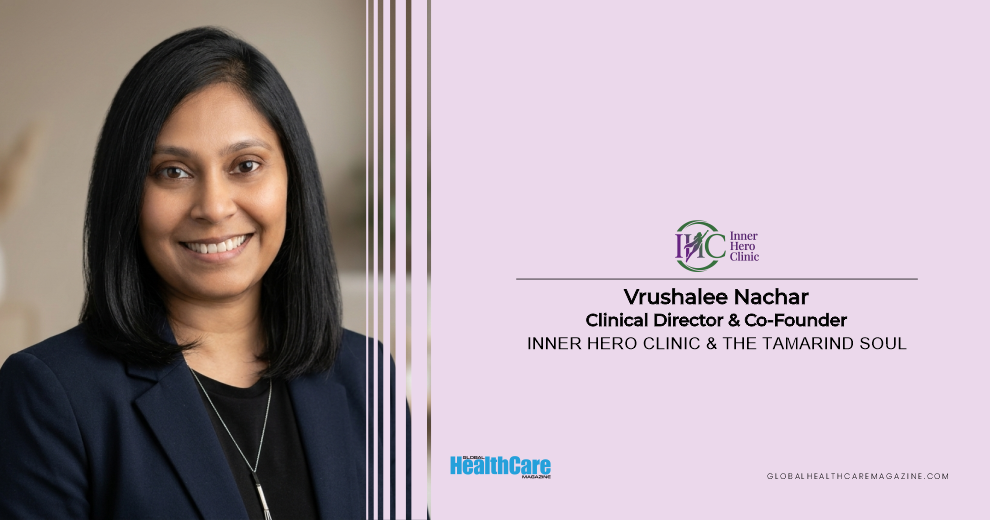
There is a particular kind of knowledge that cannot be acquired in a classroom. It comes, instead, from the accumulated weight of experience: from navigating rooms where you are both the most qualified person and the least expected to be heard, from learning to read the invisible architecture of power within organizations, and from carrying a culture’s worth of wisdom and silence simultaneously into every professional encounter. Vrushalee Nachar, Clinical Director of Inner Hero Clinic and Co-Founder of The Tamarind Soul, has spent nearly two decades collecting exactly that kind of knowledge, first without knowing quite what to call it, and then with the precise and graceful fluency of someone who has finally found the language.
She grew up in India, shaped by a culture that is simultaneously rich in wisdom and quietly dismissive of emotional pain. “We were taught to be resilient,” she says, and the sentence lands with the heavy weight of everything left untaught: how to name what you carry, how to grieve what you have lost, and how to recognize when the systems around you are asking you to shrink. From a very early age, she faced racism, sexism, and patriarchal structures. She fought against them, outspoken and unflinching, earning labels for it: weird, difficult, crazy.
Vrushalee arrived in Canada carrying more than a decade of corporate experience across some of the world’s most demanding organizations, including AXA, WIPRO, and TATA Communications, and continued building her career through Rogers, TD Bank, Scotiabank, and Broadridge Financial. Across more than eighteen years in HR, Learning and Organizational Development, Project and Change Management, and executive coaching, she sat across from hundreds of leaders who were, by every external measure, extraordinarily successful. They appeared articulate and driven while quietly unraveling behind closed boardroom doors.
She observed how corporate cultures frequently disguised burnout as dedication, people-pleasing as collaboration, and fear of conflict as professionalism. She could coach on strategy, on executive presence, on communication. But she kept arriving at something that strategy alone could not reach: the interior world.
“After spending nearly two decades observing the external patterns of human behavior, I felt deeply compelled to work directly on the inside.”
That realization, arriving during the COVID-19 pandemic, sent her back to school. She pursued a Master’s in Counselling Psychology, studying attachment theory, trauma neuroscience, internal family systems, and somatic processing. She also holds a Master’s degree in Business Management and Language and Linguistics, alongside certifications in DiSC®, CLDM, CTPD, ADKAR, NART, and TTCT. When she completed her training and became a Registered Psychotherapist with the College of Registered Psychotherapists of Ontario, she described this transition not merely as a career change, but as a profound homecoming.
Born from a Wound
Inner Hero Clinic grew organically from a profound personal and collective wound.
As a narcissistic abuse certified clinician working in trauma-centered spaces, Vrushalee recognized something that existing mental health infrastructure had largely failed to name. There was a deep need for a strength-based space for high-functioning individuals whose relational traumas and silent childhood wounds were surfacing in their high-intensity lives. These were people who had transformed hyper-vigilance into perceptiveness, emotional suppression into composure, and over-responsibility into leadership. She reframed these traits as ingenious survival solutions to past challenges.
Mental health access remained deeply unequal. Waitlists stretched for months. Therapy was geographically concentrated in urban centers. For racialized communities, immigrant populations, and high-achieving professionals, the gap between available care and culturally resonant care was enormous. She watched South Asian women, women who looked like her, dismiss their own pain because they had spent a lifetime being told that what they felt was an overreaction.
“Within every person, no matter how heavy the weight they carry, there lives a hero waiting to emerge.”
Vrushalee founded Inner Hero Clinic on a single, non-negotiable conviction: every person, regardless of geography, background, or the complexity of what they carry, deserves access to evidence-based, trauma-informed, and deeply human psychotherapy. The fully online model was deliberate from day one. It removed the logistical barriers of commutes, waiting rooms, and geographic limitations, so that someone in rural Ontario or coastal British Columbia could access the same quality of care as someone in downtown Toronto. Today, Inner Hero Clinic serves clients across Canada. The name is intentional. The clinic exists primarily to walk beside clients while they discover the power to rescue themselves.
Giving Language to the Nameless
One of the most important parts of Vrushalee’s work happens before a single therapeutic technique is introduced. It is the work of correcting misconceptions: the pervasive, damaging beliefs about trauma and narcissistic abuse that cause people to discount their own experience before they have had a chance to understand it.
The first and perhaps most damaging misconception is that trauma requires a dramatic, singular event. People arrive saying they do not think they have trauma because nothing that bad has ever happened to them. However, the true measure of trauma lies in its ongoing impact on the nervous system. Prolonged emotional neglect, chronic invalidation, and relational instability can be as neurologically disruptive as a single catastrophic moment. Complex PTSD is built slowly and quietly, often inside families and relationships that looked perfectly ordinary from the outside.
The second misconception surrounds narcissistic abuse. Many clients spend years questioning whether what they experienced was ‘bad enough’ to deserve the word abuse. Narcissistic abuse rarely announces itself. It arrives through the slow erosion of self-trust, through the intermittent reinforcement of warmth and withdrawal that creates a kind of emotional vertigo. By the time a client arrives, they have often spent years explaining away their own pain. Vrushalee’s first work is to give them language.
“What you experienced had a name, it had a pattern, and your response to it was entirely rational.”
The third misconception assumes recovery follows a simple, upward trajectory. In reality, the healing process operates cyclically. As deeper layers are processed, clients often feel temporarily more tender, more aware of what was lost. Vrushalee frames this period as a necessary excavation. She weaves psychoeducation into every session, teaching the neuroscience of trauma in plain language, explaining how the amygdala stores emotional memory and how the nervous system creates survival adaptations that were once brilliant but have now overstayed their welcome. She views knowledge in this context as the foundational act of self-compassion. Beneath every misconception, she holds space for grief, standing witness for the person who desperately needed someone to acknowledge that their experiences truly mattered.
The Inside-Out Model
What Vrushalee has built over eighteen years of corporate work and clinical training is an integration she calls the inside-out model at The Tamarind Soul: addressing the interior landscape first, so that the external shifts in leadership, relationships, and career become deeply embedded and sustainable.
Clinically, she draws from an integrative toolkit, including Cognitive Behavioral Therapy, Trauma-Focused CBT, Internal Family Systems, somatic approaches, narrative therapy, Dialectical Behavior Therapy, and Emotionally Focused Therapy. She also holds a Narcissistic Abuse Treatment Certification, bringing a specialized framework to the complex relational trauma presentations she encounters.
What truly distinguishes her approach is the bridge she builds between clinical depth and organizational reality. Most therapists have not sat in a boardroom during a restructuring. Most executive coaches have not trained in trauma neuroscience. Vrushalee has done both. That dual literacy allows her to hold the full complexity of a high-achieving professional, simultaneously navigating burnout, boundary violations, leadership pressure, and the weight of a cultural identity that was never designed to be expressed in a Western corporate context.
“My approach relies on a continuous, dynamic conversation between clinical science and lived experience.”
In coaching, she brings somatic awareness into what is typically a strategy-driven space. She invites clients to notice where ambition lives in their bodies and where fear shows up before the mind has processed it. This body-informed coaching is particularly transformative for leaders who have spent entire careers being rewarded for ignoring their inner signals in favor of external metrics. At The Tamarind Soul, this integration extends further into group containers and retreats, spaces she considers among the most powerful vehicles for transformation. When self-aware, performance-driven individuals enter a shared healing space together, the collective nervous system creates a field of permission, and people discover they are not alone in what they carry.
Four Chambers of the Same Heart
Vrushalee describes her four areas of work as four chambers of the same heart. Individually, each is meaningful. Together, they create something that breathes.
Therapy is the foundation, the place where work happens at the level of the nervous system, processing stored trauma and building the internal safety that makes all other growth possible. Without this foundational work, coaching risks becoming a sophisticated way of rearranging furniture in a house built on a faulty foundation.
Coaching is where the insights from therapy become actionable. At The Tamarind Soul, her programs are designed for individuals ready to translate internal clarity into external change, whether navigating a career pivot, rebuilding after a relationship rupture, or reclaiming leadership identity after burnout. It operates at the intersection of insight and strategy, asking not only who you are becoming, but what you will do with that becoming.
“Retreats compress months of individual progress into days of felt experience.”
Retreats are what she considers the accelerator. When she brings a group into an immersive, body-based healing container, such as her upcoming five-day somatic healing and narcissistic abuse recovery retreat in Mexico, something shifts that cannot happen across a fifty-minute virtual session. The nervous system needs time, movement, community, nature, and the experience of being witnessed by people who understand.
Leadership development completes the ecosystem. Healing without application is incomplete. True leadership, the kind that creates psychologically safe and genuinely human workplaces, requires individuals deeply committed to their own interior work. A client might begin in individual therapy, transition into group coaching, attend a retreat, and then carry that integration into their leadership practice. Each layer deepens the previous one, making the healing self-reinforcing.
A Practice Built on Presence
As Clinical Director, Vrushalee’s primary responsibility is to ensure the clinical integrity of Inner Hero Clinic. Every therapeutic offering and treatment modality must align with evidence-based, trauma-informed, and ethically grounded practice. She oversees clinical orientation, manages intake processes, and supervises practicum student placements.
She also holds her own client caseload. This is non-negotiable. Maintaining an active practice keeps her connected to the real human experiences the clinic’s systems are designed to serve.
“The therapeutic relationship remains at the center of my professional identity.”
The clinic’s practice philosophy rests on five core pillars: compassion without judgment, evidence-based practice, inclusivity and cultural sensitivity, accessibility through the fully online model, and holistic wellbeing. The team includes therapists with over a decade of experience specializing in complex trauma, grief, and family systems, along with expertise in emotional regulation, cultural and intergenerational challenges, and prenatal and postpartum support.
Inner Hero Clinic is a proudly approved practicum site in the Counselling Psychology Program. Offerings include the Narcissistic Abuse Reset group, corporate psychological safety programming, and a dedicated service called Therapy for Therapists. Vrushalee holds this last offering with particular conviction. Healers are not exempt from carrying wounds, and unprocessed therapist material becomes a clinical hazard. Every clinician at the clinic engages in their own personal therapy and reflective practice.
“Creating a safe space relies entirely on maintaining a genuine, welcoming posture.”
Safety is communicated before the first session, in the ease of the booking process, and the free consultations are offered without pressure. Trust, for many clients, was used as a transaction in their histories, so it is earned here slowly and consistently. Vrushalee is most passionate about the moment of rupture-to-repair in therapeutic work: that breath-holding instant when a client who has spent a lifetime dismissing their own experience finally allows themselves to be witnessed.
The Fire That Forged the Framework
There is a particular kind of test, Vrushalee reflects, that emerges from doing everything right and still having it hurt.
She spent years in corporate environments building human-centered leadership frameworks within systems that were not always designed to be human. She found herself in environments where expectations were contradictory, where the goalposts shifted, and where her voice was somehow the last one heard in decisions. She navigated narcissistic organizational dynamics from the inside, and she says this clearly because she believes it matters. The expertise she now brings to clients recovering from narcissistic abuse was developed, in part, in the fire of her own experience. She knows the particular exhaustion of being excellent and simultaneously erased.
What allowed her to navigate through it was willingness: a willingness to sit with the discomfort of not knowing, to seek support rather than project competence, and to let those experiences teach her rather than define her. She established The Tamarind Soul and Inner Hero Clinic from a place of deep clarity.
“Clarity provides the conviction to move in the right direction, even when the complete path remains unseen.”
Her form of resilience focuses entirely on leaning forward toward the version of herself she could see more clearly each time the floor dropped out. She reminds her clients often that their lowest moments act as invitations to discover who they are truly becoming.
The Metrics That Matter
The milestone Vrushalee holds most closely remains deeply personal: the moment a client who came to her unable to trust their own perception looks across the screen and says, ‘I know what I know.’ Something in their eyes has shifted. The self-doubt has not disappeared, but it has been met by something stronger. That is the work. Everything else is infrastructure supporting that moment.
Inner Hero Clinic has grown into a multi-province practice serving clients across Canada. The Narcissistic Abuse Reset group therapy program remains one of the outcomes she holds most closely. Watching individuals who came in isolated and convinced their experience was somehow their fault leave an eight-week group with language, community, and restored self-trust is what she calls legacy work. The stories shared by hundreds of women following those groups have affirmed her mission time and again: women who changed careers, left marriages, started businesses, and found relationships renewed, all making those changes from a grounded place of deep self-knowing.
“The metrics that move me: the number of people who return to themselves.”
At The Tamarind Soul, she has facilitated transformative group coaching experiences and immersive retreat offerings. The upcoming Mexico retreat, “Regulate. Release. Restore.,” represents years of vision and practice converging into something she describes with unmistakable excitement.
The Continuum She Is Building
Vrushalee is building toward a continuum of care: a world where the distance between corporate wellbeing, clinical psychotherapy, peer community, and immersive healing has been collapsed. A high-achieving professional in crisis does not have to choose between executive coaching and trauma therapy, because both exist within the same intelligent, compassionate ecosystem.
The immediate horizon includes expanding the clinical team across Canada, launching the Mexico retreat in 2027, and developing corporate programming through The Tamarind Soul that brings trauma-informed leadership directly into organizations. She is deeply invested in the intersection of cultural identity and psychological well-being, particularly for South Asian, immigrant, and BIPOC communities historically underserved by mental health systems. Her aim is to make culturally responsive care the universal standard.
“A world where healing operates as a continuous, lifelong practice.”
She is committed to reducing the stigma around mental health care, particularly in communities where seeking help has been framed as weakness. She intends to engage at the policy level on issues of mental health access and the psychological safety of workplaces. She envisions expanding the in-person retreat offerings to multiple geographies, creating immersive healing experiences in environments intentionally chosen for their restorative power.
The Practice of a Full Life
She will tell you, without the curated answer, that she has not always gotten this right. She burned out at least once during her corporate years, learning the hard way that true sustainability requires operating from a place of fullness. Presence is the most essential clinical tool she possesses, and presence cannot be faked in the room where someone is finally learning to trust.
“Self-care acts as a strict professional obligation.”
Concretely, this means non-negotiable boundaries around her clinical schedule, consistent personal therapy, and regular clinical consultation. Outside of work, she is restored by travel that deposits her somewhere unfamiliar enough that she has to pay attention to everything again. Her background in linguistics shapes the way she listens for metaphor and meaning in her clients’ language. Books remain one of her great pleasures, and nature is deeply restorative. The image of someone walking through a lavender field is not incidental to the aesthetic of Inner Hero Clinic. It reflects exactly where she goes to refill.
To the high achievers, the leaders, and the caregivers holding so much for so many, she offers something direct: your strength does not disqualify you from needing support. The very qualities that make you exceptional require particularly thoughtful maintenance. A blade that never sharpens eventually dulls. To the South Asian women, the immigrant women, and the women who were handed expectations before they were handed options: your story did not begin when you arrived in a country or entered a boardroom. It began long before those moments, and it does not end with any of them.
In any room, she says, the most powerful thing you can do is be genuinely and consistently yourself. Such deep authenticity naturally translates into genuine authority. And for anyone on the edge of reaching out for support, she offers this:
“The inner hero emerges precisely through the courage of asking for help.”
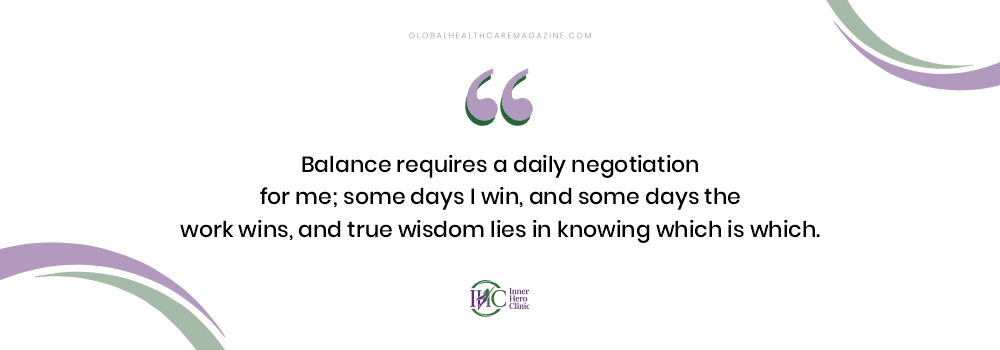
Quotes
Also Read: The Most Inspiring Mental Health & Wellness Leaders of 2026