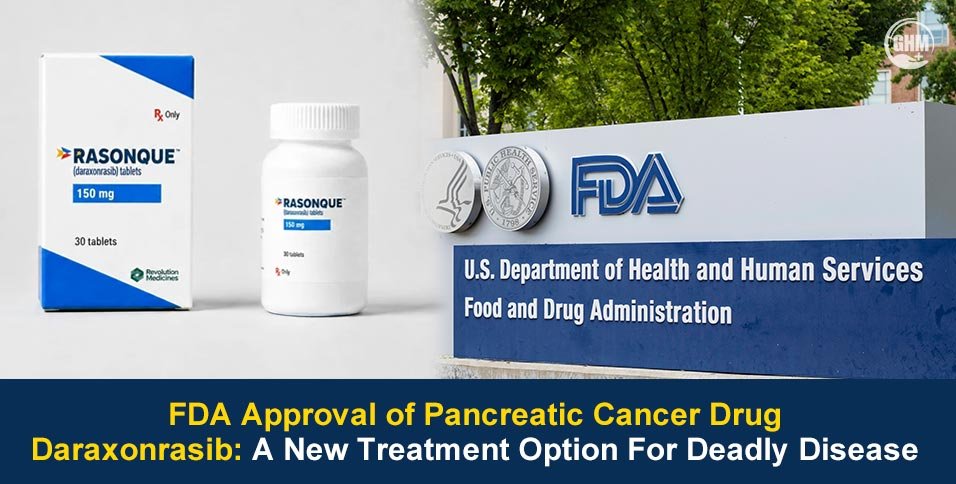
The U.S. Food and Drug Administration (FDA) has approved Revolution Medicines’ once-daily pill, daraxonrasib, under the brand name Rasonque, for eligible adults with metastatic pancreatic adenocarcinoma. It is the most common form of pancreatic cancer and is one of the deadliest and hardest-to-treat cancers.
This FDA approval of pancreatic cancer drug Daraxonrasib follows clinical trial results showing that patients treated with daraxonrasib had an overall survival rate that was doubled compared with those receiving standard chemotherapy.
The American Cancer Society estimates approximately 67,350 new pancreatic cancer diagnoses in the U.S. this year. The daraxonrasib FDA approval offers a new option for patients whose cancer has progressed after previous treatment or who cannot tolerate intensive combination chemotherapy.
About The FDA-Approved Pancreatic Cancer Pill
The new pancreatic cancer pill Daraxonrasib works by blocking multiple forms of the RAS protein pathway. These proteins act as molecular switches inside cells and can help fuel uncontrolled tumor growth when altered.
Targeting RAS has challenged cancer researchers for decades. The Revolution Medicines pancreatic cancer drug therefore represents an important attempt to directly address a biological pathway involved in many pancreatic tumors.
Unlike traditional chemotherapy, which broadly attacks rapidly dividing cells, this targeted approach in the pancreatic cancer pill Daraxonrasib focuses on a specific cancer-driving mechanism. However, the treatment is not a cure and does not eliminate the need for continued monitoring and medical care.
Clinical Trial Results Show a Significant Survival Benefit
The FDA approval of pancreatic cancer drug Daraxonrasib follows a successful randomized, open-label clinical trial involving about 500 patients with previously treated metastatic disease.
Patients who received the new pancreatic cancer pill Daraxonrasib achieved a median overall survival of 13.2 months, compared with 6.7 months in the standard chemotherapy group. The clinical trial results represented a substantial improvement in a disease where treatment options have historically been limited.
The results are also a breakthrough that attracted attention because pancreatic cancer often progresses rapidly and is frequently diagnosed at an advanced stage, limiting the effectiveness of available treatments.
The Daraxonrasib FDA Approval Process Moved Quickly
The FDA used several programs designed to speed the development and review of promising medicines for serious diseases. FDA approval of pancreatic cancer drug Daraxonrasib was a quick process
New pancreatic cancer pill Daraxonrasib received:
- Breakthrough Therapy Designation
- Orphan Drug Designation
- Priority Review
The Rasonque pancreatic cancer treatment was also reviewed through an expedited FDA process. Before final FDA approval, the agency issued a “safe to proceed” letter that opened an expanded access pathway for some patients.
“This drug showed unprecedented results in an area of high unmet need,” said Angelo de Claro, M.D., director of the FDA’s Oncology Center of Excellence.
Side Effects of the New Once-daily Pancreatic Cancer Drug
Although the Rasonque pancreatic cancer treatment offers a new oral treatment option with a once-daily dose, patients may still experience significant side effects.
The most commonly reported adverse effects of Daraxonrasib included:
- Rash
- Diarrhea
- Mouth sores, also called stomatitis
- Nausea and vomiting
- Abdominal pain
- Fluid retention, known as edema
- Reduced appetite
- Bleeding or hemorrhage
Patients should discuss potential benefits and risks with their oncology team.
Cost and Access of The New Pancreatic Pill
Revolution Medicines has priced Rasonque pill at $39,800 for a 30-day supply in the United States, according to sources. The company said it would also provide patient assistance.
The price could make insurance coverage and affordability major issues as the drug enters wider clinical use. For health systems, it will be challenging to ensure that major advances in cancer treatment are accessible to the patients who may benefit from them.
For now, the long-term impact of the FDA approval of pancreatic cancer drug Daraxonrasib will depend on real-world outcomes, patient access, and continued research.