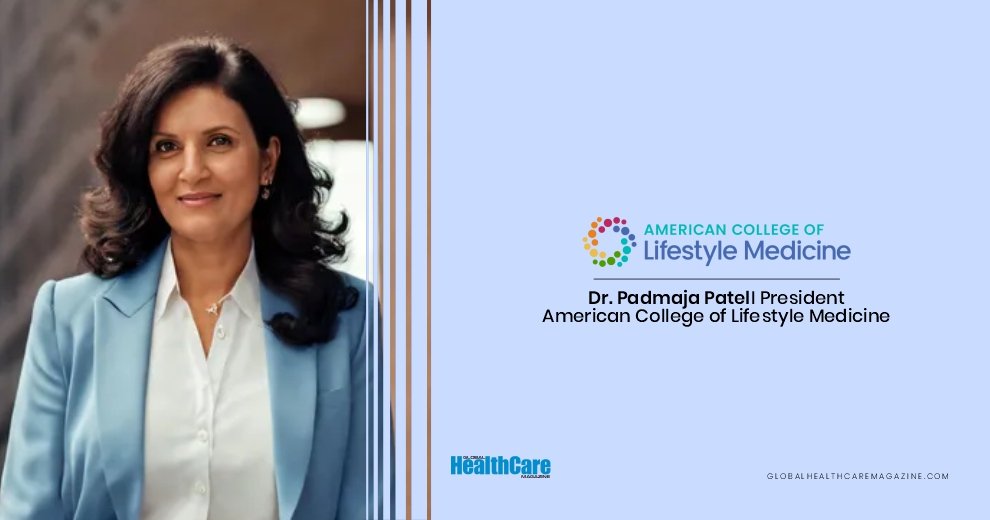
In a modest exam room in Midland, Texas, a young internist once sat across from patients whose charts told the same story again and again: diabetes, hypertension, a heart working harder than it should. It was the late 1990s, and the tools she had been trained to reach for, the prescription pad and the referral slip, kept treating symptoms while the causes multiplied. Dr. Padmaja Patel would spend the next quarter century trying to change that order of operations entirely.
Today, Dr. Patel serves as President of the American College of Lifestyle Medicine, a national medical professional association representing the interdisciplinary field of lifestyle medicine. She also holds the title of Chief Medical Officer at Nudj Health, sits on the Texas Nutrition Advisory Committee, and consults with health systems and payers across the country.
But to understand how she arrived at the center of a national conversation about chronic disease, it helps to go back to where the conversation started for her: a solo practice, a health system facing significant healthcare-cost pressures, and a stubborn belief that “the most powerful prescription in medicine isn’t written on a pad; it’s written into the design of care itself.”
The Long Apprenticeship
Dr. Patel began her career as an Internal Medicine Specialist at Premier Physicians-Family in Midland, a post she held from December 1998 to December 2003, more than five years of internal medicine practice that gave her an intimate view of chronic disease as it actually unfolds in ordinary lives.
In January 2004, she opened her own practice and ran it for nearly seventeen years, until December 2020. It was there, as a solo practitioner, that she began experimenting with what she now calls lifestyle medicine interventions: nutrition, physical activity, stress management, restorative sleep, social connection, and avoidance of risky substances, deployed not as wellness add-ons but as a clinical strategy aimed at chronic disease remission.
The Midland Experiment
In June 2017, Dr. Patel took on a role that would define the next chapter of her career: Medical Director of the Lifestyle Medicine Center at Midland Memorial Hospital, a position she held for six years, until May 2023. She helped develop and lead the center, recruiting and training interdisciplinary teams and developing patient education resources while advising hospital leadership on system-wide integration.
The numbers from that period are the kind that make hospital boards pay attention. Midland Health, a self-insured system, had exceeded its benefits-cost budget by three million dollars in 2016. She helped implement an intensive lifestyle medicine program for employees. Within a single year, the initiative was associated with a two-million-dollar reduction in hospitalization costs and a one-million-dollar reduction in pharmacy expenses, contributing to three million dollars in savings in 2018 compared with 2017.
She applied the same logic to cardiac care and helped develop an intensive cardiac rehabilitation program at Midland Health that incorporated nutrition, stress management, and social connection. By making intensive rehab more accessible within the health system, she helped expand participation, strengthening both patient access and the program’s financial viability.
Building the Institution
While running the Midland program, Dr. Patel began climbing the leadership ladder of the American College of Lifestyle Medicine. She joined its Board of Directors in August 2020, serving through 2022. In October 2021, she became Founding Chair of the Clinical Practice and Quality Committee, a role she continues to hold. In November 2022, she was named President-Elect, and in December 2024 she transitioned to President, beginning a two-year term for 2025–2027.
Alongside her domestic work, she has also served as Vice President of the World Lifestyle Medicine Organization, a coalition of national and regional societies advancing evidence-informed prevention around the world. Current professional biographies continue to identify her in that role.
The Present, Widely Distributed
Dr. Patel’s current portfolio reads like a map of where American health policy actually gets made. Since February 2024, she has run her own consultancy, Healthcare Transformation Strategist and Lifestyle Medicine Consultant, working with health systems, payers, employers, and innovators to design reimbursement frameworks tied to CMS, CMMI, and Medicare Advantage priorities. In July 2025, she became Chief Medical Officer at Nudj Health, leading its Lifestyle Medicine Services, a role she has held for more than a year.
Her civic and regulatory footprint is broader still. In December 2025, Governor Greg Abbott appointed her to the newly established Texas Nutrition Advisory Committee, created under Texas Health and Safety Code Chapter 119B to develop nutritional guidelines and examine the relationship between nutrition, ultra-processed foods, and chronic disease.
Since March 2025, she has served as President of the Midland Quality Alliance, a physician-led organization and ACO-REACH organization, where she chairs its Quality Committee. She has advised the Texas Medical Board’s Committee on Alternative Payment Models since July 2024, contributed to the Primary Care Collaborative’s Whole Health and Lifestyle Medicine Workgroup since April 2024, and served on the National Quality Forum’s Healthcare Professional Stakeholder Advisory Council in 2024–2025, following service on its 2021–2023 Leadership Consortium.
Between May 2023 and March 2024, she also served as System Medical Director of Lifestyle Medicine and Southwest Regional Medical Director for Wellvana Health in Nashville.
The Practitioner’s Perspective
What distinguishes Dr. Patel from many health policy voices, she says, is that “I’ve built it from the ground up across multiple care settings.” Her consulting work now spans care model design, intensive therapeutic lifestyle change programs, value-based care alignment with HEDIS and Star measures, and employer-facing population health strategy, work she describes as helping organizations move “from interest in lifestyle medicine to implementation with confidence.”
It is a long way from a Midland exam room in 1998. But the throughline has never really moved: a physician who decided that the design of the healthcare system was itself a clinical variable, and who has spent every year since trying to redesign it from the inside.