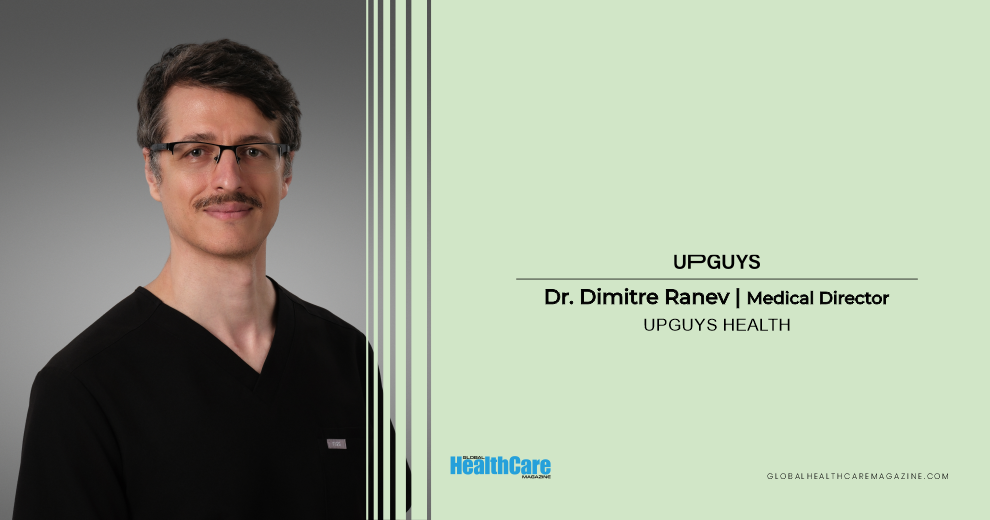
A medical career rarely arrives with a plan already drawn. More often it turns up sideways, through a rotation nobody expects to love, or a mentor’s offhand remark that somehow refuses to leave. For Dr. Dimitre Ranev, now serving as Medical Director of Upguys Health and a licensed physician practicing across Ontario, British Columbia, and Quebec, it arrived by way of a volunteer shift at a sexual health clinic in Gatineau, an opportunity he almost let pass him by.
“I actually got lucky, and sort of fell into it,” he says of his path into men’s health and preventive medicine, and there is a candor in that admission that runs through everything he says about his career. As a medical student at the University of Toronto, Dr. Ranev assumed he was headed toward urology. Instead, he matched into family medicine at McMaster University, a turn he now describes simply: “Looking back, it turned out to be the perfect fit.”
The Long Way Around
During his residency, Dr. Ranev found a mentor who reshaped his thinking before he even realized it was happening. “She really showed me the impact that prevention can have on long-term health and quality of life,” he recalls. It is a lesson he still returns to, one that would eventually anchor his entire clinical philosophy: that the earlier a problem is caught, the more options a patient has.
After completing his residency, he took a position at a busy family medicine clinic in Gatineau, Quebec, work that was steady and familiar, the kind that fills most early careers. That opportunity proved to be the turning point of his career when he was invited to help run a new sexual health clinic within the practice.
What Gatineau Taught Him
He did not take the assignment because he expected it to become his calling. “I initially volunteered because I wanted something more focused alongside the broadness of family practice,” he explains. What he found surprised him. “I quickly realized I loved the work. It energized me, I felt I was making a real difference, and it became clear that men’s and sexual health was where I wanted to focus my career.”
It is a familiar story among physicians who eventually specialize, though Dr. Ranev tells it without the manufactured certainty career narratives often acquire in hindsight. “I honestly believe that everyone has something they’re naturally drawn to, and when you find it, it just feels right,” he says. Opportunities in teaching and leadership, he adds, followed naturally from there, born less out of ambition than out of a wish to help other clinicians feel more confident treating patients in a specialty that, even now, carries more stigma than most.
The Weight of Silence
Ask Dr. Ranev about the biggest challenges facing men’s health today, and the answer does not begin with clinical data. It begins with silence.
“There are a lot of misconceptions around men’s health,” he says. “One of the biggest is the idea that real men don’t talk about their health, especially when it comes to mental or sexual health. That stigma can stop men from seeking help when they need it.”
The second misconception, in his view, is nearly as damaging: the belief that a doctor’s office is only for emergencies. Preventive care remains underused by men, he notes, despite years of evidence that screening and early detection change outcomes.
Then there is a third pattern he encounters constantly in his own exam room: patients who write off fatigue, weight gain, erectile dysfunction, or urinary symptoms as simply the price of growing older. Aging plays its part, he acknowledges, but many of these issues have identifiable causes that can be treated or significantly improved through lifestyle changes, medication, or other evidence-based therapies. A significant part of his job, as he describes it, is helping men understand they do not have to quietly accept these symptoms as an unavoidable feature of getting older.
Teaching as a Second Practice
If there is a single thread connecting every version of Dr. Ranev’s career, clinical medicine, education, and leadership alike, it is teaching.
“Medicine and health can be incredibly complicated for people who aren’t in the field, and I genuinely enjoy taking the time to explain things in a way that’s easy to understand,” he says.
He has come to believe that informed patients are more confident decision-makers, making education as important as treatment itself. “When patients understand what’s happening in their bodies, they’re much more engaged and empowered to take control of their health.”
That instinct extends well beyond the exam room. He holds an appointment as a Faculty Lecturer at McGill University, where he contributes to the education of medical students and residents, a role he has held since September 2015. He is also the co-host of the Primary Medicine Podcast. Both, he says, sharpen the same muscle. His teaching work at McGill forces him to translate complex medical concepts into something clear and practical, a discipline that carries directly into how he speaks with patients.
“Patients are much more likely to follow through if they understand why we’re recommending something and how it fits into their goals,” he says, and digital health simply extends that conversation. “Digital health helps extend that education beyond the clinic, reaching more people and reinforcing those messages over time.”
A Career Built in Layers
To look at Dr. Ranev’s professional history is to see a physician who rarely closes one door before opening the next. He began seeing patients at Clinique Médicale du Plateau in Gatineau, Quebec, in September 2010, a role he held until 2023. In September 2012, he added a position at Montreal Fertility Centre, alongside a four-year appointment at University of Ottawa Health Services that ran from 2012 to 2016.
The years that followed layered further responsibilities onto an already full practice: Medical Director of the Clinique Santé et Sexualité du Plateau from January 2017 to December 2022, a physician role at Clinique Medigo from 2017 to 2019, an Independent Medical Assessor position with Altum Health at the University Health Network from December 2017 to June 2021, and a stint with the virtual care platform Dialogue from July 2018 to May 2022. In between, from 2015 to 2016, he practiced with MD Home Call, later acquired by Crescent Capital-backed NHDS.
Since March 2017, Dr. Ranev has also served as a Medical Doctor with TELUS Health, a relationship that has now run nine and a half years and that, between May 2024 and April 2025, expanded into a term as Provincial Medical Director for Ontario TELUS Health Care Centres. More recently, he has added positions at Côté Santé and Eden Telemed, both beginning in 2024, and in October 2025 he stepped into his current role as Medical Doctor and Medical Director at Upguys Health, a clinic specializing in men’s endocrine health.
A Directorship Built on Systems
Ask Dr. Ranev what he enjoys most about his current post, and the answer has less to do with title than with problem-solving. “One of the things I enjoy most is being able to solve problems at the systems level,” he says. He still sees patients and still finds meaning in that work, but he has found a particular satisfaction in improving how a clinic functions for patients, clinicians, and staff alike.
That satisfaction is hard-won. Earlier in his career, he remembers feeling frustrated by operational issues that affected patient care without having any real ability to fix them. Now, in a leadership seat, he can identify a problem, implement a solution, and watch its effects ripple outward. The experience has also made him more forgiving of the leaders above him. “It is also humbling to realise how complicated it can be to make those changes,” he says, a recognition that has made him more sympathetic toward the broader healthcare leaders and decision-makers who face even larger, more tangled systems.
Nowhere is that leadership philosophy more visible than in the preventive care program he helps lead at the TELUS Health Care Centres, where he works alongside nurse practitioners, registered dietitians, kinesiologists, and physiotherapists. “I don’t think anyone has all the answers when it comes to health,” he says, and the team he has built reflects that belief, offering patients a more holistic mix of education and support than any single clinician could provide alone. Looking ahead, he would like to see even greater integration of mental health professionals into both preventive care and men’s health, a space he believes still has enormous room to grow.
Learning to Sit With Criticism
Not every part of leadership has come naturally to Dr. Ranev, and he is unusually candid about the part that has not: how he responds to criticism. “I’ve realized that my initial reaction is often to take feedback very personally,” he admits. “It’s almost a physical response, like fight or flight, because I tend to internalize it, even when I know the feedback is beneficial.”
Early on, that instinct had consequences. It made colleagues hesitant to raise concerns about systems or protocols he had helped design, which quietly closed off the kind of honest communication a clinic needs to function well. He has since worked to change that pattern, training himself to pause before reacting and to treat feedback as an opening rather than an attack. “I want people to feel comfortable speaking up,” he says, “because the best ideas and the biggest improvements often come from honest conversations.”
Crossing Into Quebec
Among the milestones Dr. Ranev points to when asked about the measurable impact of his work, one stands out clearly: the expansion of Upguys into Quebec. It was not a simple undertaking. It required real planning and a working understanding of a healthcare landscape that operates differently from the rest of Canada, something his own history in the province helped considerably. Having previously practiced as a family physician in Quebec, he admits, gave him an advantage most expansion efforts do not have.
The launch, he says, went well, and its meaning to him is less about growth for its own sake than about access. “For me, success is ultimately being able to reach more men, improve access to care, and help them take a more proactive approach to their health.”
Looking Toward Personalized Medicine
Asked where he hopes to take his field next, Dr. Ranev returns to two themes that have quietly run through the whole conversation: mental health and personalization. He wants to see more communities where men feel comfortable talking openly about their physical and mental health and supporting one another, and he points to organizations like Movember and The Man Cave as proof of what that kind of connection can accomplish.
More broadly, he believes the future of both men’s health and preventive medicine belongs to personalization. Many current treatments and lifestyle recommendations are built for the average patient, he notes, but “we’re all biologically different.” As access to biometric data and better technology grows, he expects prevention strategies to become far more tailored to the individual than the generalized approach medicine has long relied on. The field, he says, is already moving in that direction. The harder task ahead, in his view, will be making sure those advances remain accessible and affordable, so that personalized healthcare benefits everyone rather than a select few.
The Piano, Mindfulness, and Balance
Dr. Ranev is quick to say he has not achieved anything like a perfect work-life balance, though he is, by his own account, considerably better at managing it than he used to be. Much of that improvement traces back to a lesson from his residency supervisor, Dr. Zaulak, who introduced him to the practice of mindfulness. She taught him to pay attention to his own emotional state and inner dialogue, so that when his thoughts turn consistently negative, or he starts to feel drained and short-tempered, he recognizes it as a signal to step back and reassess before burnout sets in. Some of his biggest career decisions, he says, have come directly from listening to those signals.
Away from the clinic, it is the piano and exercise that help him reset. “I love learning the piano because it forces me to be fully present,” he says. Both, he notes, offer the quiet satisfaction of seeing small improvements over time, a discipline that seems to mirror the patience he brings to his patients.
A Simple Definition of Leadership
For all the roles Dr. Ranev has accumulated across a career that now spans practices in Gatineau, Ottawa, Montreal, and beyond, his description of leadership stays remarkably simple. It is not about titles or growth metrics, but about clearing the way for other people to do good work. “I believe leadership is about helping others succeed,” he says. “That means building systems that make it easier to deliver great care, creating environments where people can collaborate and learn from one another, and empowering both patients and clinicians through education.”
At the end of the day, the goal has never changed: remove the barriers, support the team, and let every decision come back to the same question, whether it genuinely helps the person sitting across from him.
Quotes

Also Read: Men’s Health & Preventive Medicine Leadership 2026