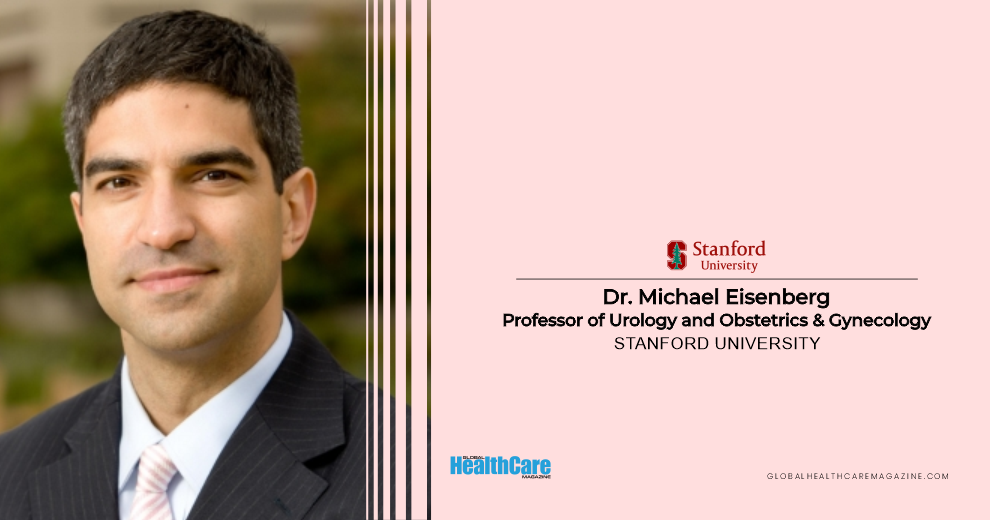
Walk into most conversations about reproductive health and the assumption, unspoken but persistent, is that fertility is a woman’s subject. It is measured in her cycles, her scans, her waiting rooms. Dr. Michael Eisenberg has spent much of his career challenging that assumption, one patient, one paper, one advisory role in the reproductive-health industry at a time. He does not do this loudly. He does it from an office at Stanford University, where the titles keep accumulating but the mission has not changed since he first put on a white coat.
Today Dr. Eisenberg is the Professor of Urology and Obstetrics & Gynecology at Stanford University, a post he has held since February 2022. Before that, he spent four years as an Associate Professor of Urology, Obstetrics & Gynecology, from February 2018 to February 2022. He joined Stanford in 2011 to establish its Male Reproductive Medicine and Surgery program, a career-long commitment to a field that has increasingly become part of broader conversations about men’s health and reproductive care.
The Work Nobody Sees
Titles on a resume rarely capture what a physician actually does with his days. For Dr. Eisenberg, the connective tissue running through all of it is male infertility and sexual dysfunction, a specialty he has practiced since joining Stanford in 2011, when he became Director of the Male Reproductive Medicine and Surgery program at Stanford, a role he still holds today.
Stanford currently identifies his clinical focus as male infertility, erectile dysfunction, men’s health, hypogonadism, Peyronie’s disease, and physiological sexual dysfunction. It is unglamorous work in the sense that it rarely makes headlines, and essential work in the sense that it addresses conditions that can affect both reproductive goals and broader men’s health.
Since 2014, he has also served as an Editorial Editor of Fertility and Sterility, one of the field’s leading reproductive-medicine journals, where his role places him at the editorial level of a publication that shapes the scientific conversation around fertility and reproductive medicine.
A Second Life in Advising
What makes Dr. Eisenberg’s story unusual, even among academic physicians, is how far his advisory work has spread beyond the university walls. The list is long, and each entry marks a company betting that clinical credibility matters as much as capital.
Over the years, he has advised companies across reproductive and sexual health, including Ro, Dadi, Sandstone Diagnostics, Underdog Fertility, Hannah, Legacy, Doveras, VSeat, HisTurn, Illumicell, and Next. His relationship with Legacy began in 2024, when the company announced him as a Strategic Advisor, while current Stanford disclosures identify advisory relationships with Legacy, Doveras, Hannah, VSeat, HisTurn, Illumicell, and Next.
Earlier in his advisory career, he worked with Sandstone Diagnostics, whose Trak system was developed as an at-home test for measuring sperm concentration. His involvement in that work reflected a broader interest in making aspects of male fertility assessment more accessible outside traditional clinical settings.
Taken together, it is a record that reflects the growing intersection of academic male reproductive medicine, consumer diagnostics, and reproductive-health innovation.
Where It Began
Every career has an origin point, and Dr. Eisenberg’s runs through two of American medicine’s more demanding training grounds. He completed his residency as a resident physician in the Department of Urology at the University of California, San Francisco, from June 2004 to June 2010, a six-year and one-month stretch that would shape his surgical foundation.
From there, he moved to Houston for a fellowship, serving as a fellow in the Department of Urology at Baylor College of Medicine from July 2010 to June 2011, where he trained in male reproductive medicine and microsurgery, the same subspecialty he has never left.
Why It Matters Now
The timing of this recognition is not incidental. As the field of men’s health and male reproductive medicine edges out of the shadows and into mainstream healthcare conversations, with growing attention to male fertility, sexual function, reproductive health, and at-home assessment, Dr. Eisenberg’s work sits at several of those intersections.
His academic output feeds the science. His editorial work with leading reproductive-health journals helps shape what becomes part of the scientific conversation. His advisory roles connect that expertise with companies developing products and services in reproductive and sexual health.
It is rare to find a single physician positioned at all three of those levels – clinical practice, academic research, and industry advising – at once, and rarer still to find one who has sustained that combination for more than a decade while remaining focused on male reproductive health.
The Long View
What emerges from Dr. Eisenberg’s record is not a story of sudden discovery or singular breakthrough. It is a story of accumulation, of a physician who chose a specialty that historically received less attention than many other areas of reproductive medicine and then spent more than two decades in training, clinical practice, research, and academic medicine, refusing to let it stay overlooked. Between the clinic at Stanford, the editorial work at Fertility and Sterility, and advisory roles across the reproductive-health industry, he has built something closer to an ecosystem than a career.
For an industry that has often treated men’s fertility as secondary to the broader fertility conversation, that kind of persistence is its own quiet form of leadership.