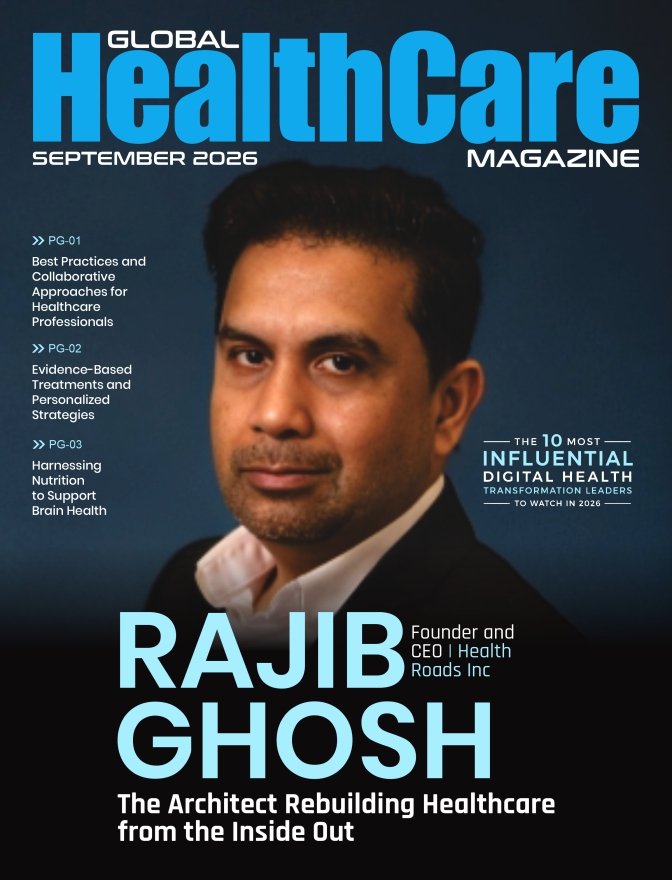
Every industry has its unglamorous corner, the client nobody wants, the record trapped in a system that was never built to release it, the invoice nobody quite knows how to collect. American healthcare has one such corner, small in population but outsized in cost, tangled with chronic illness, housing instability, and bureaucratic mazes that no single agency was ever designed to navigate alone. Few people have spent as much of a career standing inside that corner on purpose as Rajib Ghosh, Founder and CEO of Health Roads Inc.
A Lesson From Scarcity
Long before he built software, Rajib watched people build workarounds. He grew up in a part of the developing world where healthcare, as he describes it, “runs permanently short of resources,” and where the fixes he watched people improvise were rarely expensive or heavily engineered. They were smart, resourceful acts of delivery, shaped by whoever understood the terrain best. That was the lesson that stayed with him: the people closest to a problem, not the ones selling solutions to it, were the ones who actually solved it. It eventually became the founding logic of his company.
He crossed into American healthcare and built a career that now spans more than 25 years across technology, operations, data, and analytics leadership. He spent more than a decade specifically inside social care and public health, sitting on public sector boards and committees along the way, watching up close how government agencies, community organizations, and healthcare systems actually move, or more often, do not. Along that path, he also launched and scaled five medical device products, alongside SaaS platforms, telehealth solutions, EHR systems, and medical billing software, work that earned him recognition in 2017 as an HIT Fellow from the Office of the National Coordinator for Health IT. He has since carried that analytical instinct into a columnist role for INFORMS, writing for fellow practitioners about the use of analytics in healthcare. That vantage point, close enough to feel the friction firsthand, shaped everything that came next.
Building Health Roads
In 2018, Rajib founded Health Roads, building it around a single, stubborn statistic. Roughly five percent of people, he explains, drive more than half of the nation’s healthcare spend, a population defined less by diagnosis than by circumstance: chronic illness tangled with housing instability, transportation gaps, and the kind of social determinants no electronic health record was ever designed to capture. “Nothing about overall cost changes until that corner is solved,” he says.
What he kept encountering, across community organizations, counties, jails, housing providers, and public health agencies, was not a shortage of technology. It was a shortage of people who understood the problem the way an insider does. “The sector has no shortage of technology,” he says. “What it lacks is solution people, teams who understand the problem like the back of their hand, not vendors selling platforms and user seats.” Health Roads was built to be exactly that kind of company, one that works alongside organizations to solve operational problems from within instead of simply deploying another software platform.
A System Built for No One
Rajib is blunt about where digital transformation tends to go wrong. The trouble, in his assessment, is rarely a shortage of tools. It is a shortage of understanding. Organizations buy platforms, he says, and still cannot get paid, move a record between systems, or coordinate care for their most complex members.
Part of the reason, he explains, is structural. Community organizations, counties, jails, housing providers, and public health agencies each operate under different rules, different data standards, and different constraints, and most technology on the market is built for none of them. “Digital transformation fails when it’s dropped in from the outside instead of built from inside the workflow it’s meant to fix,” he says, a line that doubles as both diagnosis and mission statement for Health Roads.
The Toolkit
The company’s answer to that gap comes in three parts, each aimed at a different failure point in the system. SocialRCM® is revenue cycle management purpose-built for community-based organizations, the kind that were never designed, structurally or financially, to bill Medicaid in the first place. QConnect is Health Roads’ HL7/FHIR interoperability engine, built to move patient data between systems that were never meant to talk to one another. NextCareEngage™ handles coordination and engagement, keeping members connected across the full arc of their care.
Individually, Rajib describes these as billing, interoperability, and engagement tools. Together, he says, they let underfunded organizations “get paid accurately, share data cleanly, and keep vulnerable people connected to care,” the exact combination needed to bend costs for the population that drives them. Artificial intelligence runs underneath all of it, though he is careful about how he frames its role. “We treat AI as a utility, not a job killer, but a productivity multiplier that lets small teams do the work of much larger ones,” he says, adding that for many of his customers, that efficiency is the difference between staying open and closing.
Reach, Depth, and a Portfolio of Patents
Health Roads has done business in 33 states and one Canadian province, a footprint that has carried the company past 100 customers, an unusually wide reach for a company its size. Rajib has worked directly with jails, housing providers, public health agencies, and community organizations of nearly every description, a vantage he calls almost impossible for an outsider to replicate.
That accumulated, on-the-ground knowledge has since taken a more formal shape: a growing intellectual property portfolio that includes filed patents covering entity resolution, master patient index normalization, and fraud and abuse detection built specifically for social care billing. It is, in his words, a “360-degree understanding” turned into “durable IP,” knowledge that cannot easily be replicated from the outside. When Rajib lists his proudest milestones, it is this combination, the customer count, the geographic spread, and the patent filings together, rather than any single number on its own, that he returns to.
The Work Itself
As founder and CEO, Rajib’s job description resists the usual executive shorthand. He describes his role as staying close to customers, to policy, and to engineering, where he still works through product and technical decisions directly rather than delegating them away. It is a deliberately hands-on posture for someone running a company operating across dozens of states.
The part of the job that visibly lights him up is smaller and more specific than strategy decks or growth charts. It is the moment a solution clicks into a real workflow, and an organization that could not get paid suddenly can. “That’s where mission and business meet,” he says, “and it’s why I do this.”
Solution People
Rajib describes his team in terms that mirror his own philosophy: deliberately built as solution people, not seat sellers. The organization blends deep Medicaid and interoperability expertise with genuine implementation discipline, spread across engineering, product, partnerships, and delivery. The culture, he says, prizes fidelity to the actual problem over generic output.
As a leader, he describes his role as fostering a culture of respect, engagement, entrepreneurial spirit, and a 360-degree view of what it actually takes to compete in a global, crowded market. It is a leadership style built less on hierarchy than on shared vantage point, the same insider’s eye he brought to founding the company in the first place, now distributed across the people who run it day to day.
That approach, he argues, is precisely how a company of Health Roads’ size has managed to serve counties of every stature and hold onto client relationships over time. The company ships, in his words, “what works in the field, not demos that impress in a room,” a distinction that sounds simple until you consider how rarely it actually holds true in enterprise software.
When the Ground Moves
Leading a small company positioned at the center of a shifting market means, in Rajib’s telling, that the ground moves regularly. A partnership ends. A policy changes overnight. A major customer’s needs shift without warning. He does not point to any single crisis as defining. Instead, he describes a repeating test: whether the team can stay focused on the customer’s actual problem while the path around it gets rebuilt in real time.
Each disruption, he says, has ultimately produced a sharper product and a clearer strategy. Staying calm and solution-focused under pressure is not, for Rajib, a leadership flourish. It is, in his own words, simply the job.
The Next Decade
Rajib’s read on where healthcare goes next is unsentimental and specific. The country, he believes, is heading toward some form of universal healthcare, pushed there by widening income inequality and an aging population. In his view, healthcare has no choice but to expand into the underfunded territory where the real cost actually lives, and Medicaid, imperfect as it is, is the first serious vehicle attempting that shift.
That shift, he argues, will only succeed if it empowers solution providers who already know the terrain, rather than organizations approaching the space from the outside. He positions Health Roads as already built for that decade-long transition, describing the company as the operational backbone that lets case management, public sector health information exchange, and AI-driven social care finally deliver on promises made for years.
Off the Clock
Outside the office, Rajib’s life runs on a different, though not entirely separate, register. He is a writer and a thespian, acting in community theater and hosting a podcast that has grown, he notes with some pride, entirely by word of mouth. Someday, he says, he would like to write a play of his own.
Family anchors him further still. His son, Reevu, is studying arts in college and has already contributed design and branding work to Health Roads, a creative instinct he describes as clearly running in the family. None of it, he insists, sits apart from the day job. Theater and storytelling, he says, sharpen his ability to understand how people communicate and what truly matters to them – an instinct that naturally carries into his work.
It is an unusual balance sheet for a healthcare technology founder to keep, a stage on one side of the ledger and Medicaid claims data on the other, but he does not treat the two as competing demands on his time. In his telling, they read more like two forms of the same practice: paying close attention to people, and to what they actually need, rather than to what an outsider assumes they need.
A Closing Thought
Rajib ultimately returns to the population his company was built to serve: the people doing some of the hardest and least visible work in American healthcare. Technology built for them, he insists, must come from people who truly understand their challenges rather than simply market solutions to them.
“The people doing the hardest, least glamorous work in healthcare, caring for the most vulnerable, deserve technology built by people who understand them, not marketed at them.”
Quotes

Also Read: The 10 Most Influential Digital Health Transformation Leaders to Watch in 2026