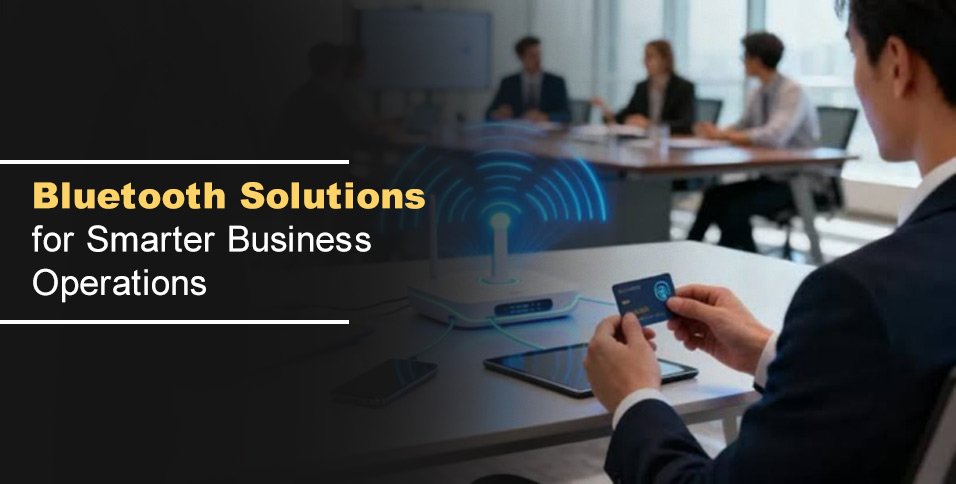
Bluetooth becomes easy to overlook since it is not visible at all times. The headset and keyboard become connected, and no one minds the wireless technology in action. But the same wireless technology works very hard by doing much more inside shops, warehouses, hospitals, and places like that. This tiny device can identify itself and help locate the equipment using sensors without having to wire everything up.
Why Bluetooth Low Energy Fits Busy Buildings
Bluetooth LE is developed for these devices that transmit small data amounts and conserve battery life. For instance, the beacon could frequently broadcast the unique ID which will be received by other devices nearby. The device transmits this data to the software program that will correlate the results with the particular item, the product display, the asset, or the location.
Deployment includes battery-powered tags, stationary gateways, and management console. Minew offers samples of all the hardware parts like beacons, sensor tags, asset trackers, gateways. Software is also essential – it means nothing when employees could not do anything using this found information.
Bluetooth LE cannot give indoor localization on its own. Even the minimum set-up uses proximity determination based on signal strength; the signal power varies due to shelves and other obstacles including people nearby. More sophisticated set-ups utilize direction finding as well as some special receivers.
The Store Shelf Becomes Easier to Manage
The electronic shelf label addresses a problem that is common to astute businesses but expensive, that is, making sure that the prices shown are synced with the point-of-sale. Rather than having the employees manually changing printed labels, it is possible for the latter to update the compatible display by a wireless system. There is a specification of the electronic shelf label that is based on Bluetooth core 5.4, courtesy of the Bluetooth SIG (Special Interest Group).
For instance, a grocery store may want to offer discounts for their freshly prepared sandwiches past certain hours of the day. This would be easy to do.
Beacons Help With Stock and Store Movement
Location-based tags serve another purpose altogether. They could be placed on returnable delivery carts, scanners, and pieces of valuable equipment by retailers. The receivers will indicate the position of the asset last registered by the beacon, hence helping to speed up the search process when things get hectic.
In some of the smart retail implementations that use beacons, the technology could be used to provide customers with location-based messages from their apps. This, of course, implies that the users have to install an app first and grant permission. More obvious is the need for finding the equipment and managing replenishments.
Similar Radios, Different Hospital Priorities
A smart hospital might use Bluetooth tags to locate infusion pumps, wheelchairs, or portable diagnostic devices. When equipment moves between departments, a locating system can help staff identify the most recently reported area. This supports faster searches, but it should not be treated as a guaranteed, continuously precise map.
The Bluetooth sensor is also capable of reporting temperature and humidity in designated storage spaces. The effectiveness of the technology is contingent upon calibration, alertness, and a clear process to be followed in case of readings outside the acceptable range. In clinical environments, there are additional factors of privacy, network security, and reliability.
Small Pilots Reveal Big Deployment Problems
Before putting lots of tags, a part of the building should be tested. This should include busy aisles, storage rooms, refrigerators, as well as places where there is low gateway coverage. Find out how often the expected signals are detected, as well as the value of information about location in finishing the task.
It is also necessary to think about the battery management system. Even though frequent signal broadcasting improves detection speed, it depletes energy faster. Maintenance staff should develop an efficient strategy for changing the batteries, updating the firmware, and finding those devices that stop transmitting signals.
Finally, figure out what features the dashboard will have. It will be more useful if there is a message like, “Device missing in such and such zone and at such and such time.” Make sure you set the right user permissions, clean unnecessary data, and make the new technology compatible with existing software.
Choose the Task Before the Technology
The use of Bluetooth technology will be most effective in solving a problem that is clearly defined and can be measured. The store could measure how long it takes to update prices or how often workers look for missing carts. A smart hospital could measure the search time for equipment and ensure notifications reach the right people.
Also read: Real-Time Monitoring: Why Modern Businesses Can’t Operate Without Instant Visibility