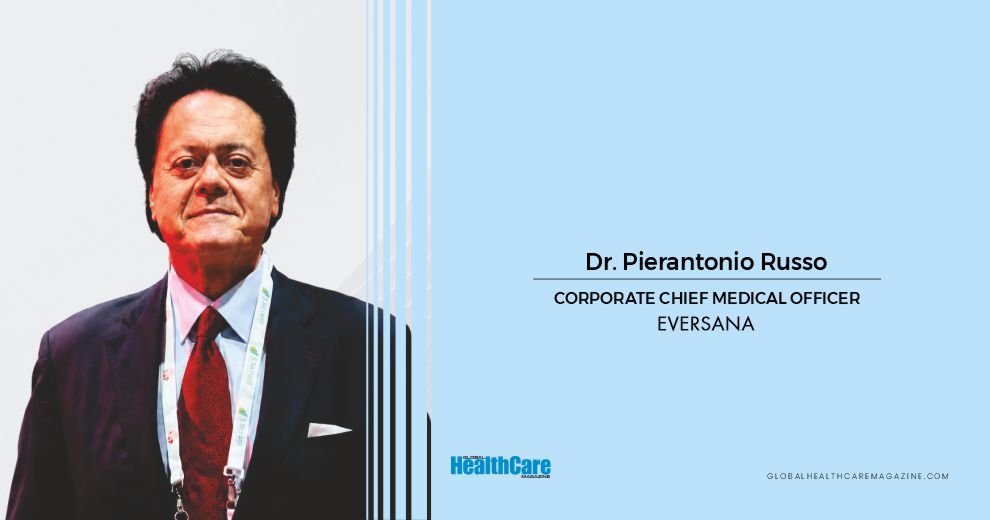
In cardiac surgery, there is little room to think about scale; the work is still measured one patient at a time. There is a patient on the table, a team around the operating room, and a decision that can change one life in a matter of minutes. For more than two decades, Dr. Pierantonio Russo, Corporate Chief Medical Officer at EVERSANA, worked inside that world, where precision mattered, and every innovation ultimately had to prove its value in the hands of a surgeon.
His path into medicine took him from Europe to specialized cardiac surgery centers in the United Kingdom and United States. He trained in pediatric cardiac surgery at Great Ormond Street Hospital in London, pursued advanced training in complex cardiac surgery at the Mayo Clinic in Rochester, Minnesota, and conducted fetal physiology and experimental surgery research at the University of Reading in the United Kingdom.
From 1988 to 2007, he held clinical, academic, and administrative leadership roles at institutions including Temple University, St. Christopher’s Hospital, Thomas Jefferson Medical College, and the University of Missouri. His work spanned cardiac surgery, pediatric cardiac surgery, and heart transplantation, including some extraordinarily young patients. One of them was only three and a half days old when she underwent a heart transplant.
After more than two decades in surgery, however, he began looking beyond the operating room. “Instead of helping one patient at a time,” he realized, data, analytics, and better system design could improve outcomes for entire populations.
That realization marked the beginning of the second half of his career. Today, he brings a surgeon’s understanding of individual patients to a much larger question: how can healthcare systems use data, technology, and better design to improve care at scale?
Where Medicine Meets the Business of Care
Healthcare becomes complicated when the science leaves the exam room. A promising therapy still has to move through reimbursement, health insurance, economics, data, and the realities of how patients receive care. It is at that intersection that Dr. Russo found the next chapter of his career.
Over time, his medical background broadened into health economics, reimbursement, insurance, population medicine, and data and analytics. He had also pursued formal training in healthcare innovation at the University of Pennsylvania and in digital medicine through Node.Health.
As an advisor to several health-services boards, he now brings a physician’s judgment to the full life cycle of a therapy. For him, the goal is to keep four things connected: the science, the economic realities, scientific evidence, and the patient experience.
The scale is different, but the underlying responsibility remains familiar: understanding how decisions made across the healthcare system ultimately affect the patient.
A Career Built in Different Languages
By the time Dr. Russo moved into corporate medical leadership, he had already learned to look at healthcare from several sides. Surgery had taught him precision and accountability for outcomes. His years inside payer organizations showed him how decisions about cost, access, and utilization could shape the care a patient actually received.
At Independence Blue Cross, where he served as Medical Director from 2007 to 2016, he worked with analytics teams to develop predictive and prescriptive models that guided the use of remote monitoring, digital solutions, and telemedicine for members with advanced heart failure.
Then, at Harvard Pilgrim Health Care, he took on a broader view of the system. His responsibilities included utilization management, provider networks, medical policy, medical costs, and advanced disease-management programs across Massachusetts, Maine, New Hampshire, and Connecticut. He also worked on bringing behavioral health into primary care.
Each setting added another language and distinct perspective to his work. Population health taught him to think more deeply and sharpened his focus on prevention and equity. Life sciences showed him what it takes to bring evidence, access, and execution to scale and ultimately reach patients.
The result is a way of working that depends as much on translation as expertise. Clinical, commercial, data, and access teams may approach the same problem from very different directions. His role is to help them find the common ground, connect those perspectives clearly, and keep sight of the patients whose lives are affected by those decisions.
Turning Healthcare Data into Action
A healthcare system can collect enormous amounts of information and still miss what is happening to the patient. The useful question is not simply how much data exists, but whether it can show where diagnosis is delayed, treatment breaks down, or follow-up falls short.
That thinking is reflected in Dr. Russo’s recent real-world research, including work examining arrhythmias in patients with COPD, diabetes, and chronic kidney disease, as well as treatment patterns in MDS and AML. The objective is not simply to generate evidence, but to identify where care, outcomes, utilization, and cost can be improved, while using digital health to bring patients and clinicians together earlier and more consistently. Value-based care adds another measure: whether those interventions improve outcomes rather than simply increase the volume of services.
For Dr. Russo, none of this works without trust in the underlying evidence. “Every recommendation should trace back to a verifiable source,” he says. That principle becomes especially important as more data, technologies, and algorithms enter healthcare.
He has argued that the larger shift comes from their convergence. Multiple data sources, greater computing power, machine learning, artificial intelligence, and generative AI are creating systems that can move healthcare from describing events after they occur toward anticipating what may happen next, supporting earlier and more timely action. In his vision of the hospital of the future, physical and virtual care would work together, operating through connected digital systems and using predictive tools to determine where, when, and how care should be delivered.
The ambition is not technology for its own sake. It is to make personalized, efficient, lower-cost care more achievable, while improving outcomes and the experience of both patients and physicians. That is the standard he brings to the work.
Building the Intelligent Health Service Organization
The most promising use of AI in healthcare may be identifying the right patient before a crisis arrives. In rare and complex diseases, where diagnosis can take years, predictive analytics can surface risk earlier, while AI can uncover patterns that are difficult for any clinician to review manually. Digital medicine can then extend that connection beyond the clinic itself.
The tools are more advanced now, but Dr. Russo believes the same discipline that governed his earlier work still applies: models must be validated, transparent, and fair.
His longer-term vision is what he calls an “intelligent health service organization,” where physical and virtual care operate through one connected digital platform. Machine learning could help determine the right setting, clinician, and timing for each patient, while AI supports diagnosis, treatment, imaging, and hospital operations.
For health-system leaders, his advice is practical: build strong data infrastructure, protect it, and use diverse data that includes social determinants of health.
The Questions Behind the Work
A typical day for Dr. Russo can move from reviewing a study design to a discussion about market access, value evidence, or a client’s scientific question. There are teams to mentor, evidence to review, and decisions that require him to stay close to both the science and its practical consequences.
That range comes from years of working across healthcare organizations. He has led organizations including HVH, a machine-learning health company, and held senior medical leadership roles at HVH Analytics, Behave Care (now Upward Health), Spring Hills Population Health Management in New Jersey, and Datycs, a document management and NLP company in Boston (wwwDatycs.com). He also serves on health-services advisory boards, giving him a perspective that extends beyond any single organization (Datycs, Galenus RX, Upward Health)
Yet the work that continues to hold his attention most strongly is rare inherited disease. Too often, the first challenge is not treating a patient but finding the patient who has never received the right diagnosis. That makes analytics especially meaningful to him. The models have to do more than produce an answer. They have to be rigorous enough to trust when that answer could change a patient’s life.
Under an NCATS/NIH-sponsored contract, Dr. Russo served as Principal Investigator for the development of RarePath AI, an initiative designed to use real-world data and advanced analytics to identify patients who may be living with undiagnosed or misdiagnosed rare diseases. The work evolved toward a predictive framework combining large-scale claims data, rare-disease ontologies, graph neural networks, and AI agents to help clinicians recognize potential diagnoses earlier.
Where Different Minds Meet
At EVERSANA, innovation does not belong to one department. It happens around the table, where each business unit brings different questions to the same problem.
Dr. Russo’s role is to make sure the debate stays grounded in evidence and that different disciplines challenge one another without losing sight of the question they are trying to answer. The ideas that matter most, he believes, are those that no single function could have reached alone.
When the Stakes Are Personal
Few leadership roles leave room for mistakes like pediatric heart transplantation. A child may be close to the edge of survival, a family may be waiting through the worst night of their lives, and the team must be ready when an organ becomes available, sometimes in the middle of the night.
For Dr. Russo, those moments shaped his understanding of what leadership really requires. “Leadership in those moments is about steadiness, clear communication, and protecting your team’s ability to do their best work.”
The pressure did not disappear when he moved into corporate leadership. It simply changed form. The decisions became broader, the teams became more varied, and the consequences less immediate. But the people involved still needed the same things from their leader: clarity when the situation was uncertain and calm when the pressure began to rise.
Those lessons have stayed with him. The setting may change from an operating room to a conference room, but effective leadership still begins with giving people the confidence to do difficult work well.
Measuring Impact One Patient at a Time
The clearest measure of Dr. Russo’s clinical work was never a number on a report. It was what happened to a child after surgery. He helped advance techniques designed to reduce the trauma of cardiac procedures, including performing the Fontan operation without cardiopulmonary bypass and promoting rapid, early extubation to support faster recovery and fewer complications. He also helped build pediatric heart-transplant programs for children who had few options left.
That work eventually took him beyond U.S. hospitals. From 2007 to 2015, he served as Director of Cardiac Surgery for Gift of Life International, operating, teaching, and helping develop cardiac-surgery programs in emerging countries. His international work also included surgical engagements in Colombia, while his teaching career has stretched across more than 27 years, including professorships and teaching roles at Wharton, the Indian School of Business, and Harvard Medical School.
His academic and clinical work has also earned international recognition. He was elected to the Romanian Academy of Science and received an honorary diploma from the Latvian State Cardiology Center, in addition to honors including the Health Care Award (Gran Croce al Merito della Sanità) in Rome, the President’s Award from the National Italian American Foundation, a Paul Harris Fellowship, the Lifetime Achievement Award from NIAPAC, and the 2017 Health Hero Award in Boston.
Those experiences shaped a simple standard that still guides his work: measure what matters, and know where the evidence came from. At EVERSANA, that means applying the same accountability to real-world evidence, rare-disease diagnosis, value-based access, and the path innovative therapies take to reach patients.
A Life Kept in Motion
Balance, for Dr. Russo, does not mean drawing a strict line between work and everything else. It comes from keeping life varied. Travel gives him a change of setting, while staying engaged with new ideas keeps him curious and connected. He continues to teach; teaching remains part of that rhythm, including his work as guest faculty at the Indian School of Business.
Away from those commitments, he reads widely and makes time for classical music performances. There is something about the discipline and structure of great music that he finds restorative.
These interests offer more than a break from a demanding career. They keep him curious, connected, and grounded. In his view, those qualities matter beyond personal well-being. They also shape the way he approaches leadership, giving him the perspective to return to his work with renewed attention and a broader sense of possibility.
The Next Decade of Medicine
The next chapter of healthcare will require more than better technology. It will require leaders who can understand what the technology means for patients, clinicians, and the business organizations responsible for bringing therapies to them.
Dr. Russo sees his role as a bridge between clinical science and enterprise strategy. AI, real-world evidence, and commercialization must remain grounded in patient benefit and scientific integrity. His own focus remains on applying rigorous analytics to rare disease and health equity, where the need is greatest. Earlier insight can make a profound difference.
He is also realistic about the pace of change. “Change is hard to embrace,” he says, but medicine has repeatedly shown what becomes possible when new tools are adopted thoughtfully. Minimally invasive procedures have already made many once-risky cardiac interventions faster and more precise.
He expects the same trajectory from AI and digital medicine. The goal is not to replace medicine, but to help more patients benefit from it.
The Patient Behind the Data
The most important lesson is also the simplest: evidence should guide decisions, but data should never obscure the person behind it. Dr. Russo’s career has moved from repairing one heart at a time to shaping healthcare systems that can reach millions, yet he sees the responsibility as fundamentally continuous across both roles. The standard remains the same: be rigorous about the evidence, honest about what it can and cannot tell us, and humane in how it is used.
Technology will continue to change the way medicine is practiced. Algorithms will become more capable, data will become richer, and care will become more connected. What must remain constant is the patient at the center of every decision.
Dr. Russo is a member of the STS, AMA, and FCP, a fellow of the AAP and the College of Physicians of Philadelphia, and holds an unrestricted medical license in the State of Pennsylvania.
Quotes