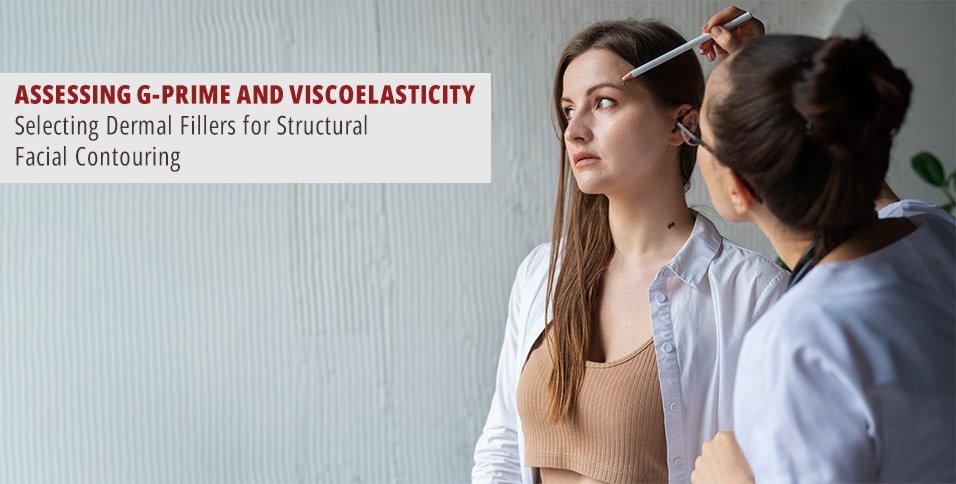
Choosing the right injectable product for deep structural facial contouring requires a clear look at mechanical behavior under load. Facial tissues exert complex forces. Mastication, mimicry, and gravity continuously compress, stretch, and shear anything placed beneath the skin. When the goal is to define a jawline, project a chin, or restore severe midface volume loss, relying solely on volumetric swelling or concentration percentages often leads to migration, flattening, or premature degradation. Rheology gives us the exact framework needed to predict how a gel behaves once implanted.
Rheological Fundamentals: Defining Elasticity and Viscosity
Rheology is the study of how soft matter deforms and flows. In the context of hyaluronan matrices, two main mechanical parameters dictate performance: elastic modulus, represented mathematically as G-Prime, and viscous modulus, represented as G-Double-Prime. The combination of these two values defines the overall viscoelasticity of a given gel. G-Prime measures the amount of energy a material can store elastically when a specific force is applied. In practical terms, it measures firmness and resistance to deformation. A high G-Prime filler acts like a firm spring. When surrounding tissues press against it, the material resists the push and bounces back toward its original shape.
Viscous modulus represents the loss of energy through flow under stress. When a gel experiences continuous movement, part of that force dissipates as heat or shear flow. The ratio of viscous behavior to elastic behavior is known as Tan Delta. A low Tan Delta means elastic behavior dominates over fluid behavior, making the gel sturdy and resistant to sagging. When planning structural facial contouring, selecting products with a high G-Prime filler profile and low Tan Delta ensures the material retains its shape under significant physical pressure.
Tissue Dynamics and Targeted Anatomical Placement
Tissues vary significantly in density and mobility across different anatomical planes. Subcutaneous fat in the cheeks requires a different mechanical response than periosteal placement along the mandible. Injecting a soft, low G-Prime product deep on the bone usually produces disappointing outcomes. The weight of the overlying soft tissue matrix spreads the gel outward laterally rather than lifting it vertically. The result is unwanted widening instead of crisp definition. Conversely, placing a rigid, cross-linked HA structural filler too superficially can create visible lumps, unnatural immobility during facial expression, and localized tissue strain. Matching dermal filler structural support to the depth and resistance of the target tissue layer is fundamental to predictable results.
Gel firmness depends directly on cross-linking technology and polymer concentration. Cross-linking binds individual hyaluronic acid strands into a three-dimensional molecular network. Unmodified hyaluronic acid degrades inside human tissue within hours to days due to hyaluronidase enzymes and free radicals. Adding chemical cross-linkers, most commonly 1,4-butanediol diglycidyl ether, creates a durable matrix. A higher density of cross-linking increases the gel’s structural rigidity comparison metrics. However, excessive cross-linking can compromise biocompatibility or cause chronic inflammatory reactions. Manufacturers must balance cross-linking efficiency, total polymer concentration, and hydration capacity to optimize viscoelastic properties dermal filler behavior.
Physical testing reveals clear differences across available product lines. Laboratory measurements using oscillatory rheometers show that gels with high concentration and dense cross-linking show elevated resistance to dynamic shear. A 2018 comparative rheological study published in dermatologic literature demonstrated that fillers engineered for deep supraperiosteal placement exhibit G-Prime values ranging between 300 and 800 Pascals, depending on frequency and strain parameters. In contrast, soft gels designed for superficial fine lines often register G-Prime values below 100 Pascals. These physical distinctions explain why filler selection by G-Prime value directly dictates clinical performance and duration.
Clinical Application of Structural Formulations
When evaluating materials engineered specifically for high structural demand, Revolax stands out as a dense, monophasic hyaluronic acid formulation. Revolax utilizes a high degree of cross-linking combined with a consistent, monophasic structure that provides high cohesion and high physical resistance to displacement. Medical professionals often buy Revolax online for clinic use to address areas requiring strong projection, such as the chin, cheekbones, and mandibular angle. The cross-linked HA structural filler properties of Revolax allow practitioners to establish defined contours while maintaining low swelling rates post-procedure. The balance between gel rigidity and elasticity in the Revolax range makes it a reliable option for deep anatomical placement where structural stability is required.
The core operational criteria for targeted placement include:
- Matching the elastic modulus directly to the depth of the target anatomical plane
- Verifying high cohesivity to prevent gel fragmentation under muscular movement
- Balancing cross-linking density with hydration potential to limit excessive post-injection swelling
The difference between a structural vs volumizing filler depends entirely on how force distributes through the gel. A volumizing filler absorbs water and expands, filling space primarily through volume displacement. A structural filler acts as a mechanical pillar. It lifts overlying muscle, fascia, and subcutaneous fat purely through its elastic resistance to compression. When treating the lower third of the face, structural support takes precedence over simple hydration or volume expansion. The deep fat pads of the chin and jawline require facial contouring injectables capable of maintaining projection despite constant movement from the mentalis and masseter muscles.
Mechanical Behavior Under Injection and Shear Forces
Elastic modulus filler selection must also factor in extrusion force and injectability. Higher G-Prime materials naturally present higher resistance when passing through thin-gauge needles or cannulas. Rheological engineering solves this challenge through shear-thinning properties. Under high shear rates, such as the rapid force exerted while pushing the gel through a narrow needle hub, the internal cross-linked network temporarily aligns, allowing the gel to flow smoothly. Once the gel leaves the needle tip and settles into the resting environment of the target tissue, the shear rate drops to zero. The gel immediately recovers its high G-Prime state, regaining its original firmness and lifting power.
Cohesivity plays a parallel role alongside viscoelasticity. Cohesivity measures the internal affinity of a gel matrix, determining how well the material holds together as a unified mass under pressure. A gel can possess a high G-Prime value, yet if its cohesivity is extremely low, it may fragment into smaller particulate clusters when exposed to dynamic physical force. Highly cohesive gels maintain continuous integrity, spreading force evenly across the entire implant rather than breaking apart. Selecting a cross-linked HA structural filler that combines high cohesivity with high elasticity minimizes the risk of gel displacement into adjacent anatomic compartments over time.
Long-Term Degradation and Predictable Outcomes
Long-term stability within the tissue depends heavily on resistance to enzymatic breakdown and mechanical degradation. Continuous facial movement subjects implanted gels to millions of micro-strains over months of wear. Shear stress breaks down weaker physical bonds, slowly reducing the functional lifting capacity of lower-grade formulations. Products designed with optimized cross-linking density retain their viscoelastic profile far longer under these conditions. Clinical monitoring demonstrates that high-rigidity gels maintain structural definition significantly longer than lower G-Prime counterparts placed at identical depths.
Systematic evaluation of viscoelastic parameters shifts aesthetic planning away from subjective trial and error toward objective scientific selection. Mapping the face according to local mechanical forces allows practitioners to match tissue resistance with the correct gel properties. Deep bony defects, weak chin projections, and severe structural loss demand high resistance to compression. Soft, dynamic areas require low-resistance fluidity. Analyzing G-Prime, viscous modulus, and cohesivity before choosing a gel leads directly to predictable projection, crisp anatomical contours, and durable stability.