Introduction
A man in his late thirties sits in the waiting room having thought about this appointment, on and off, for roughly a decade. He has a lower front tooth that rotated years ago and has slowly pulled two neighbours out of line with it. Every time he sees a photograph of himself mid laugh, he notices. Every time he considers doing something, a question stops him, usually about age, or work, or how long it would take.
That description fits a large share of adult orthodontic patients in Dubai. Questions pile up over years and rarely get asked out loud. Here are the ones that come up most often at consultations, answered plainly.
Table of Contents
- Introduction
- Am I Too Old for This?
- Will Everyone at Work Notice?
- How Long Does Treatment Take?
- Does It Hurt?
- What About Travel and Relocation?
- Do I Need to Fix My Gums First?
- Will My Teeth Move Back Afterwards?
- What Actually Happens at the First Visit
- Conclusion
- Contact Us
Am I Too Old for This?
Teeth move in response to gentle, sustained pressure, and that biological process continues throughout adult life. Bone remodels more slowly than it does in a fifteen year old, which can mean a longer treatment period for braces, though the mechanism itself works the same way at forty as it does at fourteen.
Adult clinics look noticeably different from how they did twenty years ago. Patients in their thirties, forties and fifties are common, and a fair number are treating something they were told about as teenagers but never acted on. Age alone rarely rules anyone out. Gum condition and bone support matter far more than the number on a birth certificate.
Will Everyone at Work Notice?
This concern outranks every other one among working adults, particularly people in client facing roles.
Several routes exist. Metal braces are the most visible and remain the workhorse of orthodontics because they handle complex movements reliably. Clear braces use tooth coloured ceramic brackets on the outer surface, which photograph far more discreetly. Invisible braces, meaning clear aligner trays, come out for meals and are missed entirely by most people in normal conversation. Lingual braces sit behind the teeth and stay hidden from the front altogether.
Worth knowing before you choose: nothing is completely undetectable at close range. Aligners require small tooth coloured attachments bonded to some teeth, and those are visible if someone looks carefully. Ceramic braces show up if a colleague sits next to you at lunch. What all the discreet options genuinely deliver is an appearance most people will not register across a meeting table.
How Long Does Treatment Take?
Honest answer: it depends on the case, and any figure quoted before an examination is a guess.
What determines the timeline is how far teeth need to travel, whether the bite needs correcting alongside the alignment, how the bone responds, and how consistently you follow instructions. Minor alignment of front teeth can finish relatively quickly. Cases involving bite correction, significant rotations or gaps from missing teeth take considerably longer.
Aligner treatment carries an additional variable, which is wear time. Trays only work while they are in the mouth, and plans assume they stay in for the great majority of each day. Removing them frequently for coffee meetings and long dinners stretches the treatment out.
Your orthodontist should give an estimated range at the end of the assessment, with the reasoning behind it.
Does It Hurt?
Expect soreness rather than sharp pain. Teeth feel tender for a few days after braces are fitted and again after each adjustment, and biting into firm food during that window feels uncomfortable. Soft meals and cold drinks help. Painkillers you would normally take for a headache are usually enough.
Cheeks and lips take a week or two to toughen up against the brackets, and orthodontic wax covers any spot that rubs in the meantime. Aligner wearers describe tightness for a day or so each time a new tray goes in.
Fitting the braces themselves involves no drilling and no injection. Brackets are bonded to the outer surface of each tooth with an adhesive, the wire is placed, and the appointment ends. Adults bracing themselves for something closer to a filling appointment usually find the visit uneventful.
Discomfort fades as treatment settles into a rhythm. Most patients report that the anticipation was worse than the reality.
What About Travel and Relocation?
Dubai life involves flights, and often an eventual move to another country. Both are manageable with planning.
Tell the clinic your travel pattern at the consultation. Appointment intervals can often be arranged around long trips, and aligner patients can sometimes carry several trays with them. Ask what to do if a bracket loosens abroad, and keep wax and the clinic number in your bag.
Relocation is straightforward when records are digital. Scans, photographs and treatment plans transfer to a treating orthodontist in another city far more easily than plaster models ever did. Raise it early if you already know a move is likely within a year or two, because it may influence which system suits you.
Do I Need to Fix My Gums First?
Frequently, yes, and this surprises people.
Moving teeth through inflamed gum tissue is not advisable, so orthodontic treatment usually begins after gum health is stable. That might mean a scaling appointment and a stretch of improved home cleaning before anything is bonded. Existing decay and old failing fillings normally get dealt with first as well.
Adults also need to know that brackets make cleaning slower. Plaque collects around bracket edges and along the gum line, and adults with a history of gum problems need to be particularly consistent during treatment. Your dentist will set out a routine that suits your situation.
Will My Teeth Move Back Afterwards?
Teeth have a tendency to drift after treatment, which is why retainers exist. Retention is not an optional extra tacked onto the end. It is part of the treatment.
Retainers come as removable clear trays worn at night, or as a thin wire bonded behind the front teeth, and many cases use both. Wearing them as instructed over the long term is what holds the result in place. Adults who had braces as teenagers and stopped wearing retainers are, in fact, a significant proportion of people now seeking treatment a second time.
What Actually Happens at the First Visit
The consultation is a conversation and an examination, not a commitment.
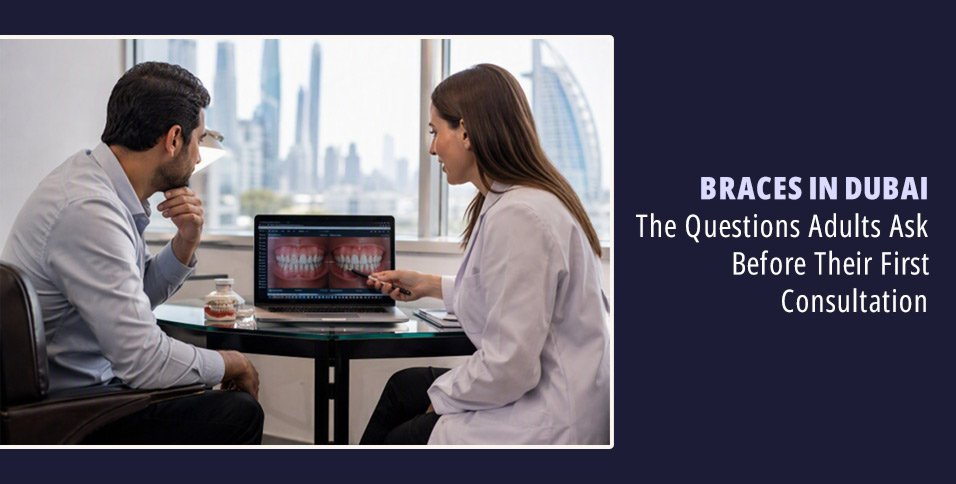
Expect a clinical examination of teeth, gums and bite, photographs, radiographs where clinically indicated, and usually a digital scan taking a few minutes with a handheld wand. From that, the orthodontist explains what is happening in your mouth, which approaches are realistic, and what each involves in terms of time, appointments and daily routine. You should leave with a plan you understand and the space to think it over.
Bring your questions written down. Ask to see your own scan on screen, since looking at your teeth from angles a mirror cannot reach usually makes the explanation click.
Conclusion
Adults considering braces in Dubai tend to circle the decision for years, held back by assumptions about age, appearance and time rather than by anything a dentist has told them. Most of those assumptions do not survive a proper consultation. Options now range from metal braces through clear braces to invisible braces, treatment fits around working life more easily than it once did, and the biology cooperates well into later decades. Booking the assessment costs you an hour and replaces a decade of guessing with an actual answer.