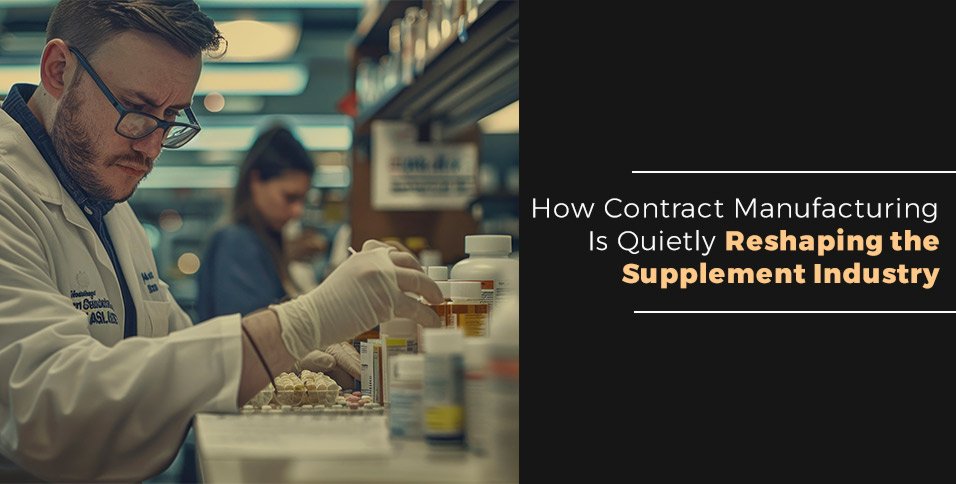
For most of the past two decades, launching a supplement brand meant choosing between two expensive compromises. Build a production facility — millions in capital, years of regulatory paperwork, and a technical team most founders do not have. Or accept whatever a white-label catalogue offered, which usually meant selling the same formula as a dozen competitors under a different label.
Contract manufacturing has broken that trade-off. The effects are now visible across the whole industry: in how quickly brands launch, how often they iterate, and what consumers can actually buy.
The economics changed first
The defining shift is in minimum order quantities. Traditional private-label production often started at 10,000 units or more per SKU, which forced brands to bet their entire budget on one formula and one flavour. Today, a growing number of manufacturers work from 3,000 pieces per SKU — in some cases lower for samples and pilot runs. That takes the cost of a first production run from six figures down to something an e-commerce brand can fund out of working capital.
The consequence is behavioural, not just financial. Brands now test three formulations instead of betting on one. They discontinue what does not sell and reallocate within months rather than years. The winners in this environment are not the companies with the largest factories — they are the operators who treat formulation as a portfolio.
What contract manufacturing actually covers
Many buyers assume they are purchasing production capacity. In practice, a full-service contract partner covers a much wider chain:
- Formulation development and R&D, including stability work
- Ingredient sourcing, qualification and traceability
- Manufacturing across dosage forms
- In-process and finished-product quality control
- Packaging, labelling and artwork compliance
- Regulatory and export documentation
The documentation is the part buyers most often undervalue — and the part that decides whether a product can actually be sold into a given market.
Quality is now the competitive battleground
Regulators, retailers and marketplaces have all raised the bar. A Certificate of Analysis is no longer a courtesy document; it is the evidence that a batch meets specification for identity, potency, purity, microbial limits and heavy metals. Batch records show that the batch was made the way it was supposed to be made.
Two signals separate serious manufacturers from the rest. First, third-party testing from accredited laboratories, rather than in-house claims alone. Second, certification scope — GMP, ISO 22000, HACCP — verified on the certificate itself, not just displayed as a logo on a homepage. “We test everything” without paperwork to support it is a red flag, not a reassurance.
Dosage form decides cost, compliance and shelf appeal
The format conversation often happens too late. Capsules, tablets, softgels, gummies, powders and drops each carry different implications for unit cost, bioavailability, stability, shelf life and consumer acceptance. Gummies have grown fastest in consumer demand, but they are also among the most demanding to produce consistently — heat, moisture and pectin or gelatin behaviour all affect the finished dose.
Choosing a format before choosing a manufacturing partner is backwards. The form constrains the formula, the packaging and the compliance path.
Certifications are market access, not decoration
Halal, kosher, organic, non-GMO and vegan certifications are frequently treated as marketing badges. Functionally they are entry tickets. For a brand exporting to the Middle East or Southeast Asia, a genuinely halal-certified line — pork-free gelatin, alcohol-free processing, documented separation from non-compliant materials — is not optional. The same logic applies to organic claims in the EU or non-GMO positioning in North America. Certification expands the addressable market; its absence silently removes it.
Supply chain visibility and lead times
Ingredient traceability has moved from a compliance checkbox to a commercial differentiator. Buyers increasingly want to know the origin of a raw material, its testing history and whether a substitute was used. Lead times matter just as much: a realistic four-to-six-week production window, with spot delivery capability for repeat orders, is what allows a brand to respond to demand instead of forecasting it perfectly.
How to evaluate a manufacturing partner
A practical checklist, in roughly the order it should be applied:
- Certification scope — what exactly is certified, and by whom
- Documentation turnaround — samples, COAs and specifications, not just sales decks
- True cost per unit — including capsule, packaging and testing minimums
- Intellectual property terms — who owns the formula, and what the NDA covers
- Communication — a single accountable contact and predictable response times
- Scalability — whether the same partner can take you from 3,000 to 300,000 units
Brands working with a GMP-certified contract manufacturer in Guangzhou typically apply this list to compare two or three candidates on documentation rather than on price alone, because price differences between serious suppliers are far smaller than the differences in what they can prove.
What still goes wrong
Testing costs are frequently understated at quotation stage. Component minimums — capsules, jars, cartons — can quietly raise the effective MOQ well above the stated figure. Specifications drift between the sample and the production batch unless they are locked in writing. And wellness language with no regulatory basis continues to create problems for brands at the point of listing, not at the point of sale.
Where this is heading
Three forces look likely to shape the next phase: consolidation among contract manufacturers as compliance costs rise, greater transparency as buyers demand ingredient-level traceability, and technology — automated in-process inspection, digital batch records — moving from large facilities down into mid-sized ones.
Underneath all of it is a simpler point. The brands that scale are not the ones attached to the biggest plant. They are the ones that choose the right partner early, lock specifications in writing, and treat quality documentation as a sales asset rather than paperwork.