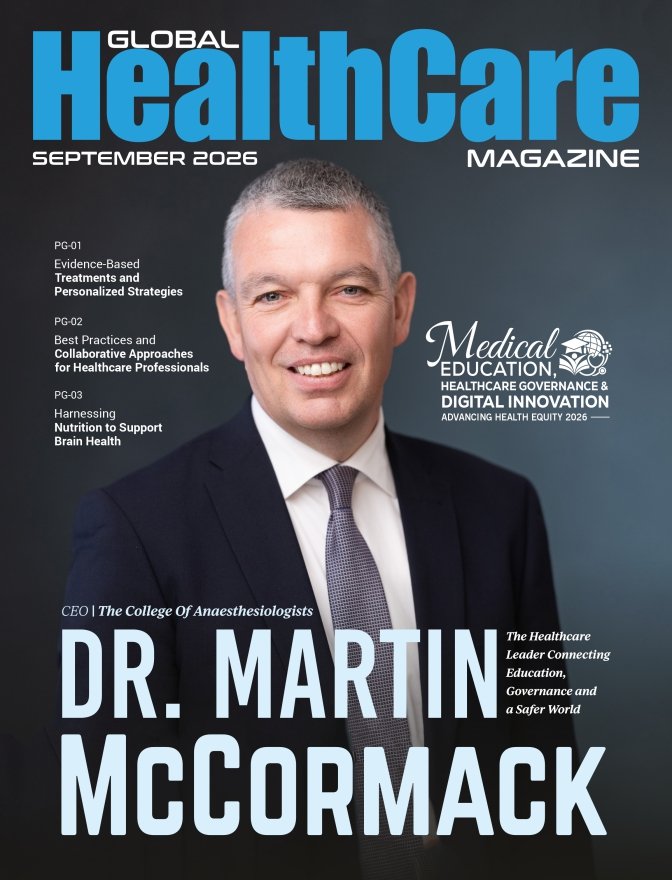
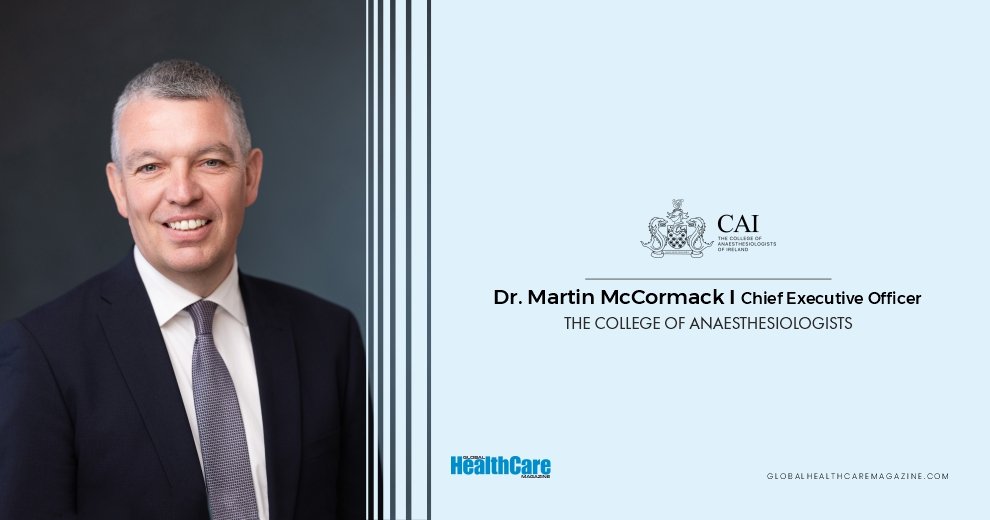
Long before he held a title with the word chief in it, Dr. Martin McCormack sat with families in the hardest hours of their lives. He worked in palliative care between Beaumont Hospital and St Francis Hospice, and he spent three years as a trauma counsellor with patients and families in intensive care. Later, as Head Medical Social Worker at Beaumont Hospital, he led a team of thirty-six medical social workers, including work developing an acute hospital bereavement service.
It is not the resume most people imagine when they picture the Chief Executive Officer of the College of Anaesthesiologists of Ireland. But it is, in Dr. McCormack’s telling, exactly where his understanding of healthcare began. “Healthcare may be organised through institutions, professions, policies and budgets,” he says, “but it is ultimately experienced one person and one family at a time.”
That undivided view has never left him. It shaped the questions he would go on to ask as a technology leader, an educator, a governance figure, and now, as the steward of one of Ireland’s key postgraduate medical training bodies.
From Social Work to the Server Room
The jump from medical social work to Chief Information Officer of Beaumont Hospital looks, on paper, like an unlikely detour. Dr. McCormack does not see it that way. For him, technology was never really about computers. It was about information, and information was the thing that determined whether a clinician could make a good decision.
“A clinician making a decision without the right information, a patient repeatedly explaining their history, disconnected departments maintaining separate records, or an organisation unable to understand its own performance were not simply technology problems,” he says. “They were healthcare problems.”
That distinction became a guiding principle, one he has carried into every role since. Digital transformation, he insists, is fundamentally about people, information and better decisions, not technology for its own sake.
Arriving at the College
Dr. McCormack’s path eventually led him to postgraduate medical education, and ultimately to the leadership of the College of Anaesthesiologists of Ireland. It is, in many ways, the role where the separate strands of his career finally converge.
Anaesthesiology sits inside some of the most safety-critical spaces in medicine: operating theatres, intensive care, perioperative medicine, pain medicine, and the management of critically ill patients. In that institution, he saw an opportunity to strengthen something whose reach extends well past examinations and curricula, into patient safety, workforce capability and the performance of the wider health system.
Since taking on the role, his priorities have spanned educational excellence, organisational renewal, workforce development, digital transformation, international collaboration, good governance, and building an inclusive organisational culture.
One of the most tangible outcomes has been the doubling of specialist anaesthesiology training capacity in Ireland. It is not, he stresses, simply an educational milestone. It is a strategic investment in the country’s future workforce, made at a moment of rising demand, demographic change and sustained pressure on the system. For him, that expansion is a direct expression of long-term workforce planning: the specialist required years from now has to begin training today.
“When we educate a specialist doctor, we are not simply awarding a qualification,” he says. “We are developing someone who may make thousands of consequential decisions over the course of a career.”
That, to him, is the real job of a postgraduate training body. Not administering exams and curricula, but anticipating the capabilities that future specialists will need, decades before those specialists ever step into a theatre. The doctors entering specialist training today, he points out, will still be practising well into the 2040s. The question is not only whether they are ready for today’s health service. It is whether they are being prepared for the one that is coming. Education, professional standards and patient safety, he says, should be understood as parts of the same system, not competing priorities.
Teaching What Cannot Be Automated
Alongside his executive role, Dr. McCormack is an Adjunct Associate Professor at Trinity College Dublin, where he teaches undergraduate and postgraduate students about human service organisations and leadership. He brings the same conviction to the classroom as the boardroom: that institutions like hospitals cannot be run as though they were machines to be optimised.
“These are organisations built around people, relationships, professional judgement and purpose,” he says.
For him, the relationship between teaching and leadership runs in both directions. Standing in front of students forces him to test his own assumptions and stay close to how a new generation thinks about organisations and technology. “Teaching keeps you intellectually curious,” he says. “The moment a leader believes they have nothing left to learn is probably the moment they should become concerned.”
That belief in developing people beyond himself is not confined to the lecture hall. It runs through his work as an executive coach and mentor to emerging leaders, and through his wider commitment to developing capability in others.
The Question Artificial Intelligence Is Forcing Medicine to Ask
Nowhere does Dr. McCormack’s thinking feel more urgent than on the subject of artificial intelligence. Medical education, he says, has always leaned heavily on the acquisition and testing of knowledge. That foundation is now being shaken.
“If AI can pass the examination, write the essay and increasingly provide the answer, we have to ask what exactly we are educating people for,” he says.
His answer is not that knowledge has stopped mattering. It is that knowledge alone is no longer enough. What matters increasingly is judgement: whether a doctor can interpret incomplete information, recognise uncertainty, challenge an answer that sounds convincing but might be wrong, and take responsibility for a decision when the evidence does not point cleanly in one direction.
“The question is no longer simply what a doctor knows,” he says. “It is how well they can think, decide and act when the answer is uncertain.”
For curricula and assessment, that means building toward critical reasoning, adaptability, communication, ethical decision-making, digital literacy, teamwork, and the capacity to work intelligently alongside technology rather than in competition with it.
But Dr. McCormack sees a broader governance question rising up behind the educational one, a question boards and executives across every sector are beginning to confront. Which decisions can appropriately be supported, or delegated, to technology? Where must human judgement remain decisive? How does an organisation challenge an algorithmic output that sounds authoritative? And when technology contributes to a decision, where does accountability finally rest?
On that last question, he does not hesitate.
“Technology can inform a decision,” he says. “It cannot remove our responsibility for making it.”
Workforce Planning Begins Years Before the Vacancy
Leading a postgraduate training body has also pulled Dr. McCormack directly into one of healthcare’s most persistent difficulties: workforce shortages. He is wary of how easily the word shortage can flatten a much deeper problem. A gap in staffing rarely begins the day a hospital fails to fill a position. It often began a decade earlier, in a training pipeline that was never built wide enough.
“The specialist we will need ten years from now may need to enter training today,” he says.
That reframes workforce planning entirely. It is not, in his view, an annual count of vacancies. It has to account for population need, demographics, service design, training capacity, specialty and geographical distribution, retention, and the technological change reshaping how care is delivered. The question shifts from how many doctors do we need to something more demanding: What capability will the population need, where will it be needed, and what has to be decided now to build it?
Turning Training Data Into Foresight, and Incidents Into Learning
That same instinct, to look forward rather than simply record the past, shapes how Dr. McCormack thinks about learning analytics. Postgraduate medical education generates enormous volumes of information: training progression, assessment results, clinical exposure, examination performance, workforce flows. Too often, he says, it sits scattered across separate systems, used mainly to explain what has already happened.
He sees a bigger opportunity in using that same information to anticipate what happens next: where learners may need support, where training environments are becoming strained, and whether the pipeline of future specialists actually matches the healthcare need ahead of it.
But he is careful not to romanticise data itself. “The value of data is not in the dashboard,” he says. “Its value lies in the decision that changes because of it.” Alongside the opportunity, he raises the governance questions that come with it: who owns the data, what decisions algorithms should be allowed to influence, how learners are protected from inappropriate profiling, and how prediction is kept separate from certainty.
That philosophy has recently taken on a very concrete form. In 2026, the College signed a memorandum of understanding (MOU) with the HSE, building a bridge between national patient safety intelligence and postgraduate medical education. Through it, the College can now access relevant incidents recorded within the National Incident Management System (NIMS), operated by the State Claims Agency, and analyse those relating to anaesthesiology, intensive care and pain medicine.
The purpose, he is careful to say, is not simply to examine what went wrong. It is to identify patterns, extract learning, and feed that learning back into education and professional practice, closing a loop that runs from incident, to insight, to education, to safer care. For Dr. McCormack, that loop is what separates a system that merely records its failures from one that actually learns from them.
Governance as the Architecture of Safety
Dr. McCormack has also served across board and committee roles in healthcare and other national institutions, giving him governance experience from both the executive and non-executive perspectives. He resists the idea that governance is something distant from patient care, confined to board papers and risk registers. For him, it rests on a small number of essential principles: purpose, accountability, transparency, trust, and constructive challenge.
“Patients experience healthcare at the bedside, in the clinic, in the operating theatre and sometimes on an emergency department trolley,” he says. “But the conditions that make excellent care possible are shaped long before those encounters.”
An investment decision determines whether a service has enough capacity. A workforce decision determines whether the right professional is standing in the room. A technology decision determines whether that professional has the information they need. An education decision shapes their competence before they ever arrive. “Governance is ultimately about creating the conditions in which people can deliver excellent care safely,” he says.
That same period has also been one of quiet institution building. In 2025, the College achieved Silver accreditation from the Irish Centre for Diversity, external recognition of its commitment to embedding diversity and inclusion into its culture. For Dr. McCormack, building a high-performing institution was never only a matter of strategy and systems. It also meant creating an environment in which people feel respected, included, and able to contribute.
Leading Where No One Person Holds the Answer
Dr. McCormack’s doctoral research examined professional identity and strategic renewal within multistakeholder environments, a subject that sits close to the broader challenges of healthcare leadership. Authority in healthcare, he points out, is never held by one person or institution. It is spread across government, regulators, boards, professional bodies, clinicians, universities, patients and the public, each holding a different piece of legitimacy and expertise. The same stakeholders, he notes, can look at exactly the same problem and understand it in entirely different ways.
That reality has shaped his entire model of leadership. The heroic leader who claims to possess all the answers is poorly suited to a system this complex. “No single organisation, and certainly no single individual, can transform healthcare alone,” he says.
Instead, he describes the leaders healthcare will need as boundary spanners, people able to move between professional and institutional worlds, hold competing perspectives without losing sight of purpose, and build enough shared legitimacy for people to act together. That, in his view, calls for real intellectual humility. Being able to say “I don’t know yet” is not a failure of leadership. What matters is what a leader does next: whether they can gather the right expertise, invite honest disagreement, weigh the evidence, and change course when new evidence arrives.
“In complex healthcare systems, leadership is not about having all the answers,” he says. “It is about creating the conditions in which better answers can emerge.”
His research has also shaped how he thinks about professional identity itself. Too often, he says, it is treated as resistance to change waiting to happen. He sees it differently. Values like responsibility, expertise, service, autonomy and commitment to patients can become the very legitimacy on which change is built, provided leaders first understand what professionals believe they are being asked to protect, or to give up, when change arrives. Successful transformation, in his words, connects innovation with professional purpose rather than setting the two against each other.
Global Health as Partnership, Not Export
Dr. McCormack’s understanding of healthcare has never stopped at Ireland’s coastline. Through sustained engagement in Malawi and Malaysia, and through the College’s partnership with the College of Anaesthesiologists of East, Central and Southern Africa (CANECSA), he has built a clear philosophy: sustainable progress is not about how indispensable an outside partner becomes. It is about how much capability remains once that partner has stepped back.
“The measure of a successful global health partnership is not how indispensable we become,” he says. “It is how much sustainable capability remains when we are no longer in the room.”
His work in Malawi deepened his sense that health systems operating with limited resources do not need simplified imports from elsewhere. They need solutions designed around their own context, workforce and ingenuity, built through listening rather than prescribing. “Global health works best when we stop thinking in terms of donors and recipients,” he says, “and start thinking in terms of partners.”
CANECSA offers the clearest example of that philosophy in practice. Established in 2012 by anaesthesiology societies and associations across East, Central and Southern Africa, with support from the College of Anaesthesiologists of Ireland, CANECSA was formed to address a stark reality: there can be no safe surgery without safe anaesthesia, and shortages of trained anaesthesiologists had become a significant barrier to safe surgical access across parts of sub-Saharan Africa.
Rather than sending visiting specialists to treat the symptom, the College, alongside CANECSA, RCSI and regional partners, worked to build training sites, curricula, examinations and accreditation, the institutional capability needed for a region to train and develop its own specialists over the long term.
“Train one specialist, and you influence the care of thousands of patients,” he says. “Build the capability to train specialists, and you can influence a health system for generations.”
In Malaysia, the relationship has run since 2017, built alongside the Malaysian Society of Anaesthesiologists and the College of Anaesthesiologists, Academy of Medicine of Malaysia. Together they have developed specialist training and registration pathways across the country, including Borneo, combining internationally benchmarked examinations with structured, competency-based training organised and managed within Malaysia itself, complete with workplace-based assessment, supervisor reports, research requirements, and a route to gazettement and registration on Malaysia’s National Specialist Register.
“The expertise, commitment and leadership already existed in Malaysia,” he says. “Our role was to work alongside our Malaysian colleagues and support them in building the additional training capacity they wanted for their health system.”
He is equally direct about what success looks like. “The objective was never to make Malaysia dependent on Ireland,” he says. “Success is the opposite: strong Malaysian institutions, supported by Malaysian clinicians, developing the specialists Malaysia needs.” He is quick to add that the learning has never travelled in one direction only; working across such different geographical settings, from major urban centres to communities in Borneo, has taught him as much as it has taught his Malaysian colleagues.
Health Equity in a Fragmenting World
Asked about health equity, Dr. McCormack reaches for history rather than abstraction. Progress in global health over the past eighty years, he says, did not happen by accident. It was built through institutions, international cooperation, education and investment, and a shared belief that major health challenges could be solved collectively. The results have been extraordinary: dramatic reductions in child mortality, and major progress against HIV/AIDS and malaria.
He believes that record now stands at risk. International cooperation is becoming more fragmented at precisely the moment health threats are becoming more interconnected. Pandemics, climate change, antimicrobial resistance and workforce shortages do not respect national borders. Yet history, he points out, shows that even during periods of deep political division, countries and institutions have still found ways to work together around shared health objectives.
That is part of why he sees education as one of the most powerful and sustainable forms of global health infrastructure available. His experience in Malawi, Malaysia and through CANECSA gives that belief a practical dimension: sustainable global health must build capability rather than dependency.
The broader lesson is that wealthy countries cannot solve their own workforce gaps simply by recruiting scarce professionals from systems that need them themselves. The alternative is to invest in the educational institutions, trainers, curricula, assessment systems and professional infrastructure that let countries and regions develop and retain their own specialist workforce, a shift he describes as moving from brain drain to brain gain, and from international assistance to genuine partnership.
“Building a safer world requires us to recognise that strengthening healthcare capability anywhere ultimately contributes to health security everywhere,” he says.
The history of global health should give us confidence. Humanity has repeatedly demonstrated that it can cooperate across borders to address enormous challenges. The question for today’s healthcare leaders is whether we have the courage to continue investing in the institutions, people and partnerships that made that progress possible.
At a time when climate change, pandemic threats and antimicrobial resistance require greater international cooperation, the answer cannot be greater fragmentation.
The Thread That Runs Through It All
Across education, workforce planning, technology, governance and global partnership, Dr. McCormack keeps returning to a single idea: patient safety is not owned by one department. It is produced, or eroded, by the whole system working together, long before a patient ever reaches a hospital bed.
He believes the health systems that succeed in the years ahead will not necessarily be the ones with the most advanced technology or the largest datasets. They will be the ones that learn fastest, the ones that identify risk earlier, connect education with workforce need, use data intelligently, cross traditional organisational and professional boundaries, and preserve human judgement even as the tools around them grow more powerful. That kind of leadership, he says, calls for people who are comfortable with uncertainty, capable of listening, able to build trust across very different groups, and confident enough to change direction when the evidence demands it.
He measures his own leadership less by what has been delivered in any one period than by the capability it leaves behind. Strong people, inclusive institutions, trusted partnerships and systems that learn are, to him, the more meaningful measures of leadership. That, to him, is the fuller agenda hiding beneath achievements that might otherwise look unconnected: doubled training capacity, deeper international partnerships, an accreditation for inclusion, a stronger connection between patient-safety intelligence and postgraduate education, and developing learning analytics.
It is a vision built from decades spent moving between very different settings: a hospice ward, a hospital technology role, a lecture theatre at Trinity, training partnerships in East Africa and Malaysia, and governance work in Dublin. In every one of them, Dr. McCormack has been asking some version of the same question that has remained consistent throughout his career: What does this person need from the system around them, and how do we build it so it holds?
Quotes