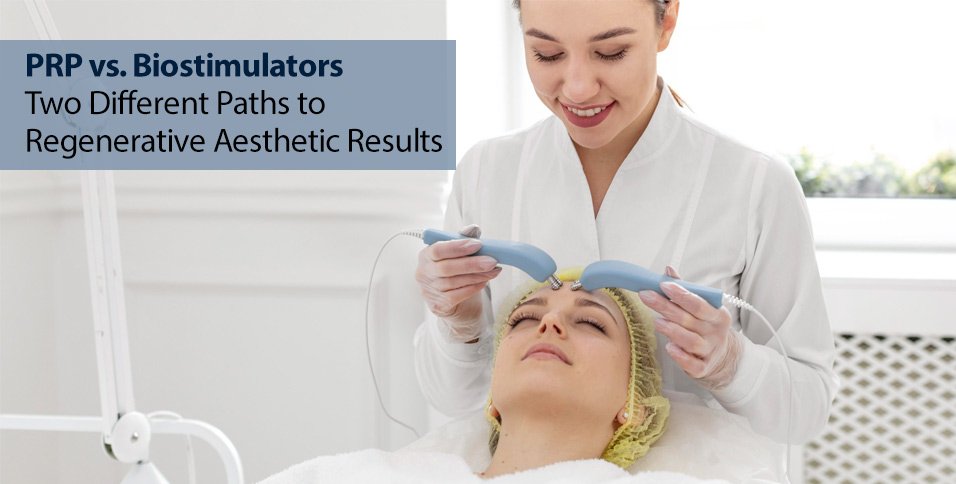
The regenerative aesthetics category has expanded considerably in a short time. Where practices once had to choose between neurotoxins and hyaluronic acid fillers, today’s providers can choose from a growing menu of treatments that work with the body’s biology to produce results, rather than simply adding or blocking a substance to achieve a cosmetic effect. Among the most clinically relevant of these are platelet-rich plasma (PRP) and synthetic biostimulators, represented primarily by poly-L-lactic acid (PLLA) and calcium hydroxylapatite (CaHA).
These two treatment categories are both described as regenerative, and both stimulate collagen production, but the mechanisms, clinical experiences, patient profiles, and regenerative aesthetics training requirements are meaningfully different. Understanding those differences is what allows practitioners to use each modality where it is most appropriate, combine them intelligently where combination adds value, and communicate honestly with patients about what each treatment does and does not deliver.
This article offers a side-by-side comparison of PRP vs biostimulators from a clinical and educational standpoint, covering mechanism of action, onset and duration, best-suited indications, safety considerations, and how to think about sequencing or combining the two in practice.
What Is PRP and How Does It Work in Aesthetic Medicine
Platelet-rich plasma is an autologous treatment; it is derived from the patient’s own blood, making it categorically different from any externally manufactured injectable product. The preparation process involves a standard blood draw, typically 15 to 60ml, followed by centrifugation to separate and concentrate the platelet-rich layer from red blood cells and platelet-poor plasma. The concentrated platelet-rich plasma is then administered to the target area through microinjection or applied topically to open microneedling channels.
The clinical effect of PRP is driven by growth factors released from activated platelet alpha granules, including PDGF (platelet-derived growth factor), TGF-β (transforming growth factor-beta), VEGF (vascular endothelial growth factor), and EGF (epidermal growth factor). These growth factors initiate a cascade of cellular responses: fibroblast proliferation, increased collagen and elastin synthesis, neovascularization, and accelerated tissue repair. The result in aesthetic applications is typically improvement in skin quality, texture, and mild volume restoration over a series of treatments.
An important regulatory note: the use of PRP in aesthetic medicine for facial rejuvenation, hair restoration, and skin quality is generally considered off-label in the United States. PRP hands-on training has FDA-cleared applications in wound healing and certain orthopedic contexts, but aesthetic applications do not carry the same formal clearance. Practitioners should document this in their informed consent process and discuss it with patients clearly at consultation.
Primary aesthetic applications of PRP
- Facial skin quality: Microinjection of PRP improves skin texture, tone, and radiance through fibroblast stimulation and neovascularization. Often combined with microneedling for enhanced channel absorption.
- Hair restoration: Scalp PRP for androgenetic alopecia stimulates follicular activity, extends the anagen phase, and increases hair shaft diameter. A 3-4 session initial series is typical, followed by maintenance every 4-6 months.
- Under-eye rejuvenation: Periorbital PRP addresses volume loss and skin quality in the tear trough area. Technically demanding due to periorbital vessel density and skin fragility.
- Platelet-rich fibrin (PRF): PRF is a second-generation autologous product with a higher concentration of growth factors and a slower release profile than standard PRP, used in aesthetic protocols requiring extended biostimulation.
What Are Biostimulators and How Do Sculptra and Radiesse Work
Biostimulators are injectable products that work by triggering the body’s own collagen-producing cells, fibroblasts, to generate new collagen matrix. Unlike hyaluronic acid fillers that add volume directly through the injected material, biostimulators produce their aesthetic effect through the biological response they provoke. The two primary biostimulators in clinical use are Sculptra (poly-L-lactic acid, PLLA) and Radiesse (calcium hydroxylapatite, CaHA).
Sculptra is a pure biostimulator with no immediate volume effect. PLLA microparticles are injected into the subcutaneous tissue and gradually broken down by the body over weeks to months. As this degradation occurs, it triggers a sustained fibroblastic response; new collagen forms progressively around the dissolving particles. The result is diffuse skin quality improvement and gradual volume restoration that develops over 6 to 12 weeks and can last 24 months or more after a series of treatments. The absence of immediate correction makes patient expectation management critical, and proper dilution is essential; an under-diluted product injected superficially is the primary cause of PLLA nodule formation.
Radiesse works differently. The CaHA microspheres in a water-based carrier gel provide immediate volume correction at the point of injection; the gel gives instant structural support. Simultaneously, CaHA microspheres act as a scaffold around which fibroblasts organize and produce new collagen. As the carrier gel is absorbed over weeks, the scaffold effect of the CaHA microspheres continues to stimulate collagen. Radiesse therefore offers a dual mechanism: immediate correction plus progressive biostimulation, with results typically lasting 12 to 18 months. For practitioners interested in adding Sculptra training or Radiesse protocols to their practice, a dedicated online regenerative medicine program covers product selection, reconstitution, injection technique, and complication management for both agents.
PRP vs. Biostimulators: A Clinical Comparison
Both PRP and biostimulators stimulate collagen, but the path from injection to result, and the clinical experience along the way, differs significantly. Understanding these differences at a protocol level is the foundation of informed regenerative aesthetics training and intelligent treatment planning.
Mechanism of action
PRP delivers growth factors from activated platelets; the patient’s own biology drives the healing and regenerative response. The mechanism is systemic in the sense that it activates the body’s native repair cascade rather than providing an external scaffold. Biostimulators, by contrast, are synthetic or semi-synthetic materials that provoke a foreign body response at a controlled, predictable level; the body produces collagen in reaction to the injected particles. Both pathways produce neocollagenesis, but through fundamentally different signaling mechanisms.
Onset and duration of results
PRP produces gradual improvement over 4 to 8 weeks following each session, with results from a series of 3 to 4 treatments lasting 12 to 18 months depending on the application. Sculptra results begin to develop at 6 to 12 weeks post-treatment and, after a complete series, can persist for 24 months or longer. Radiesse provides some immediate volume on the day of injection, with the full biostimulatory result developing over 3 to 6 months and lasting 12 to 18 months. For patients who want visible improvement quickly, Radiesse is the better single-session option. For patients prioritizing natural progression and longevity, Sculptra’s gradual build is often preferred.
Best-suited indications
- PRP: Hair restoration, overall skin quality improvement, post-procedure recovery acceleration, combining with microneedling for texture and regenerative enhancement.
- Sculptra (PLLA): Diffuse facial volume loss, skin laxity across large surface areas, body biostimulation (arms, décolletage, buttocks), patients seeking long-duration gradual improvement.
- Radiesse (CaHA): Areas requiring both immediate structural correction and biostimulation: hands, jawline, lateral face. Hyperdilute Radiesse for diffuse skin tightening.
Downtime and patient experience
PRP involves standard injection-related bruising and swelling, typically resolving within 3 to 7 days. Patients experience no product-related side effects since the treatment is autologous. Biostimulators carry a similar bruising and swelling profile immediately post-treatment, with one additional consideration: PLLA nodule risk if the product is injected too superficially or under-diluted. Both treatment categories require multiple sessions for optimal results and an extended timeline for full effect patient communication at consultation is a clinical competency as important as injection technique.
CLINICAL NOTE: Neither PRP nor biostimulators are appropriate for all patients. Contraindications for PRP include platelet dysfunction, anticoagulant therapy, and active infection at the treatment site. Sculptra is contraindicated in patients with hypersensitivity to PLLA. Radiesse is not indicated in the lips or periocular area. Patient history review and informed consent must address each modality’s specific profile before treatment.
Combining PRP and Biostimulators: When the Protocols Work Together
One of the clinically interesting developments in regenerative aesthetics certification is the increasing use of PRP and biostimulators in combination or sequence rather than as competing choices. The two mechanisms are genuinely complementary: PRP delivers an immediate growth factor stimulus through autologous biology, while biostimulators provide sustained collagen scaffolding over a longer timeline.
A combination approach might involve administering PRP in the early phases of a treatment plan to stimulate immediate tissue regeneration and accelerate healing, followed by Sculptra sessions at 4 to 6-week intervals to build progressive collagen volume. The PRP growth factor environment may enhance the fibroblastic response to the PLLA particles. Radiesse with PRP has been used in areas where both immediate structural support and biological regeneration are desired; the CaHA scaffold and the PRP growth factor cascade operate at different depth layers and at different time points.
The evidence base for combination protocols is growing but not yet standardized. Practitioners who incorporate combination regenerative treatments should have documented training in each modality individually before combining them, and should apply the same rigorous patient selection and consent standards to combination protocols as to single-modality treatments.
Choosing Your Regenerative Aesthetics Training Path
The decision between PRP training and biostimulator training or pursuing both sequentially depends on the provider’s existing skill set, patient population, and practice growth goals. Neither modality is more advanced than the other in a categorical sense; they serve different clinical purposes and require different technical knowledge.
When to start with PRP
PRP is an appropriate starting point for providers who are comfortable with venipuncture, have existing injector experience, and want to add a regenerative service that is autologous, straightforward in terms of product management, and versatile across both skin quality and hair restoration applications. Online PRP training for physicians builds the foundational science centrifuge physics, growth factor mechanisms, and patient selection while hands-on supervised practice develops the venipuncture and injection competency. Practitioners who want to work with autologous PRP can build confidence through hands-on PRP training that pairs online learning with supervised, live-model practice.
When to start with biostimulators
Biostimulators are appropriate for providers who are already comfortable with deep injection technique and volume assessment, typically those with existing dermal filler experience. The product reconstitution requirements for Sculptra, the dilution variables for hyperdilute Radiesse, and the management of delayed PLLA nodules all require a clinical foundation that maps more closely to advanced filler experience than to the PRP pathway.
For providers with the appropriate injectable background, biostimulator training opens access to a treatment category with exceptional patient retention value. Sculptra’s 24-month duration creates natural recall visits, and the gradual result build is a distinctive clinical experience that differentiates a practice from standard filler-heavy menus.
The case for training in both: PRP certification online and biostimulator certification
The most versatile regenerative practice menu combines PRP training with biostimulator certification online not because every patient needs both, but because different patients need different things. Some patients’ aging concerns are addressed by skin quality improvement through PRP. Others need structural collagen restoration through Sculptra or immediate correction plus biostimulation through Radiesse. The provider who can accurately assess which modality serves which patient, and sequence or combine them intelligently, delivers demonstrably better outcomes and builds a more resilient practice revenue mix.
Safety, Compliance, and Scope of Practice Considerations
Both PRP and biostimulator treatments require medical licensure in the United States. All injection procedures including the blood draw and centrifuge steps of PRP constitute the practice of medicine and must be performed or properly delegated by a licensed provider (MD, DO, NP, PA, or RN under appropriate delegation). No aesthetician or medical assistant scope of practice in any US state permits independent performance of these procedures.
Vascular safety and complication management
Facial injection of any material autologous or synthetic carries vascular risk. PRP injected intravascularly carries the same arterial embolism risk as any other injectate, though the clinical consequence may differ from HA filler due to the absence of a reversibility agent. Biostimulators are not reversible with hyaluronidase. This makes anatomical knowledge, intravascular aspiration awareness, and low-pressure injection technique critical safety skills for providers offering either treatment. Vascular safety content should be present in any regenerative aesthetics course online claiming to prepare providers for real patient care.
Documentation and informed consent
Informed consent for PRP aesthetic treatments must acknowledge the off-label nature of the procedure and the current state of the evidence base. For Sculptra, consent should address the gradual onset timeline, the multiple session requirement, and the nodule risk profile. For Radiesse, the dual mechanism and timeline should be described. In all cases, state regulations governing scope of practice and delegation should be confirmed with the state medical and nursing boards before adding any regenerative injectable service to a practice menu.
Conclusion
PRP and biostimulators share a common purpose stimulating the body to regenerate but achieve it through different biological pathways, with different patient experiences, different result timelines, and different training requirements. PRP uses the patient’s own growth factor biology to initiate repair and regeneration. Biostimulators use synthetic or semi-synthetic particles to trigger a sustained fibroblastic collagen response. Both have well-defined clinical roles, strong patient demand in 2026, and the capacity to complement each other within a comprehensive regenerative aesthetics practice.
The choice of where to begin is less important than the quality of the training foundation. A platelet rich plasma training program that covers the science, the technique, and the compliance framework produces a provider who can use PRP safely and intelligently. A collagen biostimulation course that covers PLLA and CaHA reconstitution, injection depth, and complication management produces a provider who can deliver Sculptra and Radiesse with the precision the products require. Providers who complete both develop a clinical vocabulary for regenerative aesthetics that is increasingly what patients in the 2026 market are seeking.