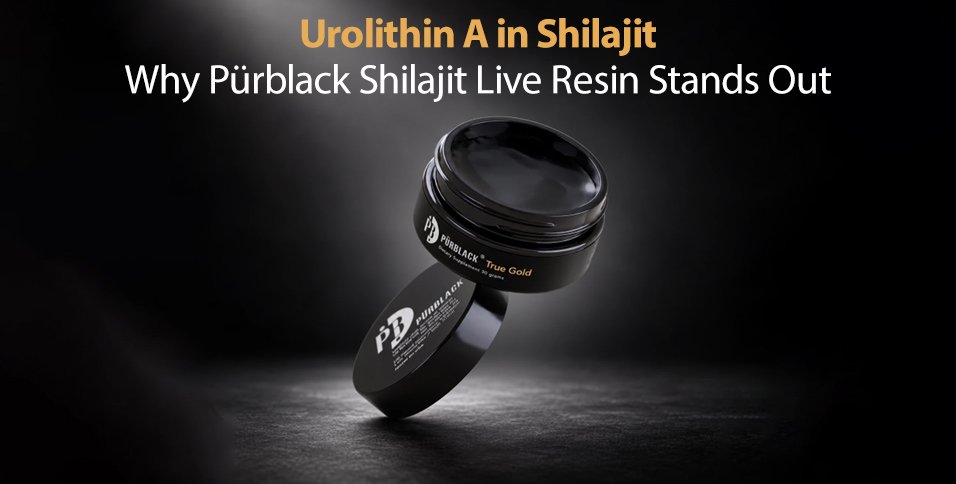
Urolithin A in shilajit matters less as a dose than as a fingerprint: it shows whether a resin still carries the dibenzo-α-pyrones that researchers describe as characteristic of the material. Pürblack can point to peer-reviewed chemistry on shilajit it supplied, which makes its resin a useful benchmark for the questions worth asking any seller.
Before looking at the study, it helps to know what separates a documented resin from an anonymous jar. Four checks cover most of the ground:
- A named process. Pürblack Shilajit Live Resin is made with a low-temperature method patented under US 10,130,656 B2, which keeps the material below 48 °C while it is washed, dissolved and filtered.
- Published lab reports. Each Pürblack product has two Certificates of Analysis (COAs): the brand’s own full-panel report and an independent one from Cambium Analytica, an NSF-owned laboratory accredited to ISO/IEC 17025.
- Marker compounds. The internal panel lists ashless humic acids, glycine and urolithin A instead of a vague promise of “85 minerals”.
- Real numbers for heavy metals. Every shilajit contains trace amounts, so a label that claims zero deserves suspicion.
What did the Molecules study find about urolithin A in shilajit?
Pürblack Shilajit contains naturally occurring urolithin A, identified by LC-MS/MS in a peer-reviewed study published in Molecules (2026) and indexed in PubMed. The researchers analyzed two Himalayan samples the brand supplied and found that urolithin A levels differed about twelvefold between them: 2.504 versus 0.209 ppm in the most effective extract. The richer sample, collected at around 2,000 meters, also turned gold and selenium salts into nanoparticles far more efficiently, with yields of 90% and 96% against 15% and 34%.
The paper is open about its ties. Pürblack paid the publication fee and provided both samples, and founder Nodari Rizun is a co-author; the authors state that he had no part in designing the study, analyzing the data or writing the manuscript. The lab work was carried out at several Serbian institutes, with the study led from the University of Kragujevac. It is chemistry. It describes what the material contains and how it behaves in a flask, not what it does in the body.
Does a serving of resin supply the urolithin A studied in clinical trials?
No, and this is where many product pages blur the science. Urolithin A in shilajit is measured in parts per million, so a typical 0.5 g serving holds micrograms of it. Stand-alone urolithin A trials use purified doses in the hundreds of milligrams: in a four-month randomized trial in middle-aged adults published in Cell Reports Medicine, that kind of supplement improved muscle strength by roughly 12% compared with placebo. The trial was run by the ingredient’s developer and says nothing directly about shilajit.
So the practical value is diagnostic. Because the compound varied so widely between two sources from the same mountain range, it gives buyers a measurable way to compare raw material, and a certificate that lists it tells you more about a jar than any adjective on the label. Pürblack’s internal COAs include urolithin A among the tested markers, next to heavy metals, microbiology and radioactivity.
Resin, capsules or gummies: which format keeps the chemistry intact?
Resin keeps shilajit closest to its natural state, which is why marker compounds can be measured in the finished product at all. Capsules and powders are usually dried extracts, sometimes blended with carriers. Gummies go further: the shilajit is heated and folded into sugar, pectin or gelatin, so a lab result describes the candy as much as the shilajit. Pürblack makes resin only, with no gummies, capsules or tinctures in its range.
The trade-off is convenience. Resin tastes earthy and bitter, and a consultant who opens the laptop at 8 a.m. is more likely to skip it than to swallow a capsule. The habit most regular users settle on takes under a minute: dissolve a pea-sized serving, roughly half a gram or less, in warm but not boiling water, tea or coffee before breakfast. For people who can’t get past the taste, the brand also sells flavored blends built on its Research Grade resin.
Pregnancy, breastfeeding, prescription drugs or an ongoing health issue are all reasons to talk to a clinician before adding shilajit in any format. For everyone else, the certificate is the best comparison tool you have. Open the PDF, look for numbers and markers, and read a urolithin A result as evidence of careful sourcing rather than as a clinical dose.