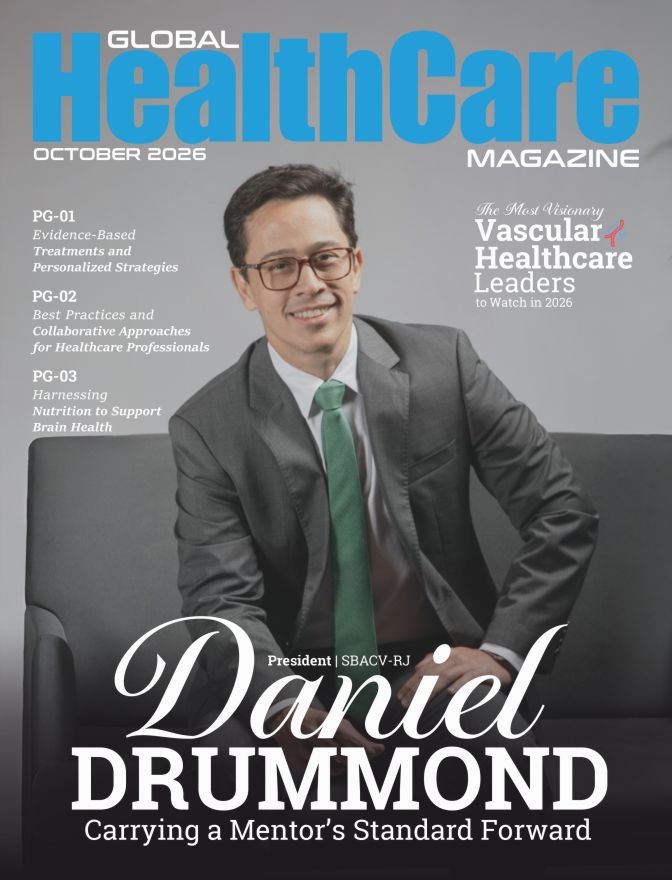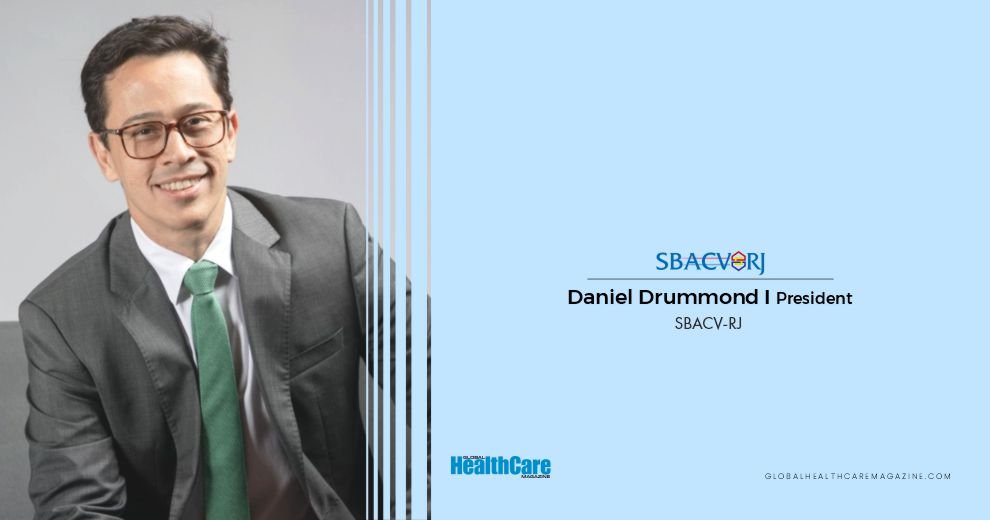
Medicine entered Daniel Drummond’s life before he had ever stepped into a medical school classroom. His uncle was a plastic surgeon. His aunt was an anesthesiologist. As a child, he watched their work from a distance and became fascinated by surgery, particularly by the way a surgeon’s hands could change the course of a patient’s life.
That curiosity became a career during medical school, when he found his way to Vascular Surgery. It was also when he met Dr. Arno von Ristow, one of Brazil’s pioneers in complex vascular surgery and a figure who would shape much of his professional life. Daniel followed him through medical school, internship, and residency, learning not only how to operate, but how to approach the profession itself.
The lessons went beyond technique. His mentor pushed him to think bigger, demand excellence from his work, and never settle for mediocrity. He also helped open doors to leading vascular centers around the world, giving the young surgeon a wider view of what was possible in medicine.
There was another institution quietly becoming part of that journey. In 2004, while still a medical student, he attended his first SBACV-RJ Encontro Carioca. More than two decades later, he has returned to that same professional community as President of SBACV-RJ.
The progression feels personal. He once entered the organization as a student looking for knowledge and direction. Today, he leads it with a different responsibility: to make sure the next generation has the same chance to learn, grow, and imagine what is possible. “I was fortunate to have mentors who expanded my sense of possibility,” he says. “Today, I want to create that possibility for those who come next.”
A Society Built on 73 Years of Vascular Care
Some institutions earn their place in a profession not through a single achievement, but through the steady work of generations. SBACV-RJ is one of them. Founded 73 years ago under its first President, Sidney Arruda, the Society has grown alongside vascular medicine in Rio de Janeiro while keeping its purpose firmly tied to the quality of care.
Its mission brings together four responsibilities: advancing science, supporting continuing education, representing vascular specialists, and defending high-quality medical practice. That work takes shape throughout the year, from monthly scientific meetings to its 55-year-old journal, Revista de Angiologia e de Cirurgia Vascular.
The Encontro Carioca de Angiologia e Cirurgia Vascular has become another important part of that tradition. In 2026, it reached its 40th edition, carrying a meeting that began decades ago into a new generation of specialists.
But the Society’s role extends beyond education. It also protects the specialty by promoting evidence-based practice and standing against vascular procedures performed without proper specialist training. The goal is straightforward: stronger vascular medicine should mean better care for patients.
Turning Strategy Into Action
Leading a medical society with more than 640 members requires more than a strong scientific program. It requires an organization that can turn plans into work that members and patients can actually see.
That is the focus of the 2026 strategic plan. As President of SBACV-RJ, Daniel is working to bring greater consistency to its execution across roughly 25 directorates, regional sections, and the fiscal council. His MBA in Health Management from FGV has shaped the way he approaches that task. He sees the Society as both a scientific body and an institution that needs clear goals, sound governance, accountability, and follow-through.
The changes reach into board meetings, professional defense, member benefits, scientific activities, and regional engagement. One priority stands out: making sure the Society remains present beyond Rio’s capital.
“A strong medical society should create value for physicians and improve patient care,” he says.
That principle gives the strategy a practical test: whether the organization can translate planning into visible value for the professionals it represents and, ultimately, the patients they serve.
Where Knowledge Keeps Moving
Education sits close to the center of SBACV-RJ’s work, but it does not stop at the classroom or conference hall. The Society has built a steady rhythm around learning, giving vascular specialists regular opportunities to test ideas, share difficult cases, and keep pace with a field that continues to evolve.
Its monthly scientific meetings bring physicians together to discuss evidence, surgical techniques, challenging cases, and emerging technologies. The Encontro Carioca extends that exchange on a larger scale, while the Society’s journal provides a longstanding platform for scientific communication and original research.
The Education directorate also works closely with training programs and younger physicians, helping connect formal training with the experience of those already practicing.
That focus will continue with preparations for the Congresso Brasileiro de Ecografia Vascular 2027, a national event centered on vascular imaging and practical education.
The ambition is not simply to pass knowledge from one generation to another. It is to create a place where knowledge, experience, critical thinking, and innovation keep meeting each other.
Protecting the Specialty as Medicine Evolves
Vascular medicine is changing quickly, but some of its most important challenges are not about technology. They are about who is qualified to use it, how decisions are made, and whether patients receive care from properly trained specialists.
That makes professional defense a central responsibility for SBACV-RJ. New technologies can expand what physicians are able to do, but they cannot replace education, clinical judgment, or accountability. The Society is therefore keeping professional defense active while grounding its approach in evidence and specialist standards.
There is another challenge that comes with a membership spread across different regions. With members practicing across the state, meaningful representation requires more than formal membership; regional specialists need scientific opportunities, institutional support, and a clear connection to the Society.
The response is practical: stronger professional-defense work, closer coordination between regions, and clearer planning across the Society’s directorates. The aim is to make the organization more present and responsive across the regions it represents.
Leadership That Opens Doors
Daniel’s days rarely fit neatly into one role. He moves between the operating room, clinical practice, and the demands of leading a professional society. His surgical work spans modern minimally invasive venous treatments as well as complex arterial, peripheral, aortic, and endovascular procedures, including pioneering work in varicose-vein treatment using Endolaser.
Another distinctive element of his clinical background is an unusually broad program of international observerships at leading centers, including Mayo Clinic, Cleveland Clinic, and UT Southwestern Medical Center in the United States, Örebro University Hospital in Sweden, and San Raffaele Hospital in Milan, Italy. These experiences have broadened his perspective on how surgical fundamentals, technology, and evidence can work together across different clinical environments.
At SBACV-RJ, that clinical perspective meets a different kind of responsibility. He coordinates roughly 80 people across the Society’s directorates, regional sections, and fiscal council, keeping scientific, educational, communication, and professional-defense initiatives aligned with its wider strategy. Yet the administrative work is not what drives him most. It is what that work can make possible for others. “Leadership becomes meaningful when the opportunities we received are multiplied for others.”
For Daniel, that means creating access to mentorship, knowledge, responsibility, innovation, and international exchange for younger physicians.
Building a Network Around Better Care
Vascular surgery does not advance in isolation. The work depends on connections between people who bring different forms of knowledge, experience, and resources to the same problem. SBACV-RJ aims to be the place where those connections can happen.
The Society brings together physicians, hospitals, universities, residency programs, medical societies, public institutions, and companies working in healthcare technology. Its scientific activities help put younger physicians in the same room as experienced specialists, while strengthening ties with academic and medical institutions in Brazil and abroad.
Technology adds another layer to that collaboration. Because vascular surgery relies heavily on imaging systems, devices, and endovascular solutions, the Society maintains dialogue with companies developing them. But collaboration does not mean endorsement. New technologies need to be presented, questioned, and assessed by specialists before they influence practice.
The Society also offers technical expertise when vascular-health matters reach public authorities or healthcare institutions. Across these relationships, the standard remains the same: scientific independence, responsible innovation, and better outcomes for patients.
When Listening Became the Leadership Test
Taking the presidency of a 73-year-old medical society came with a challenge that had little to do with titles. SBACV-RJ brought together different generations, regions, and professional experiences, each with its own priorities. Bringing those voices together required Daniel to listen before he led.
Instead of arriving with a finished plan, he built the 2026 strategy directorate by directorate. He listened to what each group needed, considered different perspectives, and worked those ideas into a shared direction. The approach gradually created something more valuable than agreement on paper: broad institutional support.
That support eventually made a contested electoral process unnecessary. For Daniel, the outcome mattered less as a personal victory than as a sign that the Society could move forward together. “Scientific knowledge can establish credibility, but human relationships build trust,” he says. “Authority can organize people; trust is what truly unites them.”
The experience reinforced a lesson that applies well beyond medicine. Leadership may give someone the responsibility to make decisions, but trust determines whether people are willing to move with those decisions.
Measuring Impact Beyond a Single Term
It is still early in the current administration, so Daniel is cautious about claiming results that will take time to measure. Still, the direction is already visible. The 2026 strategic plan now involves every directorate, monthly board meetings have created a clearer rhythm of governance, and regional initiatives are expanding.
Some of SBACV-RJ’s most meaningful measures, however, cannot be captured within a single term. Its journal and Encontro Carioca are long-running institutional markers, reflecting a culture of continuity that extends well beyond any one administration.
Daniel’s own career reflects that culture of continuity and renewal. He became the youngest President elected in the Society’s history and the youngest recipient of the Antônio Luiz de Medina Medal, its highest distinction.
He does not view either achievement simply as a personal milestone. Instead, they point to something larger: an established institution can respect experience while still giving younger professionals the chance to take responsibility and shape what comes next.
Making Room for Life Outside Medicine
Daniel does not pretend that work-life balance comes easily. At this stage of his career, and especially at the beginning of his term as President of SBACV-RJ, medicine and institutional leadership leave little room for a perfectly measured schedule. Instead, he tries to be deliberate about the time he protects.
Family comes first. Time with his wife and children gives him a place away from operating rooms, meetings, and institutional decisions. It also offers a useful reminder that professional achievement is only one part of a meaningful life.
Then there is tennis. He enjoys the sport for more than the competition. A match demands discipline, concentration, patience, and the ability to recover after losing a difficult point. Those qualities have an unexpected connection to both surgery and leadership, where not every decision or situation goes according to plan.
The time away from medicine does something important. It restores perspective. After stepping off the court or spending time with his family, Daniel can return to his responsibilities with a clearer mind and renewed focus.
Building a Bridge to the Future
The next chapter for SBACV-RJ will not be measured by how many activities appear on its calendar. Daniel wants the Society to be judged by what those activities change: stronger regional sections, meaningful value for members, better education, and a public that understands vascular health more clearly.
The Congresso Brasileiro de Ecografia Vascular 2027 is one step in that direction. Beyond the event, he sees a specialty moving toward less invasive, image-guided, endovascular, and increasingly personalized care.
Technology will accelerate that shift. Artificial intelligence, advanced imaging, robotics, automation, and data-driven medicine are already changing how healthcare works. The challenge for medical societies will be helping physicians understand these tools without allowing excitement around technology to replace careful judgment.
“I want SBACV-RJ to be a bridge between the foundations of our specialty and the medicine of the future,” he says. For him, that bridge must carry some things forward unchanged: ethics, technical excellence, clinical judgment, and human connection. The future of the specialty, in his view, depends on embracing new capabilities without losing those fundamentals.
What We Pass On
Daniel’s view of leadership begins with a simple idea: no title can make someone a leader on its own. Preparation, values, relationships, and the willingness to keep learning matter far more over time.
Much of that lesson came from watching the people who taught him. He paid attention not only to how they operated, but to how they handled difficult decisions, treated patients and colleagues, responded when things went wrong, and held themselves to a high standard. Some of the most lasting lessons, he found, were never written into a textbook.
His own connection to Vascular Surgery began more than two decades ago by watching a professor work with seriousness and commitment. That example stayed with him long after the operating room.
Now, as President of SBACV-RJ, he sees his role as part of a larger cycle. He received knowledge, opportunities, trust, and inspiration from those who came before him. His responsibility, he believes, is to ensure that those benefits continue moving through the profession rather than ending with one generation. Perhaps that is the measure he values most: leaving the profession stronger without losing the humanity that gives it meaning.
Quote
Also Read: The Most Visionary Vascular Healthcare Leaders to Watch in 2026