A surgical career can be read like a ledger, and the entries rarely lie. Seven years as a general surgery resident. Two as a fellow in vascular and endovascular surgery. Twelve more spent building a practice and a program in a single place. Add them up, and the sum is more than two decades, which is roughly how long it takes to earn the kind of trust that vascular surgery demands.
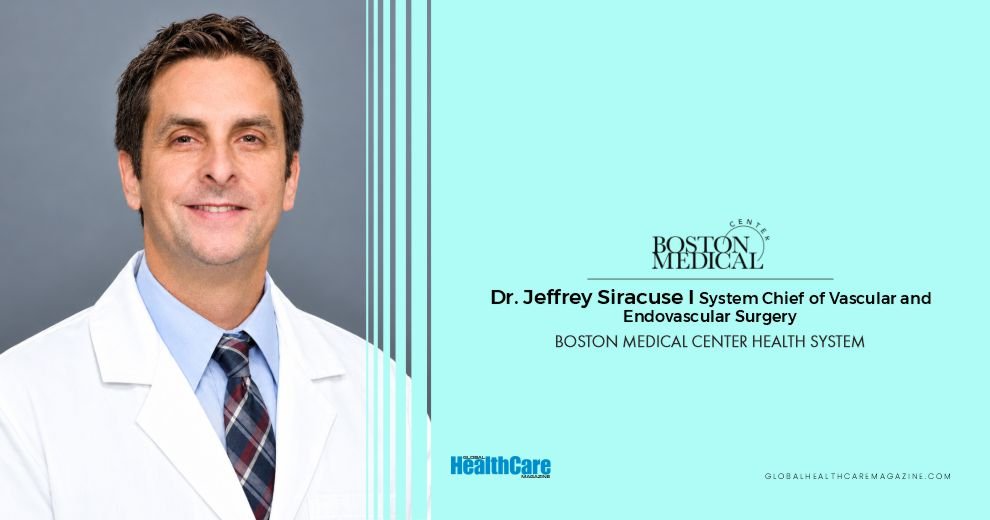
Today that ledger ends, for now, with a title: System Chief of Vascular and Endovascular Surgery for the Boston Medical Center Health System (BMC Health System). The man who holds it is Dr. Jeffrey Siracuse, and the appointment, which began in January 2026, is the newest line in a record notable chiefly for its consistency. That consistency, more than the title alone, is what makes his career worth examining.
Nine Years in the Making
The record begins in June 2005, when Dr. Siracuse became a General Surgery Resident at Beth Israel Deaconess Medical Center. He stayed until June 2012, a seven-year stretch.
Partway through, he stepped sideways into the laboratory. From July 2007 to June 2009, he served as a Research Fellow in the Harvard Longwood Vascular Research Training Program. Those two years fell within the span of his residency, which means the research was not a detour from training but a thread woven through it.
Then came the specialty itself. In July 2012, he began a fellowship in Vascular and Endovascular Surgery at New York Presbyterian University Hospital of Columbia and Cornell. It ran two years, to June 2014.
Measured from the beginning of his residency in June 2005 to the end of his fellowship in June 2014, the sequence spans roughly nine years of training. Only then did his career as an attending surgeon begin.
One Month, Two Institutions
In July 2014, two appointments started in the same month. At Boston Medical Center, Dr. Siracuse became an Attending Vascular and Endovascular Surgeon. At Boston University School of Medicine, he became an Assistant Professor of Surgery and Radiology.
Both are still on the page, and both appointments have continued for more than twelve years. It suggests a surgeon who looked at one institution and decided it was worth the long view.
A Ladder With Two Rails
His career has climbed along two rails at once, clinical and academic, and the dates are worth setting side by side.
On the academic rail, he served as Assistant Professor from July 2014 to November 2017, a little over three years. He was then promoted to Associate Professor of Surgery and Radiology, a rank he held from November 2017 to November 2022, a five-year period.
He later became Professor of Surgery and Radiology, the position he holds today. The title itself repays a second look. It pairs surgery with radiology, a combination that sits comfortably beside the endovascular half of his clinical title.
Chief, Then System Chief
The clinical rail moved on its own schedule. In November 2024, Dr. Siracuse was named Chief of Vascular and Endovascular Surgery at BMC, a full-time role. He held that post for about fourteen months before the next change arrived.
In January 2026, he became System Chief of Vascular and Endovascular Surgery. The word system changes the scale implied by the title. Rather than referring only to a division, it signals responsibility at the BMC Health System level. The change marks a step outward from leading a specialty division toward a broader institutional role.
Safety as a Discipline
One month before that appointment, in December 2025, Dr. Siracuse took on a second responsibility that deserves its own attention: Vice Chair for Quality and Patient Safety in the Department of Surgery at BMC.
The sequence is hard to miss. In December, a role devoted to quality and safety across surgery. In January, a role widening his vascular leadership to the system level. Two appointments, one month apart.
Leadership of this kind is rarely glamorous. Quality and patient safety work is made of reviews, standards, and the steady habit of asking what could be done better. It is also exactly the sort of work that separates a gifted operator from a leader whose influence extends beyond his own operating room.
The Shape of the Record
Step back from the individual entries, and a pattern emerges. Dr. Siracuse’s work brings clinical care, academic research, and institutional quality improvement into the same professional life. Rather than treating these as separate tracks, he has built a career in which they can inform one another.
His record is less a story of sudden ascent than one of steadily widening responsibility, a progression that helps explain the kind of leadership he now brings to BMC.
Where Clinical Leadership Becomes Institutional Impact
Vision in healthcare is often mistaken for announcements. Dr. Siracuse’s career suggests a quieter definition: applying discipline to clinical practice, investing in research and teaching, and accepting accountability for the systems in which care is delivered.
His responsibilities span vascular care, medical education, and surgical quality and safety. Keeping those priorities connected is the challenge and the promise—of his leadership at Boston Medical Center.
The measure of that leadership will be whether the structures he helps build strengthen patient care, support the next generation of physicians, and raise the standards by which surgical outcomes are measured.