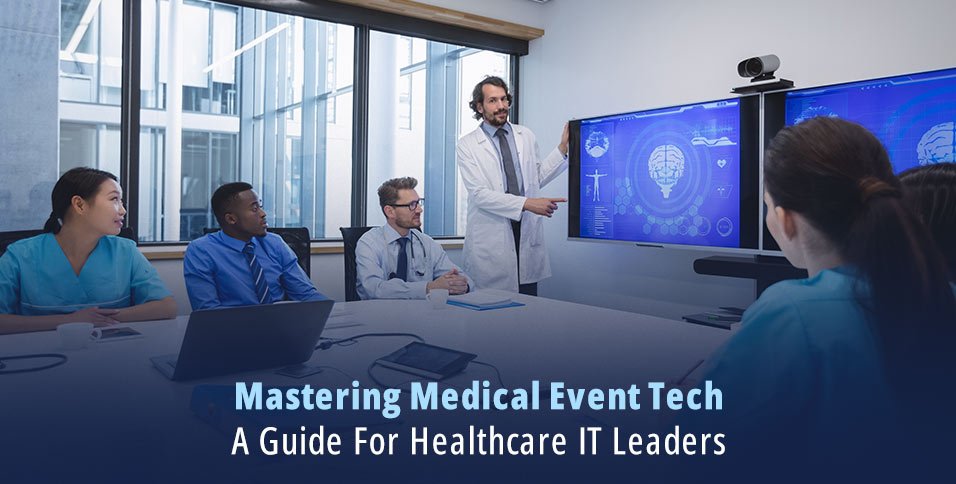
In healthcare, we often focus on the cutting-edge technology inside the laboratory and exam room. But what happens when the venue shifts to the conference hall? Suddenly, the stakes are just as high, but it’s a completely different playing field for healthcare IT leaders and their teams. Whether you’re setting up for a massive international convention, a medical trade fair, a scientific conference, or a televised procedure, you’re stepping out of the confines of your facility’s network and entering a high-pressure environment where connectivity, security, and reliability can make or break the entire event.
Technical glitches during conventions or conferences can have a negative impact, and research shows that audiences have zero tolerance for technical hiccups. Statistics reveal that nearly 70 percent of professionals have encountered technical difficulties during presentations, and 40 percent admit that these issues damaged their credibility in the eyes of their audience. To prevent technical failures during large-scale events, IT directors should use a comprehensive strategy that goes beyond Wi-Fi access and audiovisual equipment. Here’s how to build a technological environment that keeps medical events running smoothly.
Build a Strong and Reliable Network Infrastructure
Connectivity is the foundation of every successful medical event. Attendees expect effortless, instant access to event apps and digital programs, while presenters rely on stable Internet connections for live demonstrations. If your organization is hosting a medical convention or trade fair, exhibitors will need dependable Internet access for interactive displays and digital registration. To prevent connectivity issues, be sure to assess the venue’s existing network infrastructure. Evaluate available bandwidth, wireless access point placement, network coverage, and the capacity to support simultaneous connections. Also, rather than relying on the venue’s standard Internet service, consider whether dedicated bandwidth or additional networking equipment is necessary.
Contact a local ISP or an event-specific Internet vendor at least six weeks in advance to pull a dedicated fiber or broadband line directly to the venue. Don’t forget to run physical Ethernet cables to fixed desks like badge registration, press rooms, keynote setups, and exhibitor payment terminals to reduce reliance on Wi-Fi. You may also want to hire a technician to deploy enterprise grade wireless access points in high density areas, like expo halls and breakout rooms.
To assess bandwidth needs, plan on 5 to 8 Mbps per person for trade shows with live demos or video. Next, implement network segmentation and control by separating virtual local area networks (VLANs) for different groups. Give the highest priority to the staff and production network, medium priority to the exhibitor and vendor network, and capped access for the general attendee network.
Integrate Audiovisual Systems and Digital Event Platforms
In large-scale medical events, presentations, livestreams, and event and registration platforms should work together to create a consistent experience for both in-person and remote attendees. Use a medical event integration tool to connect your event planning apps to replace CSV exports, copy pasting, and messy spreadsheets with live data sharing. This integration is a must for hybrid conferences wherein a technical failure can affect participants across multiple locations. Note that a presentation that works perfectly in person may encounter problems when transmitted through a streaming platform or shared across different displays, so choose your integration tool wisely.
A few days before the event begins, coordinate closely with event organizers, audiovisual teams, and platform providers so you can do several compatibility tests. These tests should cover microphones, presentation formats, display systems, cameras, streaming tools, and conferencing software. During rehearsals and tests, establish how issues will be escalated and who will be responsible for troubleshooting.
Plan on running a full tech run-through at least 24 hours before the medical conference. Conduct end-to-end dry runs of AV gear, streaming encoders, registration check-in tablets, and live Q&A moderation tools. Be sure to have backup files for all speaker slide decks in case of cloud storage failure or network drops.
Maintain Ethical Data Use and Compliance
No matter the exact format of the medical event, a few clinical-grade IT rules still apply when you’re at the event hall or convention center. First, always treat the event hall as an extension of your facility. Any system that captures attendee data or tracks session attendance must respect healthcare data privacy boundaries. See to it that all data capture methods comply with HIPAA and local health data regulations, depending on the convention’s location.
Next, verify that patient case studies, imaging, or electronic health records used in presentations or live streams are fully anonymized and stripped of Protected Health Information. Lastly, if attendees’ data will be shared with exhibitors or sponsors, implement clear, opt-in consent mechanisms during registration.
Seamless event technology enables life-saving knowledge to be shared without interruption. The right tech foundation contributes to a medical event’s success, and ensures that everyone in the event hall can learn and connect.