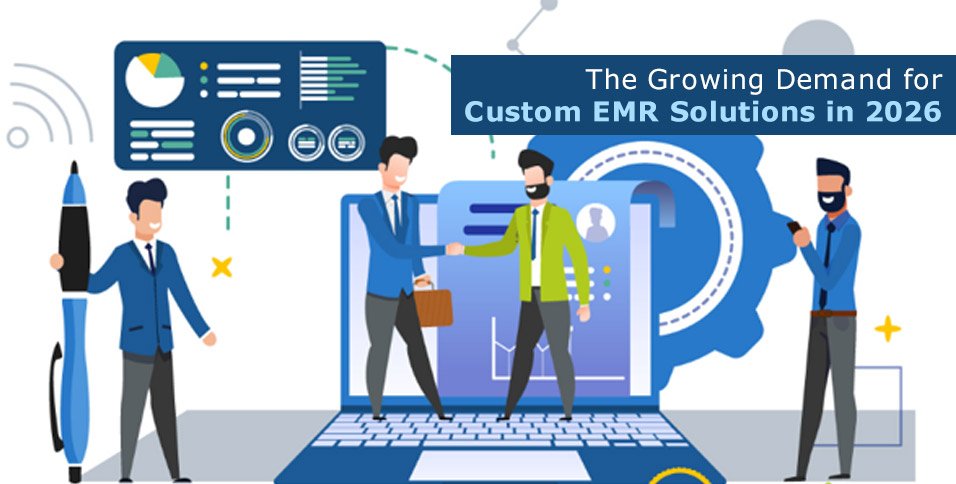
Not for treating patients, but clicking, documenting, and searching through fragmented workflows. What should support care is often what slows it down the most.
Even though there is an increasing digitalization rate in the healthcare industry, many still depend on systems that were not built for the speed and complexity of modern care delivery. It can cause a gap between what providers need and what their EMR platforms can actually deliver.
Rather than simplifying operations, these systems add friction at every step. As patient loads increase, compliance requirements strengthen, and care coordination becomes more connected across specialties, this mismatch becomes even harder to overlook.
Due to this, custom EMR software development is gaining significant momentum, driven by the need for specialized clinical workflow personalization, stronger healthcare regulatory compliance, and more adaptable next-generation EMR software architecture.
Along with that, let’s also try to understand the importance of choosing the right healthcare software development company for aligning with these growing demands.
Let’s break down why this shift is happening, what is driving the move away from traditional EMR systems, and how custom solutions are reshaping the future of healthcare operations in 2026 and beyond.
What’s Driving the Demand for Custom EMR Solutions?
The demand for custom EMR solutions is growing for very practical reasons—it’s driven by gaps that traditional systems can no longer ignore.
First, different specialties simply don’t work the same way. A behavioral health clinic, a fertility center, and a wound care practice all have unique workflows, documentation styles, and reporting needs.
Generic EMRs are built for the “average” clinic, which means they rarely fit any specialty well. This becomes even more challenging with models like RPM and CCM, where time tracking, device data, and program-based billing need to work seamlessly. That’s where specialized clinical workflow personalization becomes essential, helping organizations move away from rigid, one-size-fits-all systems.
Second, interoperability is no longer optional. With regulations like the 21st Century Cures Act and standards such as FHIR, healthcare organizations are expected to share data smoothly across systems. Patients also expect instant access to their records, and partners expect clean, structured data exchange. This has made interoperability a core requirement, not a secondary feature.
Finally, expectations around efficiency and experience have increased on both sides. Clinicians are under pressure from documentation-heavy systems that contribute to burnout, while patients now expect simple digital experiences like easy scheduling and fast access to information. This has changed how EMRs are viewed, they’re no longer just record systems, but central to daily operations and user satisfaction.
Together, these shifts are fueling the growing demand for custom EMR solutions 2026, as healthcare organizations look for systems that are flexible, connected, and truly built around real workflows.
How Custom EMR Solutions Address Modern Healthcare Needs
Custom EMR solutions are gaining attention because they directly solve the everyday problems healthcare teams face with traditional systems.
First, they are built around how an organization actually works. Instead of forcing clinics to adjust their processes to fit the software, a custom EMR is designed around real clinical and operational needs.
Whether it’s a specific specialty, care model, or internal workflow, the system reflects how care is truly delivered. This makes it easier for teams to work naturally instead of constantly adapting to system limitations.
Second, they significantly improve usability and day-to-day efficiency. Many legacy EMRs slow clinicians down with unnecessary clicks and complex navigation. A custom approach simplifies this by designing interfaces around real users.
High-volume tasks can be streamlined, different roles can see only what they need, and repetitive steps can be automated. The result is less time spent on screens and more time focused on patients.
Finally, they strengthen data access and collaboration. Modern healthcare depends on teams working together, often across departments or even locations. Custom EMRs make this easier by ensuring information is updated, shared, and structured in a usable way. They also connect more smoothly with other systems, making it easier to generate insights and support better decision-making.
Together, these improvements explain why many organizations are moving toward custom EMR solutions; they want systems that support real workflows, not interrupt them.
Emerging Trends Shaping EMR Adoption in 2026
● Ambient AI medical documentation and automation
One of the most significant recent shifts is ambient documentation, AI that listens to the patient-provider conversation and drafts clinical notes automatically, which the provider then reviews and signs. Adoption has grown quickly because it targets the burnout problem directly, giving clinicians attention back to the patient instead of the screen.
Organizations increasingly want EMRs that integrate cleanly with these tools, and a next-generation EMR software architecture is typically designed to incorporate them rather than treat them as awkward add-ons. (As with any AI in clinical settings, provider review of AI-generated content remains essential.)
● Predictive analytics and smarter decision support
Beyond documentation, analytics is moving from retrospective reporting toward forward-looking insight, flagging patients at risk of deterioration or readmission, surfacing care gaps, and supporting more proactive intervention.
The value depends on clean, structured, accessible data, which is exactly what well-architected custom systems are positioned to provide. Decision support that’s helpful rather than noisy requires thoughtful design, and that’s easier to achieve when the system is built for it.
● Greater emphasis on connected and interoperable healthcare ecosystems
The direction of travel is clearly toward connected ecosystems, EMRs exchanging data with hospitals, labs, pharmacies, health information exchanges, monitoring devices, and patient apps.
Standards-based interoperability is the foundation, and systems built on modern architecture are better prepared for a future where seamless data exchange is simply expected rather than negotiated case by case.
Benefits for Healthcare Organizations
● Greater flexibility and long-term scalability
A custom EMR can grow and change with the organization, new specialties, new locations, new care programs, new regulatory requirements without forcing a disruptive platform replacement. That adaptability is increasingly valuable in a field that keeps evolving, and it protects the investment over a multi-year horizon.
● Improved provider adoption and satisfaction
When a system fits how clinicians actually work, they use it willingly rather than resentfully. Better usability reduces documentation burden, eases frustration, and supports retention at a time when keeping good clinical staff is a serious challenge. Provider adoption is often where generic implementations stumble; fit is what overcomes that.
● Better readiness for evolving regulations and technology trends
Healthcare regulatory compliance is a moving target, interoperability mandates, privacy requirements, and quality programs all keep shifting. A custom system built on modern, adaptable architecture can incorporate new requirements and new capabilities like AI as they emerge, rather than leaving the organization dependent on a vendor’s roadmap and timeline. That readiness is itself a meaningful advantage.
Conclusion
The move toward custom EMR solutions reflects a deeper change in how healthcare organizations view their technology. The EMR is no longer a static system of record to be tolerated; it’s an active part of how care is delivered, how clinicians experience their work, and how an organization adapts to a fast-changing environment.
As that recognition spreads, the appetite for systems that fit — rather than systems that merely suffice — keeps growing. This is why modern EMR development is increasingly focused on flexibility, scalability, and specialty-specific workflows.
The benefits of custom EMR systems in 2026 come down to alignment: technology shaped around an organization’s real specialties, workflows, and goals, and built to evolve as those goals do. For organizations weighing the decision, the right question isn’t whether a custom platform costs more upfront, but whether a generic one can carry them where they intend to go over the next decade.
FAQs
1. Why is demand for custom EMR solutions increasing in 2026?
The demand is rising because healthcare organizations are dealing with more complex needs than ever before. Specialty-specific workflows, tighter interoperability requirements, and increasing provider burnout from poorly designed systems are major drivers. At the same time, new AI-driven capabilities are emerging, and most generic EMRs are not built to fully support or adapt to them, pushing organizations toward more flexible solutions.
2. How do custom EMR systems differ from traditional EMR platforms?
Traditional EMRs follow a one-size-fits-all approach, where clinics must adjust their workflows to fit the software. Custom EMR systems do the opposite, they are built around how an organization actually operates, aligning with its care models, specialties, and internal processes.
3. What healthcare organizations benefit most from custom EMR solutions?
Specialty practices, multi-location healthcare networks, and organizations running specialized care programs like RPM or CCM benefit the most. These setups require more tailored workflows, which generic EMRs often fail to support efficiently.
4. How does workflow personalization improve provider efficiency?
When workflows are tailored to actual clinical processes, providers spend less time clicking through unnecessary steps. Features like role-based views, automated documentation, and streamlined task flows reduce manual effort, lower errors, and help clinicians focus more on patient care.
5. What role does interoperability play in modern EMR systems?
Interoperability is now a core requirement. Standards like FHIR enable secure and structured data exchange between hospitals, labs, devices, and patient applications. It also supports regulatory compliance and ensures that patient data moves smoothly across the healthcare ecosystem.
6. How are AI and automation influencing EMR adoption?
AI is becoming a key factor in EMR evolution, especially for documentation and decision support. Features like ambient clinical documentation and predictive analytics are increasing demand for systems that can integrate AI tools effectively, while still keeping clinicians in control of final decisions.
7. Can custom EMR solutions support future healthcare regulations and standards?
Yes. Because custom EMRs are built on flexible and modern architectures, they can adapt more easily to new regulations, compliance updates, and evolving industry standards without requiring a complete system replacement.
8. What should healthcare organizations consider before investing in a custom EMR platform?
They should evaluate how well the system fits their specialty workflows, its ability to support interoperability, scalability for future growth, total cost of ownership, regulatory readiness, and most importantly, the experience and reliability of the development partner.