
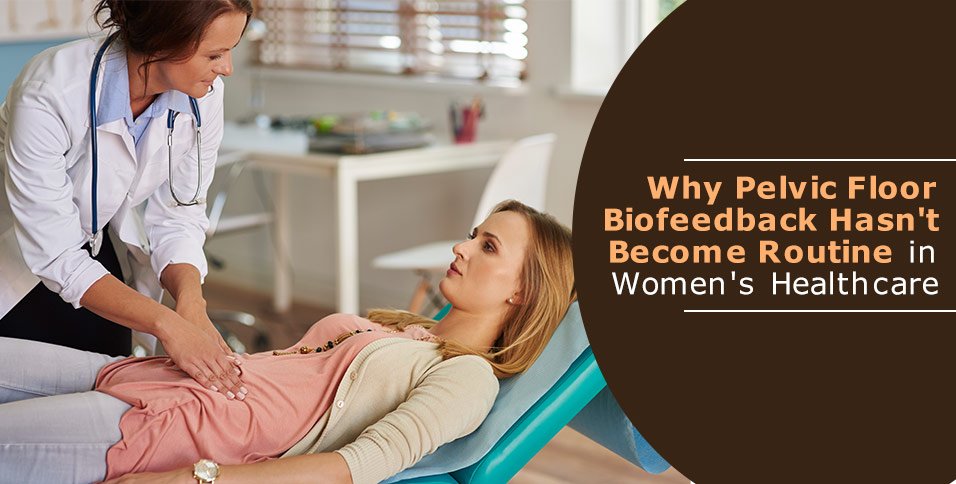
Pelvic floor biofeedback has been available in specialist clinics for decades, yet most women who leak urine, feel pelvic heaviness or struggle with weak muscles after childbirth will never be offered it. That gap is not simply an oversight. It sits where clinical evidence, health service budgets, workforce shortages and a long-standing silence around pelvic symptoms meet, and each of those factors pushes in the same direction. Understanding why biofeedback has stayed on the margins also explains where it might realistically fit in the future.
What Biofeedback Actually Does
Biofeedback turns an invisible muscle contraction into something a person can see or hear. In a clinic, this usually means a small vaginal sensor or surface electrodes linked to a screen that displays pressure or electrical activity as the patient squeezes and relaxes. The idea is straightforward. Pelvic floor muscles cannot be watched in a mirror, and many women contract the wrong muscles, hold their breath or push down instead of lifting. A live signal shows immediately whether the right action is happening and how long it is held.
For clinicians, the appeal is obvious. A visible baseline makes progress measurable over weeks, and a woman who sees her own trace improve may feel more motivated to keep practising at home. These are real advantages, so it is reasonable to ask why the method has not become a standard part of care.
The Evidence Problem
The main reason is that large trials have struggled to show that biofeedback adds much on top of well-supervised exercise. The best-known example in the UK is the OPAL trial, which enrolled 600 women across 23 centres. Both groups received six face-to-face sessions of pelvic floor muscle training over 16 weeks, and one group also used an EMG biofeedback device in clinic and at home. After 24 months, symptom severity had improved by a similar amount in both groups, and the authors concluded that biofeedback should not be offered routinely alongside training. The National Institute for Health and Care Research summarised the result in a 2021 alert.
The same summary offers a revealing explanation for earlier, more positive studies. Some of the benefit previously credited to biofeedback was probably the result of extra time with health professionals rather than the device itself. In other words, attention and supervision mattered, and the screen was one way of delivering them. National guidance in England reflects this, and clinicians generally treat biofeedback as an option for selected patients rather than a default.
Cost, Equipment and Clinic Time
Even where clinicians see value in it, biofeedback competes for scarce resources. Clinic-based systems need equipment, single-use probes, private rooms and appointment time, and every session spent on a biofeedback screen is a session not available for another patient on the waiting list. When trials suggest similar outcomes with supervised exercise alone, health services have little incentive to fund extra equipment.
This is part of the reason home devices have attracted interest. Products such as a kGoal smart kegel trainer move the feedback element out of the clinic and onto a phone, letting women see their squeezes, follow guided sessions and track consistency between appointments. That shift does not change what the OPAL results showed, and it is not a replacement for assessment by a pelvic health physiotherapist. What it can address is the practical side of the problem, which is the long stretch of unsupervised home practice where many women lose confidence, forget technique or simply stop. Used as a practice aid within a plan agreed with a clinician, feedback at home targets the adherence gap rather than claiming to outperform supervised care.
A Workforce Stretched Thin
The second barrier is people. Specialist women’s health and pelvic health physiotherapists are in short supply in many countries, and continence nurses and urogynaecologists face similar pressure. Biofeedback, at least in its traditional form, requires a trained professional to set up the session, interpret the signal and adjust the programme. When waiting times for a first pelvic health appointment already run to months in some areas, adding a time-intensive technique is hard to justify.
Workforce shortages also shape referral habits. A GP who knows the local physiotherapy service is overwhelmed may hand over a leaflet on exercises instead of referring, and a leaflet cannot tell a patient whether she is contracting correctly.
The Silence Around Symptoms
Perhaps the biggest obstacle sits before any treatment decision is made. Many women never mention pelvic floor symptoms to a clinician at all. A 2023 survey for the Royal College of Obstetricians and Gynaecologists found that 69% of 2,000 UK women had never spoken to anyone in the NHS about their pelvic floor health, and more than half of those with symptoms had not sought help. Among them, 39% thought their symptoms were normal and 21% were too embarrassed. The same survey found that 23% did not know how to do pelvic floor exercises at all.
Those numbers matter for biofeedback because no technique can become routine for a problem that goes unreported. The college used the findings to call for earlier education, better training for health professionals, and timely access to physiotherapists and specialists, arguing that routine antenatal and postnatal appointments should be used to raise the subject. Until conversations about leakage and prolapse are ordinary, the question of which treatment tools to offer stays secondary.
Where Feedback Might Earn a Lasting Place
None of this means feedback is useless. It means the value lies less in the technology itself and more in what it supports: correct technique, regular practice, and a reason to keep going between appointments. A more realistic future may combine a proper assessment, a supervised programme with a physiotherapist, and simple tools that make home practice visible.
That model asks less of clinic time and puts more emphasis on the months of practice that determine whether training works.
Research could also become more targeted. Anyone who wants to review the findings of the OPAL trial will see how broad its comparison was. Rather than testing biofeedback across large mixed groups again, future studies may look at women who cannot initially identify their pelvic floor, those who drop out of home programmes, or those living far from specialist services. Those are the groups where a visual or audio cue might make the most practical difference.
The Missing Link Between the Clinic and the Bathroom Floor
Biofeedback has not become routine because the evidence for adding it to supervised training is weak, because clinics lack the time and staff to deliver it, and because too many women never raise their symptoms in the first place.
The more useful question for healthcare systems is not whether every patient needs a biofeedback session, but how to make sure every woman with symptoms is asked, assessed and supported through the long middle part of treatment that happens at home. Feedback tools that strengthen that stage, alongside honest conversations and enough specialists to go round, are likely to matter far more than any single device on its own.