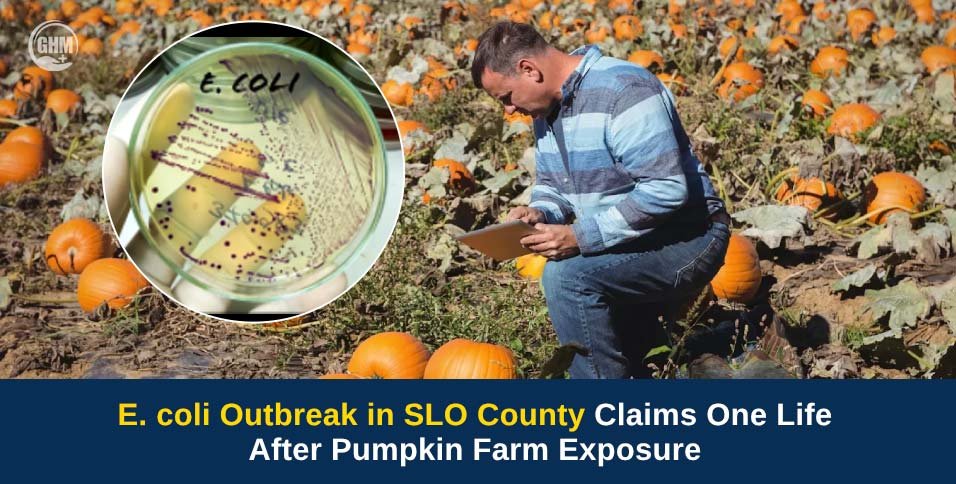
One person has died following an E. coli outbreak in SLO County, California, linked to visits to Brookshire pumpkin farms. County health officials confirmed the death on November 10, 2026, following five laboratory-confirmed infections and 10 suspected cases. Officials did not disclose the person’s age, identity, gender, or additional medical details.
Although the exact source of E. coli contamination remains unknown, the San Luis Obispo County Public Health Department says the risk of further exposure has passed and no ongoing public health threat remains.
The death adds to concerns surrounding the E. coli outbreak in California, which affected visitors to a seasonal pumpkin farm during October.
Five Confirmed Cases Amid Brookshire Farms E. coli Outbreak
The E. coli outbreak investigation focused on Brookshire Farms, located on Los Osos Valley Road in San Luis Obispo. The farm offers seasonal attractions, including pumpkin picking, corn mazes, and hayrides.
According to SLO County Public Health, all five people with laboratory-confirmed Shiga toxin-producing E. coli (STEC) O157 infections visited the farm on October 17 or 18, 2026.
The SLO County E, coli investigation also identified 10 suspected cases involving individuals who visited the property between October 16 and 26 and subsequently developed symptoms.
Three of the five confirmed E. coli cases in San Luis Obispo County involved children who developed hemolytic uremic syndrome (HUS), a serious complication that damages red blood cells and can lead to kidney failure. Local reporting said these children required intensive care.
Brookshire Farms reopened on November 6, the same day county officials announced they were wrapping up the E. coli investigation.
E. coli Outbreak Investigation Couldn’t Identify Contamination Source
Health officials conducted environmental testing to determine how visitors contracted the infection. However, testing of water, food, and other samples collected at the farm did not detect the specific E. coli O157 strain responsible for the E. coli Outbreak in SLO County.
Some samples contained other bacteria, including different E. coli strains, but investigators could not establish a connection between those findings and the confirmed infections.
Genetic testing provided additional evidence of a shared exposure about E. coli Outbreak in SLO County. Bacterial strains from three patients matched each other, while a fourth test remained pending and a fifth could not be performed. The matching strains did not closely resemble other known strains in national databases.
Investigators identified several potential common E. coli exposures, including:
- Edible corn cups.
- Pumpkins.
- Hay.
- Non-potable water sources.
However, officials did not confirm any of these as the source of contamination. No farm animals or public petting zoos were operating at the property.
Investigators also faced limitations because some potentially contaminated items were no longer available for testing and sampling occurred after the suspected exposure period. The county does not plan additional environmental testing.
Symptoms and Health Risks of Shiga Toxin-Producing E. coli
Shiga toxin-producing E. coli (STEC) is a group of bacteria that produces toxins capable of damaging the digestive system and causing illness.
Common E. coli infection symptoms include:
- Stomach cramps and abdominal pain.
- Diarrhea.
- Bloody diarrhea.
In severe cases, STEC infections can cause hemolytic uremic syndrome (HUS). This condition damages red blood cells and can affect the kidneys, potentially leading to kidney failure and other serious complications.
Children under five face a greater risk of developing severe complications from STEC infections, according to SLO County Public Health. People experiencing symptoms should seek medical attention.
County Health Officer Dr. Christy Mulkerin said, “Based on the findings of our investigation, we believe the risk of additional exposure associated with this incident has passed, and there is no longer an ongoing public health threat.”
Food Safety Measures to Prevent E. coli Infections
Health officials continue to encourage basic food safety practices to reduce the risk of STEC infections amid the E. coli Outbreak in SLO County. Recommended E. coli prevention measures include:
- Wash hands thoroughly with soap and water after outdoor activities or contact with animals.
- Wash fruits and vegetables before eating them.
- Keep raw foods separate from other foods during preparation and storage.
- Avoid drinking untreated water.
- Choose pasteurized milk and juices.
- Follow applicable food safety regulations when preparing or providing food to the public.