Root canal treatment asks clinicians to clean and disinfect a complex network of narrow spaces inside a tooth, much of it beyond direct view. The quality of that work depends on careful instrumentation, effective irrigation, and sound clinical judgment.
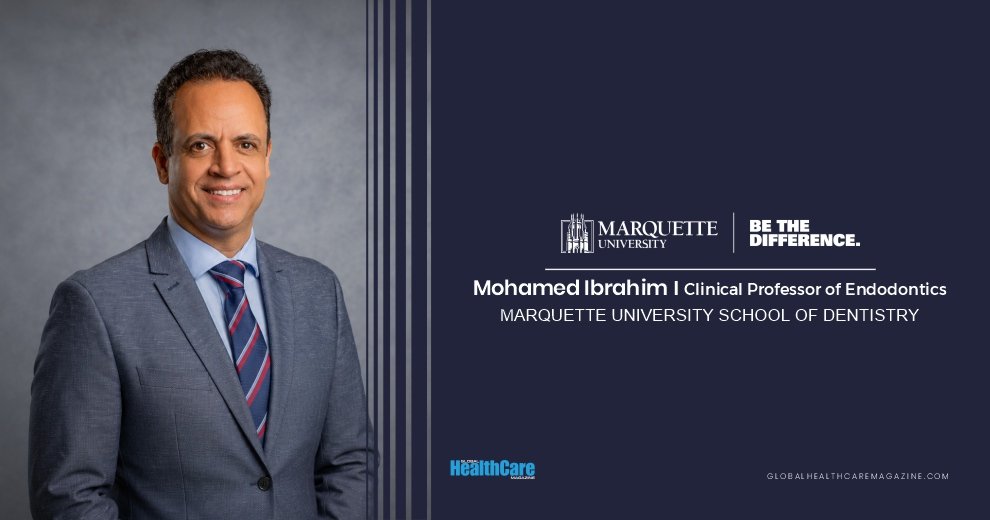
Dr. Mohamed Ibrahim, Clinical Professor of Endodontics at Marquette University School of Dentistry, has spent his career studying that question and teaching others how to answer it. He is also the school’s Director of Predoctoral Endodontics.
The Professor and the Program
Dr. Ibrahim was promoted to Clinical Professor in 2025. His directorship of predoctoral endodontics places him at the entry point of the specialty, the program through which dental students first encounter it.
It is a quiet kind of influence. The students who learn the fundamentals under his direction will carry them into practices he will never visit. It is also a role that sits beside a research agenda. The same professor who guides first-time learners is running studies on irrigation, biomaterials, and computational models, so the classroom and the laboratory share a single set of questions.
Two Universities, One Doctorate
His training began at Mansoura University in Egypt, where he received his Bachelor of Dental Surgery (BDS), Master of Science (MS), and endodontic training. In 2006, he began doctoral studies at the University of Cologne in Germany through a joint supervision program involving Mansoura University and the University of Cologne.
The arrangement tied two institutions to a single body of work. Four years after he arrived in Germany, in 2010, his doctoral training had led to a PhD in endodontic microbiology and disinfection through the joint program. Dr. Ibrahim also earned a Doctor of Medical Dentistry (Dr. Med. Dent.) degree from the University of Cologne, specialising in endodontic hydrodynamic disinfection.
The path is worth noticing for its structure. A joint supervision program asks a student to answer to two faculties at once, in two countries, and to satisfy both. It is a demanding apprenticeship in being precise.
His doctoral work in hydrodynamic disinfection established a research foundation that continues to inform his approach to endodontic irrigation.
The Science of Moving Fluid
That research interest turned out to be a thread rather than a destination. The problem he keeps returning to is a physical one. How does a liquid travel through a canal, and is what it carries enough to do the job?
The question is deceptively simple. A canal cannot be opened like a book, so the proof of cleanliness has to be built from careful methods.
Irrigation, the flushing of a canal with disinfecting solutions, is where that question becomes practical. Dr. Ibrahim’s research interests include hydrodynamic disinfection and the effectiveness of different irrigating approaches.
At Marquette, his active research projects include computational fluid dynamics (CFD) of irrigating devices. This approach uses computational models to examine how fluids move through the complex anatomy of root canals, helping researchers understand the performance of different irrigation methods.
On the Page
Dr. Ibrahim’s research also reaches readers through published chapters.
He co-authored “Biocompatibility of Dental Biomaterials,” which appears in Biomaterials for Oral and Dental Tissue Engineering, published by Elsevier in 2017. The chapter was written with Noha A. El-Wassefy and Dina S. Farahat.
He also co-authored “Injectable Gels for Dental and Craniofacial Applications,” included in Applications of Biomedical Engineering in Dentistry, published by Springer in 2020, alongside Noha A. El-Wassefy and Dina S. Farahat.
Together, the two chapters show a range. One concerns how materials behave alongside living tissue. The other concerns gels designed to be delivered by injection, particularly their potential applications in dental and craniofacial tissue engineering.
Serving the Profession
Beyond the clinic and the classroom, Dr. Ibrahim holds a series of roles within professional organizations.
- American Association of Endodontists (AAE): Selected in 2024 for a three-year term on the Research and Scientific Affairs Committee (RSAC).
- AAE26 Non-Surgical Track: Track Organizer for the Non-Surgical Root Canal Therapy Track at the 2026 AAE Annual Meeting.
- American Dental Education Association (ADEA): Member-at-Large of the ADEA Council of Faculties (COF) for the 2026–2027 term.
These appointments reflect his involvement in both the scientific and educational dimensions of dentistry. His AAE committee service connects him with research and scientific affairs, while his ADEA role places him within a council dedicated to representing faculty and advancing excellence in dental education.
His track at AAE26 is dedicated to non-surgical root canal therapy, which is the discipline’s everyday craft. That choice of focus says something about where he finds importance.
Building What Comes Next
Dr. Ibrahim’s research extends beyond conventional endodontic techniques into computational science and the development of better educational methods. Marquette identifies several active areas of investigation:
- Computational fluid dynamics of irrigating devices
- Finite element analysis of immature and cracked teeth
- Interactive learning approaches
- Learning modes and improvements in dental education
His work in artificial intelligence has also produced a significant contribution to dental education. In a study published in the International Endodontic Journal, he and his collaborators presented a novel AI model for consistent and traceable image analysis in preclinical endodontic procedures. The research addresses academic integrity in practical dental examinations, where accurate assessment of students’ clinical competencies is essential.
Dr. Ibrahim’s research has also examined how learning-style-based education influences student performance and perceptions in preclinical endodontics. This connects his interest in computational models with a practical question: how can dental students learn complex procedures more effectively?
His published work on injectable gels for dental and craniofacial applications adds another dimension to his research interests, extending his engagement with biomaterials and tissue engineering.
On paper, these subjects may look separate. Read together, they describe a single ambition: to make endodontics more measurable, whether the subject is a student’s learning or a canal’s cleanliness. It is a fitting direction for a professor who trained across two countries, earned his doctorate through a joint program, and now directs the first encounter students have with his specialty.
In an era when dental education is being asked to absorb new technologies, Dr. Ibrahim’s work offers a working answer. Test the fluid. Model the tool. Teach the student to see what cannot be seen.