Pain is one of the hardest things in medicine to measure, because it lives where no instrument can reach. A patient can describe it, but a clinician must still decide how much weight a description should carry.
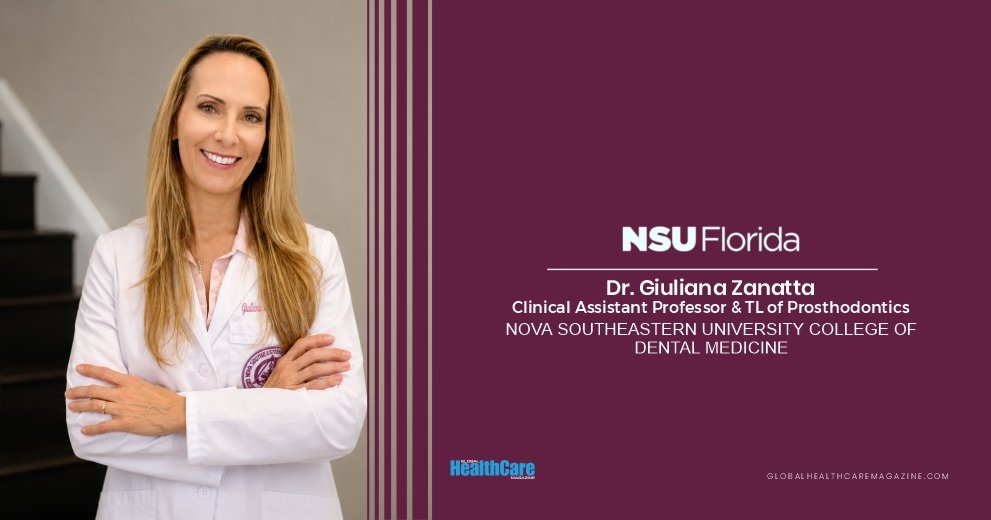
Dr. Giuliana Zanatta spent years working on that problem. Today she is a Clinical Assistant Professor and Team Lead of Prosthodontics at Nova Southeastern University College of Dental Medicine, a prosthodontist, dental educator, and clinical researcher with more than 25 years of experience.
A Faculty Leader in Davie
Dr. Zanatta joined Nova Southeastern University in June 2025, where she serves as full-time clinical faculty and Team Lead in Prosthodontics. As clinical faculty and team lead, she mentors future dentists, supports evidence-based treatment planning, and contributes to clinical research initiatives.
The combination is telling. Her days are divided among teaching, patient-centered planning, and research, and each informs the others. Her academic and research interests include prosthodontics, implant and removable prosthodontics, temporomandibular disorders, clinical research, and the integration of emerging technologies into dental practice and education.
Translation, in Both Directions
A central focus of her work is connecting clinical research with practical patient care. The effort involves carrying findings from research into the treatment room, where they can be evaluated against the needs and experiences of patients.
Dr. Zanatta is particularly interested in digital dental workflows, artificial intelligence, the clinical evaluation of oral-care technologies and products, biofilm management, preventive oral care, and patient-centered research.
She brings what she calls a clinician-scientist perspective to developing and evaluating new technologies, therapeutic approaches and oral-care solutions. Her approach also values interdisciplinary collaboration among universities, clinicians, researchers and industry partners. The objective is to ensure that promising ideas are evaluated rigorously and translated into clinically meaningful applications.
Twenty-One Years at the Chair
The foundation of that perspective is practice. From January 2000 to July 2021, Dr. Zanatta worked as a Clinical Dentist in her own office, Dra. Giuliana Zanatta Dental Office, in Itatiba, São Paulo, Brazil. The practice represented more than 21 years of continuous clinical experience.
Her work there included:
- Diagnosing and devising treatment plans for patients with temporomandibular disorders who required oral rehabilitation
- Performing dental implants, multiple types of prosthetics, direct restorations, and occlusal appliances
- Managing the practice itself, from material procurement to coordinating with specialists across multiple disciplines
During the COVID-19 pandemic, she also assumed responsibility for the practice’s wider operations, including administrative functions previously handled by secretarial staff. She emerged with more than 20 years of clinical experience and a habit of independent patient care, along with a commitment to ongoing professional growth.
The Researcher Behind the Scale
Alongside the practice ran a second career in research. From March 2001 to May 2008, Dr. Zanatta was a Researcher at the Universidade Estadual de Campinas (UNICAMP). During her Master’s and Doctorate studies, she managed different stages of clinical research, from patient selection and informed consent forms to evaluation of the collected data.
Her early contribution to this area was a study involving a Combined Experimental Scale to assess painful symptomatology in patients with temporomandibular disorders. She was the first author of the peer-reviewed paper, published in the Brazilian Journal of Oral Sciences in 2006, alongside four collaborators.
Its subject returns to the problem of pain: “Assessment of painful symptomatology in patients with temporomandibular disorders by means of a combined experimental scale.”
The study examined changes in patients’ reported pain before, during, and after treatment with flat occlusal appliances. Patients recorded their symptoms using the combined experimental scale over a 150-day treatment period. The researchers then analysed the recorded assessments to evaluate changes in painful symptoms.
For a condition like temporomandibular disorder, in which pain is a central symptom, a structured method of recording the patient’s experience provides researchers with a way to evaluate changes throughout treatment. The significance lies in the study’s attempt to make a subjective experience more systematically assessable, giving clinicians and researchers a structured way to follow patients’ reported symptoms.
A Long Tie to UNICAMP
Her connection to UNICAMP continued for years. From March 2009 to December 2020, she was a Collaborating Researcher in Piracicaba, São Paulo. She contributed to research and development initiatives and took part in evaluating Master’s dissertations and Doctorate theses.
Her activities there included:
- Collaborating with interdisciplinary teams to strengthen academic rigor and promote innovative research methodologies
- Sharing research findings and fostering a culture of continuous learning among peers
Her involvement also extended to academic evaluation, where she participated in research committees and supported the development of postgraduate scholarship.
The Classroom, Early and Late
Teaching has been part of the picture for more than a decade. From August 2014 to May 2015, Dr. Zanatta was a part-time Professor of Prosthodontics at Universidade Paulista in Greater Campinas. She delivered lectures using diverse teaching methods, mentored students, and worked with faculty colleagues to develop course materials that stayed current and relevant to industry standards.
That early experience anticipates her present work at Nova Southeastern University, where mentorship is again a core duty.
The Bridge Years
Dr. Zanatta’s path to Florida passed through New Jersey. From January 2024 to June 2025, she served as a Research Collaborator at Rutgers School of Dental Medicine. The experience added another academic connection to a career that had already moved between clinical practice, university research, and postgraduate teaching.
Her professional activities have also included work involving oral-care innovation and regulatory coordination, broadening her exposure to the processes involved in evaluating and developing healthcare products.
The Shape of the Work
Dr. Zanatta’s professional journey runs from a private dental practice in Brazil to research collaborations and academic teaching in the United States. At each stage, clinical experience has remained connected to her interest in research and patient outcomes.
Her work at UNICAMP explored a practical challenge in dentistry: how to assess and record the changes patients experience when receiving treatment for temporomandibular disorders. Her subsequent academic roles have brought that research background into the education of future dentists.
Today, as Team Lead in Prosthodontics at Nova Southeastern University, she mentors students while contributing to evidence-based clinical education.
The connection between these experiences is what defines her approach: clinical observations should lead to meaningful questions, research should help answer them, and education should carry that knowledge into better-informed dental practice.