A dental crown must withstand repeated forces of chewing while protecting the natural tooth opposite it. Before a new material can be considered for clinical use, researchers must understand how it responds to wear and repeated loading under controlled laboratory conditions.
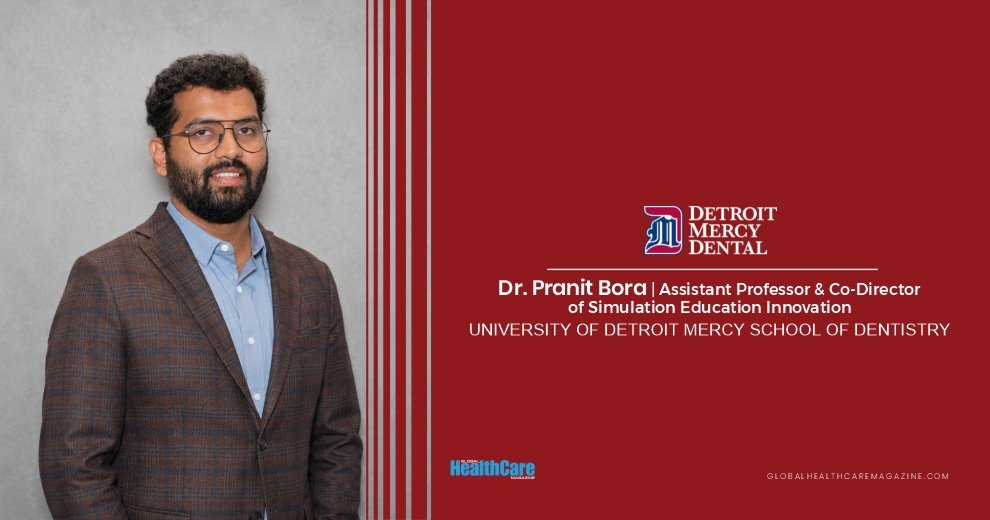
Dr. Pranit Bora has built part of his career on that investigation. He is a Clinical Assistant Professor and Co-Director of Simulation Education Innovation at the University of Detroit Mercy School of Dentistry, a prosthodontist and an educator whose work brings together research, digital technology, and teaching.
A Professor in the Simulation Clinic
Dr. Bora joined the University of Detroit Mercy School of Dentistry in April 2024, serving in the Division of Clinic Essentials and Simulation. He currently holds the positions of Clinical Assistant Professor and Co-Director of Simulation Education Innovation.
His teaching responsibilities are specific. He teaches across fixed and removable prosthodontics, implant dentistry, dental anatomy, occlusion, and digital workflows. His responsibilities have also included course-director and instructional roles in several simulation clinics.
Each of those settings serves a different purpose. A simulation clinic is where students practice hand skills before they treat patients. Fixed and removable prosthodontics cover the replacement and restoration of teeth. Implant dentistry extends that work into a more complex territory. His previous teaching assignments have included directing courses in fixed partial dentures and simulation-based prosthodontics, instructing students in occlusion and articulators, and supporting practical exercises involving single crowns.
These responsibilities place him at several stages of preclinical dental education, where students develop the technical skills and clinical understanding required for patient care.
A Foundation in Prosthodontics and Biomaterials
His own education is layered in a similar way. Dr. Bora holds an MDS in prosthodontics, the specialty at the centre of his clinical work. He also earned an MS in dental biomaterials at the University of Alabama at Birmingham (UAB).
He completed his Bachelor of Dental Surgery (BDS) at Pravara Institute of Medical Sciences in India, followed by his MDS at K.M. Shah Dental College. At UAB, he earned both his Master of Science in Dentistry in Dental Biomaterials and a Graduate Certificate in Dentistry in the same discipline.
Biomaterials is the discipline that asks what a restoration is made of, and how long that substance will last inside the mouth. It is a natural partner to prosthodontics, and Dr. Bora’s later research draws directly on both.
His time at UAB also included several academic and research appointments. From August 2022 to March 2023, he worked as a Student Assistant in the university’s Department of Immunology. He subsequently served as a Student Assistant in the School of Dentistry’s Office of Dental Admission from December 2022 to March 2024 and as a Research Assistant in its Behavioral and Population Sciences department from April 2023 to March 2024.
The Research That Earned a Prize
One strand of Dr. Bora’s research examines 3D-printed crown materials. His research on their enamel wear and fatigue resistance earned him the first-place 2025 Stanley D. Tylman Research Award, presented by the American Academy of Fixed Prosthodontics. The two measures at its centre are practical ones. Enamel wear asks whether a restoration is gentle on the natural tooth opposite it. Fatigue resistance asks whether the restoration itself can last under repeated stress.
Published in the February 2025 issue of The Journal of Prosthetic Dentistry, the study compared 3D-printed resin crown material with lithium disilicate, a widely used glass-ceramic restorative material. The researchers examined both the wear caused to opposing enamel and the materials’ ability to withstand repeated loading.
The findings showed that the 3D-printed resin material produced less opposing enamel wear than lithium disilicate. Both materials also survived two million fatigue cycles under the study’s specified laboratory conditions.
The research offered evidence about the mechanical and wear characteristics of 3D-printed restorative materials, while underscoring the importance of further evaluation before drawing conclusions about their long-term clinical performance. The award recognised the research presented at the Academy’s 74th Annual Scientific Session in February 2025, where Dr. Bora’s work received first place in the Tylman competition.
His broader publication record includes peer-reviewed studies on denture-base materials, zirconia crown fracture strength, CAD/CAM restorations and the characterisation of materials used in 3D-printed dental crowns and hybrid prostheses.
Where Evidence Meets the Classroom
Dr. Bora’s work brings together evidence-based research, digital dentistry and hands-on teaching. The arrangement of his career reflects that combination. He has a foundation in prosthodontics, in dental biomaterials and in clinical practice. His work spans advanced prosthodontic restorations, digital workflows and 3D-printing applications in restorative dentistry.
None of those threads sits apart from the others. A digital workflow produces a restoration, 3D printing fabricates it, and biomaterials research helps establish whether the result can withstand functional demands. Simulation-based teaching gives students opportunities to understand these technologies and develop the practical skills needed to use them.
At Detroit Mercy, he is also involved in curriculum development, academic mentorship, and the integration of digital tools into preclinical dental education. His role as Co-Director of Simulation Education Innovation reflects the importance he places on connecting technological development with measurable student competency.
For students, this approach brings research beyond the laboratory and into the practical environment where clinical skills are developed. Understanding a material’s properties becomes part of understanding why a particular restorative approach is selected and how it should be applied.
Innovation Beyond the Laboratory
Dr. Bora’s interest in practical problem-solving also extends to dental devices and product design. His professional record lists several registered designs and a utility patent associated with dental instruments and equipment.
These include a denture washer, a device for preparing rests for cast partial dentures, a dental retroilluminator, and a dental panoramirror. The range reflects an interest in improving the tools and processes used in everyday dental practice, alongside his academic research into restorative materials.
This work adds another dimension to his professional interests. Rather than focusing exclusively on how existing dental materials perform, he has also explored ways to develop practical devices that address specific challenges in clinical procedures.
Research, Service and Academic Contribution
His involvement extends beyond the courses he teaches. From September 2024 to September 2025, Dr. Bora chaired the Standing Committee for Research at the University of Detroit Mercy School of Dentistry. The position complemented his own research work and brought him into the broader academic responsibilities of supporting research within the institution.
Dr. Bora’s professional memberships include the American Dental Association, American Dental Education Association, Academy of Dental Materials, American Association for Dental Research, and Michigan Dental Association. He also serves as a reviewer for several dental publications, including the Enviro Dental Journal, Acta Scientific Dental Sciences, and the International Journal of Dentistry and Oral Health.
These commitments connect his interests in research, professional development, and dental education with a wider community of clinicians, researchers, and educators.
The Shape of the Work
Dr. Bora’s path brings together a specialty degree in prosthodontics, a master’s in dental biomaterials at UAB, a national research award, and a faculty position at the University of Detroit Mercy School of Dentistry. His work moves between two environments that are closely connected: the research laboratory, where restorative materials are evaluated, and the simulation clinic, where students develop the skills to apply scientific knowledge in practice.
His research on 3D-printed crowns demonstrates the importance of testing new materials against established alternatives. His teaching responsibilities bring that same attention to evidence and practical performance into the education of future dentists.
In an era of rapid technological change in restorative dentistry, his contribution lies in ensuring that innovation is accompanied by careful evaluation, sound clinical understanding, and the practical preparation of the next generation of dental professionals.