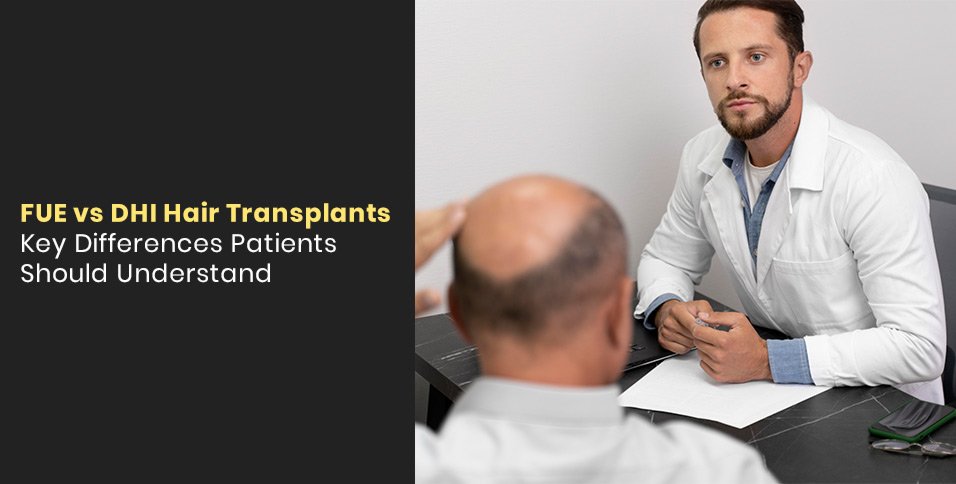
FUE and DHI hair transplants use the same method to remove hair follicles from the donor area. The difference lies in how those follicles are placed. With FUE, the surgeon first creates small incisions in the thinning area and then places the grafts into them, while DHI uses a pen-like implanter that creates the opening and inserts the graft in a single step.
Both techniques can produce natural, lasting results, and published comparisons generally show similar graft survival when the procedure is carried out by an experienced team. The choice between them usually depends on the size of the area being treated, how much density is needed, whether you want to avoid shaving the whole head and your budget, rather than one technique being clearly superior.
How FUE and DHI Differ Step by Step
In both procedures, individual follicular units, small natural groups of one to four hairs, are removed from the back and sides of the scalp using a tiny circular punch, typically between 0.7 and 1 millimetre in diameter. These areas are chosen because the hair there is genetically more resistant to the hormone responsible for male pattern hair loss, so it tends to keep growing after being moved.
With FUE, the extracted grafts are sorted and stored in a cooled solution while the surgeon creates recipient sites, small slits or holes in the thinning area. The angle, direction and depth of each site are planned carefully to match the natural hair. The team then places each graft into these pre-made openings using fine forceps.
DHI changes that final stage. Each graft is loaded into an implanter pen, a hollow needle mounted on a handle, and the surgeon uses it to create the opening and insert the graft at the same moment. Because no separate channel-making step is needed, the graft can spend slightly less time outside the body, and the surgeon controls the angle and depth of each hair directly as it goes in.
Density, Angles and the Natural Look of the Result
A natural-looking transplant depends on direction, angle and spacing. Hair along the front hairline grows forward at a low angle, while hair in the crown grows in a spiral pattern. Getting these details right is what separates a result that blends in from one that looks planted.
DHI’s supporters point out that the implanter gives precise control over each graft, which can help when working on the hairline or packing grafts closely into a small area. Because each graft is inserted into a fresh opening immediately, it can also allow placement between existing hairs with less risk of damaging them, which is helpful for patients who still have some native hair in the treated zone.
FUE with carefully made recipient sites can achieve very similar precision in skilled hands. Many surgeons create sites with fine blades sized to each graft, which also allows close spacing and natural angles. In practice, the experience of the surgeon and technicians has a far greater effect on the final look than the name attached to the technique.
Shaving, Session Size and Cost
Shaving is one of the most practical differences. Standard FUE usually involves shaving the donor area and often the recipient area too, so the team can see each site clearly. DHI can sometimes be performed with less shaving in the recipient area, which appeals to patients who want to return to work quickly without an obvious change in appearance. The donor area still normally needs to be trimmed short for extraction in both techniques.
Session size is another difference. DHI implantation is slower and more labour-intensive, so it’s often used for smaller or moderate sessions, while FUE can typically handle larger numbers of grafts in one day. For someone needing extensive coverage across the top and crown, FUE may complete the work in fewer sessions.
Cost follows from that. Because DHI requires more time and specialised instruments, it often costs more per graft than FUE. Across the UK market, full transplant procedures broadly range from around £2,000 for small sessions to £15,000 or more for large ones, depending mainly on the number of grafts. Asking for a clear breakdown of how many grafts you need, which technique is recommended and why, and what is included in the price makes comparing quotes much easier. Speaking with a London hair restoration clinic that performs both approaches can also give you a more balanced view, as the recommendation is then based on your hair loss rather than on the only method available.
Recovery and Results Timeline for Both Techniques
Recovery is very similar for both methods. The first few days bring some swelling and tenderness, particularly around the forehead, and tiny scabs form around each graft. These usually fall away within 7 to 10 days with gentle washing as instructed by the clinic. Most patients return to desk work within a few days, although strenuous exercise, swimming and direct sun on the scalp are typically avoided for a few weeks.
Between roughly two and six weeks after surgery, many of the transplanted hairs shed. This is a normal stage and doesn’t mean the grafts have failed, as the follicles remain in place beneath the skin. New growth usually begins around three to four months after the procedure, becomes noticeable at around six months and continues to thicken and mature over 12 to 18 months.
Some patients who have DHI with minimal shaving find their recovery less visible to others, because existing hair helps hide the healing grafts. Beyond that, the healing timeline and final results are broadly the same for both techniques.
Choosing Between FUE and DHI for Your Hair Loss Pattern
DHI is often suggested for patients with early to moderate hair loss, those who want to refine or lower their hairline, and those who want to add density between existing hairs without shaving the whole head. It can also suit people who want a more discreet recovery and are treating a smaller area.
FUE tends to suit larger areas of thinning or baldness, including the crown and advanced stages of male pattern hair loss, where many grafts are needed in a single session. It’s also often the more cost-effective choice when coverage matters more than fine refinements.
It’s worth being cautious with clinics that present DHI as a completely different or superior procedure. Both techniques rely on the same donor extraction, and the quality of the result depends on careful planning, gentle graft handling and a realistic assessment of your donor supply. It also helps to understand what is driving your shedding in the first place, since the NHS overview of hair loss and its causes makes clear that some types are temporary and reverse on their own, while pattern baldness is permanent and progressive. Before deciding, ask how many grafts your donor area can safely provide over your lifetime, how your hair loss might progress in the next decade and how the chosen technique fits that long-term plan. Those answers will tell you far more about the likely outcome than the name of the method on the quote.