Healthcare is evolving faster than ever. Rising patient expectations, increasing administrative burdens, staffing shortages, and changing reimbursement models are pushing medical practices to modernize their operations. By 2027, technology will no longer be a competitive advantage—it will be a necessity.
Practices that invest in intelligent digital solutions today will be better positioned to improve patient care, reduce operational costs, increase efficiency, and remain compliant with evolving healthcare regulations.
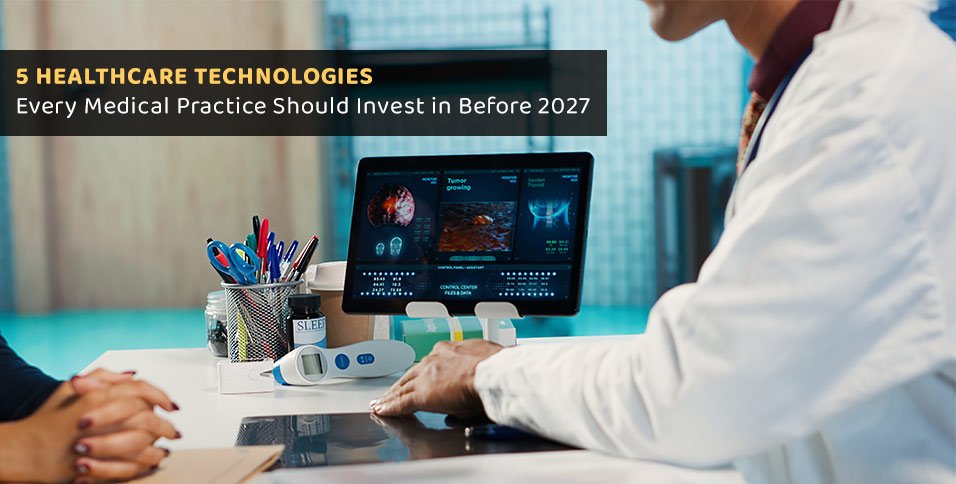
From artificial intelligence to automation, here are five healthcare technologies every medical practice should consider investing in before 2027.
1. AI-Powered Electronic Health Records (EHR)
Electronic Health Records have become the backbone of modern healthcare, but traditional systems often create documentation fatigue for physicians. The next generation of AI EHR Software is changing that by automating many of the repetitive tasks that consume valuable clinical time.
AI-enhanced EHR platforms can:
- Generate clinical notes automatically
- Summarize patient histories
- Suggest diagnoses based on symptoms
- Recommend evidence-based treatment plans
- Flag potential medication interactions
- Reduce documentation errors
Instead of spending hours entering patient information, providers can focus on meaningful patient interactions while AI handles much of the administrative work.
Benefits
- Less physician burnout
- Improved documentation accuracy
- Faster patient encounters
- Better clinical decision support
- Higher patient satisfaction
As AI capabilities continue to mature, practices adopting AI EHR Software today will gain a significant operational advantage over those relying on outdated systems.
2. Advanced Medical Practice Management Platforms
Running a healthcare practice involves much more than delivering quality care. Scheduling, billing, insurance verification, patient communication, reporting, and revenue management all require seamless coordination.
This is where Medical Practice Management Software plays a critical role.
Modern practice management solutions integrate administrative workflows into a single platform, allowing staff to work more efficiently while improving the patient experience.
Key features include:
- Online appointment scheduling
- Automated reminders
- Insurance eligibility verification
- Claims tracking
- Revenue reporting
- Patient billing
- Staff scheduling
- Workflow automation
Instead of juggling multiple disconnected systems, practices can manage daily operations from one centralized dashboard.
Why It Matters
Efficient operations directly affect financial performance. A robust Medical Practice Management Software solution helps reduce administrative overhead, improve collections, minimize scheduling gaps, and streamline communication across departments.
When integrated with an EHR system, it creates a connected healthcare ecosystem that improves both clinical and operational efficiency.
3. AI Medical Coding Solutions
Medical coding remains one of the most time-consuming and error-prone processes in healthcare. Coding inaccuracies often lead to claim denials, delayed reimbursements, compliance risks, and revenue leakage.
Modern AI Medical Coding Software uses natural language processing (NLP) and machine learning to automate coding directly from physician documentation.
Rather than manually reviewing every clinical note, AI can:
- Extract relevant diagnoses
- Identify procedures
- Recommend ICD-10, CPT, and HCPCS codes
- Detect missing documentation
- Identify coding inconsistencies
- Support compliance audits
Major Advantages
- Faster claim submission
- Fewer coding errors
- Lower denial rates
- Improved compliance
- Reduced administrative costs
- Increased coder productivity
Healthcare organizations facing coding staff shortages are increasingly turning to AI Medical Coding Software to maintain accuracy while improving efficiency.
4. AI-Powered Patient Engagement Platforms
Today’s patients expect healthcare to be as convenient as online banking or shopping. Practices that fail to provide digital communication options risk losing patients to more technologically advanced competitors.
Modern patient engagement platforms include:
- Self-service scheduling
- Secure messaging
- AI chat assistants
- Automated appointment reminders
- Prescription refill requests
- Digital intake forms
- Telehealth integration
- Online payments
AI further enhances these systems by answering common patient questions, routing requests, and providing personalized follow-up communications.
Benefits
Improved communication leads to:
- Higher patient satisfaction
- Fewer missed appointments
- Better treatment adherence
- Increased patient retention
- Reduced front-desk workload
Patient engagement technology is quickly becoming a standard expectation rather than a premium feature.
5. Predictive Analytics and Business Intelligence
Healthcare organizations generate enormous amounts of data every day. The challenge is turning that data into actionable insights.
Predictive analytics platforms help practices identify trends before they become problems.
Examples include:
- Predicting appointment no-shows
- Identifying high-risk patients
- Forecasting staffing needs
- Monitoring financial performance
- Tracking provider productivity
- Detecting revenue leakage
- Improving population health management
Instead of reacting to issues after they occur, medical practices can proactively make data-driven decisions.
Business Impact
Analytics help leadership:
- Optimize resource allocation
- Improve financial forecasting
- Enhance operational efficiency
- Improve patient outcomes
- Support value-based care initiatives
Practices that embrace predictive analytics gain a measurable competitive advantage through smarter decision-making.
Why These Technologies Matter Together
While each technology delivers individual benefits, their real value comes from integration.
Imagine this workflow:
- A patient schedules an appointment online.
- Medical Practice Management Software verifies insurance automatically.
- During the visit, AI EHR Software documents the encounter in real time.
- AI Medical Coding Software instantly generates accurate billing codes.
- Claims are submitted faster with fewer errors.
- Predictive analytics monitor revenue trends and identify optimization opportunities.
- Patients receive automated follow-ups and reminders after the visit.
This connected ecosystem reduces manual work, improves accuracy, accelerates reimbursement, and enhances the overall patient experience.
Key Considerations Before Investing
Before adopting any healthcare technology, practices should evaluate:
- Integration with existing systems
- HIPAA compliance and security
- Vendor support and training
- Scalability for future growth
- Artificial intelligence capabilities
- User-friendly interface
- Total cost of ownership
- Return on investment
Technology should simplify workflows—not create additional complexity.
Preparing for Healthcare in 2027
The healthcare landscape will continue to evolve through artificial intelligence, automation, interoperability, and data-driven care. Practices that delay modernization may struggle with rising administrative costs, workforce shortages, and increasing patient expectations.
Investing in intelligent technologies now positions organizations to remain competitive while delivering higher-quality care. Whether it’s implementing Medical Practice Management Software to streamline operations, leveraging AI EHR Software to reduce documentation burden, or adopting AI Medical Coding Software to improve coding accuracy and revenue cycle performance, these solutions represent the future of efficient healthcare delivery.
Conclusion
The next few years will redefine how medical practices operate. AI and automation are no longer emerging concepts—they are practical tools that improve efficiency, accuracy, and patient outcomes. By prioritizing these five technologies before 2027, healthcare organizations can build a stronger operational foundation, reduce administrative burdens, and create a more patient-centered experience.
The practices that invest strategically today will be best prepared to thrive in the increasingly digital future of healthcare.