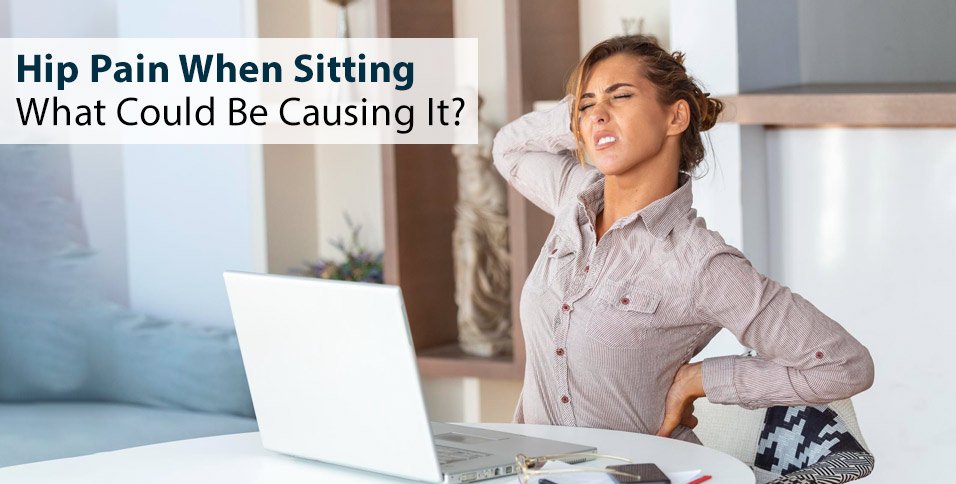
You sit down at your desk to begin the workday, feeling relatively comfortable. However, after an hour or two, a dull ache develops around your hip. When you eventually stand up, you notice stiffness or a sharp discomfort that takes a few moments to settle.
For some people, this happens during long car journeys or while watching television. Others experience hip pain almost immediately after sitting, particularly in low chairs or when crossing their legs.
Although prolonged sitting can contribute to discomfort, the pain does not always originate from poor posture or muscle tightness.
Hip pain when sitting may be associated with osteoarthritis, hip impingement, labral injuries, tendon problems or conditions affecting nerves around the lower back and buttocks. The location of the pain, how long it lasts and whether it improves with movement can provide clues about the possible cause.
Understanding these factors can help you recognise when simple activity adjustments may be useful and when further medical assessment is appropriate.
Why Does Your Hip Hurt When You Sit for Long Periods?
The hip is a ball-and-socket joint connecting the thigh bone to the pelvis. It is surrounded by muscles, tendons, ligaments and other structures that support movement and stability.
When you sit, the hip remains in a flexed position, meaning the thigh moves closer to the upper body.
This position changes the mechanical demands on the joint and surrounding tissues.
For most people, sitting is not harmful. However, remaining in one position for extended periods may aggravate an existing hip condition.
Several factors can contribute to discomfort.
Sustained Hip Flexion
Sitting with your hips deeply bent, particularly in a low chair, may increase discomfort in people with certain hip joint conditions.
For example, individuals with hip impingement may experience pain when the thigh moves closer to the body because particular joint structures come into contact during movement.
Pressure on the Buttocks and Outer Hip
Sitting also places pressure on tissues around the pelvis and buttocks.
In some conditions, sustained pressure or particular sitting positions can irritate sensitive tendons or structures surrounding nerves.
Crossing your legs may also aggravate symptoms in individuals with pain around the outside of the hip.
Reduced Movement
Remaining seated for extended periods means the hip and surrounding muscles are moving less frequently.
People with osteoarthritis may notice stiffness after rest, making the transition from sitting to standing uncomfortable.
However, stiffness after sitting does not automatically indicate arthritis.
Muscle-related problems and other conditions may produce similar symptoms.
1. Hip Osteoarthritis: A Possible Cause of Stiffness After Sitting
Hip osteoarthritis is a degenerative joint condition that becomes more common with age.
It involves changes affecting cartilage, bone and other structures within the hip joint.
Although osteoarthritis often causes discomfort during walking or weight-bearing activities, some individuals experience stiffness or pain after sitting for long periods.
What Does Hip Osteoarthritis Feel Like?
Common symptoms include:
- Pain around the groin, hip or upper thigh
- Stiffness after sitting or resting
- Difficulty getting out of low chairs
- Reduced ability to rotate or bend the hip
- Discomfort when putting on shoes or socks
- Pain during longer walks
For example, someone with hip osteoarthritis may feel comfortable while sitting but experience discomfort during the first few steps after standing.
Others may notice pain during prolonged sitting itself.
The symptoms can vary depending on the severity of the condition and individual circumstances.
Does Hip Arthritis Always Require Surgery?
No. Many people with hip osteoarthritis can initially manage their symptoms through non-surgical approaches.
These may include physiotherapy, appropriate exercise, activity modification and selected pain-relief medicines.
Weight management may also be relevant for individuals living with overweight or obesity.
Surgery is generally considered when symptoms and functional limitations remain substantial despite appropriate management.
The decision depends on the individual’s condition rather than age or imaging findings alone.
2. Hip Impingement: When Sitting Causes a Pinching Sensation
Femoroacetabular impingement, commonly called hip impingement, occurs when the shape of the ball or socket of the hip causes abnormal contact during certain movements.
Some people have this anatomical variation without experiencing symptoms.
However, when it becomes symptomatic, the condition may cause pain during activities involving hip flexion or rotation.
Why Can Hip Impingement Hurt While Sitting?
Sitting places the hip in a flexed position.
When the joint is bent deeply, particularly in a low seat, certain movements may bring sensitive structures into contact.
This can produce discomfort around the front of the hip or groin.
Symptoms may become more noticeable during:
- Prolonged sitting
- Driving
- Squatting
- Getting into or out of a car
- Twisting the hip
- Activities involving deep hip bending
Some people describe the discomfort as a pinching sensation deep inside the joint.
Others experience a dull ache that worsens after extended periods in the same position.
How Is Hip Impingement Managed?
Treatment depends on the symptoms, clinical findings and degree of functional limitation.
Initial management may involve modifying activities that consistently trigger discomfort and performing appropriate strengthening exercises.
Physiotherapy may help improve hip movement and muscle function.
Surgery may be considered in selected cases when symptoms persist and the findings support an operative approach.
However, an anatomical variation seen on imaging does not automatically require treatment.
3. Hip Labral Tears: A Possible Cause of Deep Hip Pain
The hip labrum is a ring of fibrocartilage surrounding the socket of the hip joint.
It helps support joint stability and contributes to the normal function of the hip.
A labral tear may occur following an injury, repetitive loading or in association with certain structural variations of the hip.
Some labral tears cause no symptoms. Others may produce discomfort during particular movements or prolonged sitting.
What Are the Possible Symptoms?
Symptoms may include:
- Deep pain around the groin or front of the hip
- Discomfort during prolonged sitting
- Clicking or catching sensations
- Stiffness or restricted movement
- Pain when rotating the hip
- Discomfort during exercise
For example, a physically active adult may notice hip pain after sitting through a long meeting, followed by clicking when standing and turning.
However, these symptoms are not exclusive to labral injuries.
Hip impingement and other conditions can produce similar complaints.
A clinical assessment may be needed to determine whether further investigation is appropriate.
4. Greater Trochanteric Pain Syndrome: Pain on the Outside of the Hip
Greater trochanteric pain syndrome (GTPS) is a condition involving pain around the outer side of the hip.
It frequently involves the gluteal tendons, which connect muscles around the buttocks to the upper thigh bone.
Although the condition has historically been described as trochanteric bursitis, tendon-related problems are often an important contributing factor.
Can Sitting Make Outer Hip Pain Worse?
Yes. Certain sitting positions can increase compression or irritation around the outer hip.
For example, sitting with your legs crossed may aggravate symptoms.
Other possible triggers include:
- Lying on the affected side
- Climbing stairs
- Standing on one leg
- Walking longer distances
- Rising from certain seated positions
Pain is often concentrated around the bony prominence on the outside of the hip.
Some individuals also experience tenderness when pressing the affected area.
Management may involve reducing aggravating positions, adjusting activity levels and performing progressive strengthening exercises.
Not everyone with outer hip pain has GTPS, so persistent symptoms should be assessed rather than treated based on location alone.
5. Deep Gluteal Syndrome: When Sitting Causes Buttock Pain
Not all pain described as hip pain originates from the hip joint itself.
Sometimes, the discomfort comes from structures within the buttock.
Deep gluteal syndrome refers to irritation or compression of the sciatic nerve in the deep buttock region outside the spine.
It can cause symptoms that resemble sciatica.
What Does Deep Gluteal Syndrome Feel Like?
Possible symptoms include:
- Deep aching pain in the buttock
- Discomfort that increases during prolonged sitting
- Pain extending into the back of the thigh
- Tingling or numbness in some cases
- Symptoms aggravated by driving
- Discomfort during certain hip movements
For some individuals, sitting with the knees higher than the hips may worsen symptoms.
Although the term piriformis syndrome is sometimes used, sciatic nerve irritation in the deep buttock may involve several structures rather than the piriformis muscle alone.
A careful assessment is important because similar symptoms may originate from the lower back.
6. Lower Back Problems Can Cause Referred Hip Pain
Pain felt around the hip does not always arise from the hip joint.
Conditions affecting the lumbar spine can produce discomfort in the buttock, outer hip or leg.
For example, irritation of a spinal nerve may cause pain that extends from the lower back towards the buttock and thigh.
How Can You Recognise Referred Pain?
Symptoms may include:
- Hip or buttock discomfort accompanied by back pain
- Pain travelling down the leg
- Tingling or numbness
- Symptoms that change with sitting position
- Discomfort during bending or prolonged sitting
- Weakness in certain muscle groups
However, the absence of back pain does not completely exclude a spinal cause.
Similarly, not every person with pain extending into the leg has a trapped nerve.
An assessment may involve examining both the hip and lower back to determine where the symptoms originate.
This distinction matters because treatment for a spinal condition may differ from treatment for a problem within the hip joint.
7. Muscle and Tendon Problems Around the Hip
Muscles and tendons surrounding the hip help control movement and provide stability.
These structures can become painful following injury, unfamiliar activity or repeated loading.
For example, an individual who recently increased running, cycling or gym training may develop discomfort around the hip flexors or other muscles.
Can Hip Flexor Problems Cause Pain While Sitting?
Hip flexor muscles contribute to lifting the thigh towards the body.
When these muscles or their tendons are irritated, certain movements involving hip flexion may reproduce pain.
Symptoms may include:
- Discomfort at the front of the hip
- Pain when lifting the knee
- Tenderness after exercise
- Discomfort when rising from certain seated positions
- Pain during activities involving repeated hip movement
However, pain at the front of the hip is not necessarily caused by tight hip flexors.
Hip impingement, joint conditions and other problems can produce similar symptoms.
Persistent pain should not automatically be attributed to muscle tightness without considering other causes.
Does the Location of Your Hip Pain Help Identify the Cause?
Where you feel pain can provide useful clues, although location alone cannot establish a diagnosis.
Pain at the Front of the Hip or Groin
Discomfort in this region may be associated with hip impingement, labral injuries, osteoarthritis or hip flexor problems.
Pain that becomes worse with deep bending or rotation may suggest involvement of structures within the joint.
Pain on the Outside of the Hip
Outer hip pain may involve the gluteal tendons and other structures associated with greater trochanteric pain syndrome.
Symptoms are sometimes aggravated by crossing the legs or lying on the affected side.
Pain in the Buttock
Pain deep within the buttock may involve muscles, nerves or referred symptoms from the lower back.
Tingling or pain extending down the leg may suggest a nerve-related component.
Pain Extending Into the Thigh
Some hip joint conditions produce referred pain into the thigh or even towards the knee.
Other conditions affecting the spine or surrounding tissues can cause similar patterns.
Because these symptoms overlap, additional information and examination findings are needed to identify the likely cause.
Why Does Your Hip Hurt When Standing Up After Sitting?
Some people experience relatively little discomfort while seated but notice pain immediately after standing.
This can occur when a stiff or sensitive joint begins moving after a period of rest.
Hip osteoarthritis is one possible explanation, particularly when the pain is accompanied by reduced movement or difficulty walking.
However, tendon problems and other musculoskeletal conditions can also cause discomfort during transitions between sitting and standing.
The movement requires the hip and surrounding muscles to support body weight while extending the joint.
If these structures are painful or insufficiently conditioned for the task, standing up may provoke symptoms.
Pay attention to whether the pain disappears after several steps, persists during walking or becomes progressively worse.
These details can help guide a medical assessment.
Can Poor Sitting Posture Cause Hip Pain?
Sitting posture can influence symptoms, but there is no single perfect posture that prevents every type of hip pain.
For someone with hip impingement, sitting in a low chair may place the hip in an uncomfortable degree of flexion.
For someone with outer hip pain, sitting with the legs crossed may increase pressure around sensitive tendons.
A person with nerve-related buttock pain may find certain seating positions particularly uncomfortable.
However, posture alone is not necessarily responsible for the underlying condition.
Changing position regularly and choosing seating that feels comfortable may be more useful than attempting to maintain one rigid posture throughout the day.
It is also important to avoid assuming that all sitting-related pain will improve through posture correction alone.
Persistent symptoms may require assessment for an underlying musculoskeletal or neurological condition.
What Can You Do to Relieve Hip Pain While Sitting?
If your symptoms are mild and there are no warning signs, several adjustments may help reduce discomfort.
However, the appropriate approach depends on the underlying cause.
1. Change Your Sitting Position Regularly
Avoid remaining in one position for extended periods if it consistently aggravates your symptoms.
Stand up, walk briefly or change your position when comfortable.
There is no universal movement-break schedule that suits everyone. Adjust the frequency according to your symptoms and daily activities.
2. Consider Your Chair Height
Low chairs can place the hips in a more deeply flexed position.
If this causes discomfort, consider a higher seat that allows you to sit and stand comfortably.
Avoid forcing yourself into a particular seated posture if it increases pain.
3. Avoid Positions That Compress the Painful Area
If you experience discomfort around the outer hip, crossing your legs may worsen symptoms.
Sitting with your feet supported and avoiding sustained pressure on the affected side may be more comfortable.
For buttock pain, adjusting the depth and angle of your seat may help reduce symptoms.
4. Maintain Comfortable Physical Activity
Gentle walking or other suitable movement can help preserve mobility.
Complete inactivity is not routinely necessary for most mild musculoskeletal conditions.
However, activities that repeatedly cause substantial pain should be modified until the cause is better understood.
5. Consider Appropriate Strengthening Exercises
Depending on your condition, strengthening the hip and surrounding muscles may help improve movement and physical capacity.
For some individuals, rehabilitation may involve exercises targeting the gluteal muscles, hip flexors or other lower-limb muscles.
Exercise selection should reflect the diagnosis and your tolerance.
Aggressive stretching is not always appropriate, particularly when certain movements increase joint impingement or compress sensitive tendons.
When Should You Seek Medical Attention for Hip Pain?
Occasional discomfort after prolonged sitting may improve with simple activity adjustments.
However, medical assessment is advisable when symptoms persist, worsen or interfere with everyday activities.
Consider seeking medical advice if you experience:
- Hip pain that repeatedly returns during sitting
- Stiffness that affects walking or standing
- Difficulty getting into or out of a chair or car
- Pain that interrupts sleep
- Clicking or catching accompanied by discomfort
- Reduced ability to bend or rotate the hip
- Tingling, numbness or weakness in the leg
- Symptoms that do not improve with reasonable self-care
An assessment by a healthcare professional, including a hip specialist in Singapore when clinically appropriate, may help identify the source of the symptoms and determine whether further investigations or treatment are needed.
Which Symptoms Require Urgent Assessment?
Seek urgent medical attention if you develop severe hip pain after a fall, cannot bear weight or experience sudden severe pain with significant difficulty moving the joint.
A hot, swollen and painful joint, particularly with fever or feeling generally unwell, also requires urgent assessment because infection is one possible cause.
New or rapidly worsening leg weakness, or new bladder or bowel dysfunction associated with back or leg symptoms, should be treated as a medical emergency.
Do not wait for a routine appointment when these warning signs are present.
How Is Persistent Hip Pain Diagnosed?
A healthcare professional will usually begin by asking about your symptoms and medical history.
Important details may include when the discomfort started, where the pain is located and whether it is affected by sitting, standing or walking.
Your doctor may also ask about previous injuries, physical activities and existing medical conditions.
Physical Examination
The examination may involve:
- Assessing hip movement
- Checking tenderness around the joint
- Evaluating muscle strength
- Observing walking patterns
- Performing selected movements to reproduce symptoms
- Examining the lower back or nerves when indicated
The findings help determine whether the pain is more likely to arise from the hip joint, surrounding tissues or another region.
Are X-Rays or MRI Scans Necessary?
Not everyone with hip pain requires imaging.
X-rays may be recommended when osteoarthritis, bone abnormalities or certain structural conditions are suspected.
MRI may be considered when there is concern about soft tissue injuries, labral problems or other conditions that require more detailed investigation.
Sometimes, additional tests may be appropriate if the symptoms suggest nerve-related or inflammatory conditions.
The choice of investigation depends on the clinical findings and whether the results are likely to influence treatment.
Can Hip Pain When Sitting Be Managed Without Surgery?
Many causes of sitting-related hip discomfort can initially be managed using non-surgical approaches.
Depending on the diagnosis, treatment may include:
- Physiotherapy and appropriate strengthening exercises
- Activity modification
- Adjustments to sitting positions
- Selected pain-relief or anti-inflammatory medicines
- Treatment of contributing lower back conditions
- Injections for particular conditions when clinically indicated
Medication suitability depends on individual health factors, including existing medical conditions and other medicines.
Surgery may be considered for selected structural problems or advanced joint conditions when symptoms remain substantial despite appropriate treatment.
However, pain that occurs while sitting does not automatically indicate that surgery is necessary.
The aim is to identify the cause and select treatment that addresses the patient’s symptoms and functional needs.
How Can You Reduce Recurring Hip Discomfort During the Workday?
For people who spend much of the day working at a desk, small adjustments may help reduce repeated discomfort.
Try incorporating regular changes of position rather than remaining seated for several hours without movement.
Choose a chair that allows you to sit comfortably, and avoid positions that consistently reproduce symptoms.
If your work involves long periods of driving, consider taking suitable breaks during longer journeys when it is safe and practical to do so.
Regular physical activity outside working hours can also help maintain strength and mobility.
However, do not attempt to compensate for prolonged sitting with intense exercise that repeatedly aggravates your hip.
A gradual and sustainable activity routine is generally more practical than sudden changes in exercise intensity.
If symptoms continue despite these adjustments, seek medical advice rather than repeatedly changing chairs or stretching without understanding the underlying problem.
Understanding What Your Sitting-Related Hip Pain May Mean
Hip pain when sitting can develop for several reasons, and the discomfort does not always originate from the hip joint itself.
Osteoarthritis, hip impingement, labral injuries, tendon-related conditions and nerve problems can all produce symptoms during prolonged sitting or when standing afterwards.
The location of the pain and any accompanying stiffness, clicking, numbness or weakness may provide useful clues.
However, no single symptom can reliably establish the diagnosis.
For mild discomfort, changing positions, maintaining comfortable movement and modifying aggravating activities may help.
Persistent or worsening symptoms deserve assessment, particularly when they interfere with walking, sleep or daily activities.
Understanding the underlying cause of hip pain is more useful than simply avoiding sitting. With an appropriate assessment and management plan, many individuals can address their symptoms while maintaining mobility and participating in everyday activities.
Medical Disclaimer: This article is intended for general informational purposes only and does not replace professional medical advice, diagnosis or treatment. Consult a qualified healthcare professional for advice regarding your individual symptoms or medical condition.