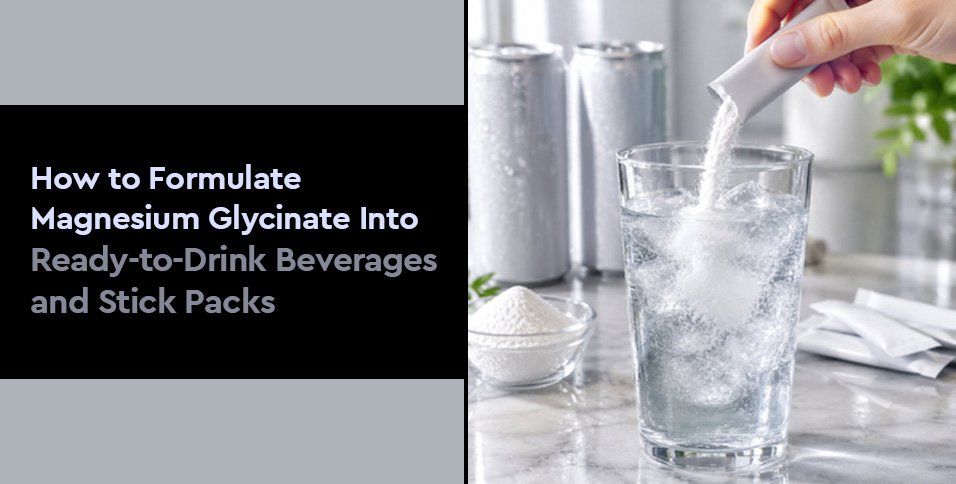
Magnesium glycinate can be formulated into functional beverages, ready-to-drink cans, and stick packs when R&D teams control system pH, elemental dose per serving, and processing stress. Liquid matrices expose dissolved minerals to sensory and clarity challenges, so pick the delivery format first and match the raw-material grade to that environment.
Can magnesium glycinate go into a beverage?
Yes. Magnesium glycinate works in liquid and reconstitutable applications, though beverages are less forgiving than tablets or capsules. Powder behavior in a dry blend does not predict behavior in water.
In aqueous systems, magnesium glycinate solubility is moderate and more workable than insoluble salts such as magnesium oxide. An encapsulated powder can hide alkalinity, sedimentation, and metallic or amino-acid off-notes; a beverage exposes every dissolved ion to the palate and the eye.
Three variables decide success on the bench and on the canning line: delivery format, acid-buffering system, and elemental magnesium payload per serving. Unreacted inorganic magnesium can raise system pH and accelerate off-notes, so starting with a fully reacted, non-buffered magnesium bisglycinate — free Mg held to ≤0.02% w/w — removes a major source of sensory drift.
RTD vs stick pack vs drink mix
Selecting the delivery vehicle early prevents costly reformulation during scale-up. Ready-to-drink (RTD) products must survive thermal processing and months of wet storage; dry formats shift hydration to the end user.
| Format | Main Risk | What to Test |
|---|---|---|
| Ready-to-Drink (RTD) | Post-processing cloudiness, salt precipitation, and pH drift over shelf life | Day-0 vs Day-30 visual clarity, accelerated stability, and thermal stress recovery |
| Stick Pack | Incomplete cold-water reconstitution, rapid sedimentation, and clumping | Stir-time to dispersion in 8–16 oz chilled water, wetting rate, and anti-caking compatibility |
| Scoopable Drink Mix | High sensory taste load, blend segregation in tubs, and moisture pickup | Organoleptic profile across serving dilutions and bulk powder flowability |
In a magnesium glycinate ready-to-drink application, the mineral stays in contact with water, organic acids, flavor solvents, and preservatives. Slow interactions eventually show up as haze or sediment.
A magnesium glycinate stick pack or powder drink mix stays dry until seconds before consumption, sidestepping long-term aqueous stability — provided the raw material wets out quickly in cold water.
For stick packs, multi-serve canisters, and liquid bases, formulators often evaluate a beverage-oriented magnesium glycinate grade such as MagneINNO™ Ultra Taste Free (about 8.00% elemental magnesium as a starting point) when they want a lower taste-load option. Albion TRAACS and other published chelate systems are common references. For MagneINNO™ grades, 10.00% and 12.01% elemental magnesium starting points are typical for gummies and for capsules or tablets; powders, stick packs, and beverages often start at about 8.00%. Those percentages are formulation starting points, not hard limits. MagneINNO supplies them as fully reacted, non-buffered magnesium bisglycinate made with proprietary MagniLift™ technology.
How pH and acid systems affect taste and clarity
Left unadjusted in plain water, raw magnesium glycinate dispersions read alkaline. Taste receptors interpret high-pH amino-mineral solutions as soapy, flat, or bitter. Most commercial functional beverages and hydration sticks are mildly acidic for microbial control and flavor brightness, so food-grade acidulants are essential.
When you titrate an alkaline glycinate solution with citric, malic, or tartaric acid, the glycine ligand buffers the drop. You will need more acidulant than in an unfortified flavored water to reach the same target pH.
Two common failure modes:
- Under-acidification: A neutral-to-alkaline finish flattens aromatics and lets the soapy back-note dominate.
- Acid-salt precipitation: Certain organic acids and buffering salts form less-soluble magnesium complexes over time, turning a bright prototype hazy or dropping crystals in cold storage.
For extreme low-pH targets — sour energy shots or high-acid sodas — verify across refrigerated and ambient storage. Slight cloudiness can appear days after batching if acidulant ratio, mineral concentration, and water hardness are not balanced.
Dose per serving and taste load
Sensory performance and mineral payload pull in opposite directions. Taste burden rises steeply as elemental magnesium per serving increases, especially in low-volume shots or lightly flavored still waters.
In general industry practice — an indicative observation from commercial work, not a MagneINNO claim or regulatory standard — many successful RTDs and stick packs land single servings at about 50–150 mg elemental magnesium per 12–16 oz rather than packing a full daily value into one can. Pushing toward 200 mg or more in a small volume increases buffering, consumes more acidulant, and makes taste masking the central battle.
To stay palatable without drowning the drink in high-intensity sweeteners, prioritize clarity and taste over maximizing the label claim:
- Pair organic acids: Citric for front-palate tartness; malic for lingering mid-to-back-palate sourness that covers the mineral finish.
- Choose synergistic flavors: Citrus (grapefruit, yuzu, blood orange), tart berry, and ginger mask amino-mineral warmth better than watermelon, cucumber, or vanilla.
- Modulate mouthfeel: Bitter blockers, flavor modulators, or balanced sodium/potassium electrolytes can round sharp edges.
Process stress and shelf life
A formula that looks crystal clear in a lab beaker can still fail at a commercial CMO. Flash pasteurization, tunnel pasteurization, and hot-fill-hold accelerate reactions between dissolved magnesium, proteins, polyphenols, and hydrocolloids.
A practical approach is controlled pre-dispersion: hydrate magnesium glycinate in a dedicated portion of ambient or warm water under high shear before adding acidulants, gums, sweeteners, or botanical extracts. Once dissolved and acidified, sequence the rest without shocking the mineral out of solution.
Also account for:
- Carbonation: CO₂ lowers pH slightly and often cuts alkaline notes; manage anti-foam at fill.
- Preservatives: Potassium sorbate and sodium benzoate need a low-pH window; measure equilibrated pH after adding the mineral.
- Electrolytes and polyphenol extracts: Calcium salts, phosphate buffers, or tannin-rich tea extracts can cross-react — check the finished matrix before scale-up.
On the procurement side, MagneINNO™ grades are GRAS self-affirmed, produced at an NSF GMP for Sport registered facility, and maintain chelation integrity above 95% over a 24-month unopened shelf life.
Bench-trial checklist
Before locking a paper formula, run a structured matrix screen. Solubility in deionized lab water can overstate performance in a real acidified, flavored RTD or stick pack.
- Format and hydration window: 15-second ice-water dissolve (stick pack) vs 12-month can clarity (RTD).
- Serving volume and elemental load: Test target elemental mg across 2 oz / 12 oz / 16 oz to find the sensory threshold.
- Target pH and titration curve: Record initial pH and exact acidulant grams to the target window.
- Acidulant system: Screen citric, malic, tartaric, and phosphoric acids alone and in blends for delayed precipitation.
- Sweetener and flavor modulators: Pair stevia, monk fruit, sucralose, or allulose with bitter-masking systems.
- Water source: Parallel trials in deionized vs plant water; hardness affects clarity.
- Day-0 vs Day-30 clarity: Store at 4°C, 25°C, and 40°C; inspect weekly for haze or crystals.
- Blind sensory: Taste Day 0 and Day 30 against an unfortified control.
Frequently Asked Questions
Is magnesium glycinate water soluble? Yes. It is moderately water soluble and disperses more readily than magnesium oxide or hydroxide. Real-world beverage solubility still depends on temperature, elemental concentration, pH buffering, and co-ingredients such as acids and electrolytes.
Why can it taste bitter or soapy in drinks? Unacidified solutions raise water pH into an alkaline range. Balancing with organic acids (citric and malic) and using a fully reacted, low-taste-load grade removes most of this off-note.
Which format is usually easiest to start with? Stick packs and scoopable powder drink mixes. The powder stays dry until the consumer mixes it, so teams avoid long-term RTD precipitation risk and can focus on wetting and immediate flavor masking.
Next steps for beverage R&D and procurement
Before a pilot run, MagneINNO™ Ultra Taste Free above is one beverage-oriented grade to screen; for commercial follow-up, samples, and lot documentation, contact NutraINNO USA Inc. (the company behind the MagneINNO™ brand) to compare starting options across powders and beverages (~8.00% elemental Mg), gummies (~10.00%), and tablets or capsules (~12.01%).
Technical and procurement teams can request a free 50 g bench sample alongside QA documentation, including lot-specific Certificates of Analysis. On MagneINNO release data, purity of 99.8% and a release pass rate of 99.8% are two separate metrics — use them for side-by-side pH and sensory screens. For commercial trials, 25 kg fiber drums ship from the Ontario, California warehouse with approximate lead times of about 3 days for in-stock material and 1 to 2 weeks for scheduled production runs.