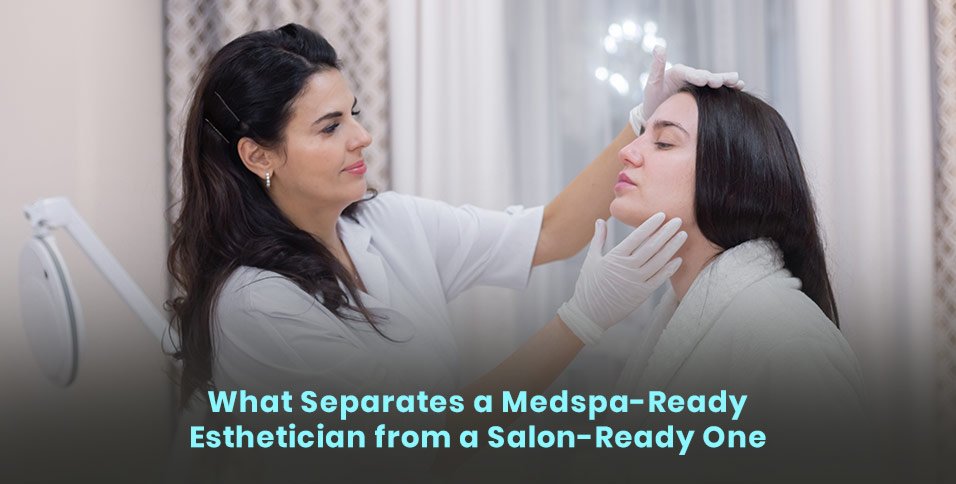
Most esthetics graduates hit the job market with a license and very little idea that two completely different career tracks exist. One leads to the salon floor. The other leads to a clinical medspa setting where the treatments are more advanced, the clients’ expectations are higher, and the paycheck reflects both. The gap between those two tracks is not about talent. It is about training depth, and most programs only cover one of them.
If you are seriously thinking about working in a medspa or eventually running your own, the choice you make about your education now will determine which track you end up on. Here is exactly what that difference looks like, and how to evaluate whether a program actually prepares you for clinical work.
The Industry You Would Be Entering
The medspa sector is not a niche anymore. The global medical spa market is projected to reach $23.29 billion in 2025 and $47.17 billion by 2031, growing at a CAGR of 12.48% from 2026 to 2031, according to Mordor Intelligence. That kind of sustained expansion means new locations are opening constantly, which means qualified providers are in demand on a scale that was not true a decade ago.
On the workforce side, the numbers are just as clear. According to the U.S. Bureau of Labor Statistics, employment of skincare specialists is projected to grow 7 percent from 2024 to 2034, much faster than the average for all occupations, with roughly 14,500 openings projected each year over the decade. A significant portion of those openings will be inside medspas, not salons, because that is where new investment is going.
The market is growing. The jobs are real. But the credential gap is real too, and it is the part nobody talks about at enrollment.
What Salon Training Covers (And Where It Stops)
A standard esthetics program does a solid job teaching you the basics: skin analysis, facials, waxing, extractions, product knowledge, and the chemistry of cleansers and moisturizers. You will graduate licensed, client-ready, and fully capable of working a treatment room in a day spa or boutique salon. For a lot of people, that is exactly the right outcome.
But a salon environment rarely asks you to operate a laser, assess a client’s candidacy for a chemical peel at clinical depth, interpret a Fitzpatrick scale reading before a device treatment, or understand the contraindications that a physician on staff needs to know about. Those skills do not appear in most standard curricula because the programs were built for the salon track, not the clinical one.
The gap shows up immediately on the job. A medspa owner does not have time to retrain someone from the ground up. They are looking for someone who already understands how clinical-grade treatments work, what safety protocols exist, and how to communicate with the medical professionals on the team.
The Treatment Depth Test: A Framework for Evaluating Programs
Before you enroll anywhere, run every program you are considering through what I call the Treatment Depth Test. Ask four specific questions:
- Who teaches the clinical modules? If the advanced skincare and device training is led by practicing physicians or nurse practitioners who still see patients, the instruction reflects real clinical judgment. If it is only taught by estheticians who have not worked in a medical setting, the frame of reference is narrower.
- Are device protocols covered, or just mentioned? A medspa-ready program teaches you to actually operate the equipment, understand contraindications, and document a treatment plan. A mention of “laser services” in a brochure is not the same thing.
- What does the graduate actually qualify for under state law? This varies dramatically by state. Some programs walk you into licensure with zero ambiguity about what you can legally perform. Others graduate students who are not clear on their scope of practice the day they finish.
- What does the placement track look like? Placement into medspas, dermatology offices, or physician-supervised settings is the clearest signal that a program built its curriculum for that environment.
Run any program through those four questions and the answer about medspa readiness becomes obvious pretty fast.
A Scenario Worth Thinking Through
Consider a student named Jada. She completes a 600-hour esthetics program at a general cosmetology school, passes her state exam, and gets hired at a medspa in Tampa. Her first week, a client comes in wanting a series of glycolic peels. The medspa’s physician needs Jada to document the client’s Fitzpatrick type, note a history of isotretinoin use, flag a contraindication, and hand off a pre-treatment recommendation. Jada knows facials. She does not know this workflow.
She is not incompetent. She is undertrained for the specific setting. Two months of scrambling to catch up, and she either finds her footing or she does not. Some do. But the cost, in confidence and in client experience, is real.
Now run the same scenario with a student who trained at a physician-taught program where clinical consults, contraindication screening, and device protocols were part of the core curriculum. That student walks into Jada’s first week with a completely different baseline. That is the concrete difference clinical training makes, and it is not abstract.
What to Look for in a Medspa-Focused Curriculum
Beyond the Treatment Depth Test, a few structural signals tell you whether a program was built for clinical placement. Hybrid or condensed formats that mirror how medspas actually schedule training work tend to produce graduates who adapt faster to the pace of a busy clinic. Programs where the ownership and faculty have active patient-care roles carry a different standard than programs where instruction is entirely academic.
Programs like Medspa Institute in Florida, which is physician-founded and owner-operated with faculty who still treat patients, represent the structural model worth paying attention to. The proximity of instruction to actual clinical practice is not a marketing point. It is a curriculum design decision that shows up in what graduates know on day one.
Accreditation matters too, but look at what the accrediting body measures. A license-only outcome is the floor, not the ceiling.
The Comparison That Settles the Decision
| Training Dimension | Salon-Track Program | Medspa-Track Program |
|---|---|---|
| Faculty background | Licensed estheticians, cosmetologists | Physicians, NPs, clinical estheticians |
| Device training | Introductory or none | Hands-on with protocols and contraindications |
| Client intake focus | Skin goals, product preferences | Medical history, Fitzpatrick typing, safety screening |
| Post-graduation setting | Salon, day spa, hotel spa | Medspa, derm office, physician-supervised clinic |
| Earning trajectory | Median hourly wage tier | Commission and clinical bonus structures common |
Neither track is wrong. But if your goal is a medspa setting, choosing the salon-track program and hoping to bridge the gap later is the harder path. The bridge exists, but it costs time and money you already spent once.
Making the Call
The smartest move is to decide your target setting before you pick a program, and then reverse-engineer the curriculum choice from there. If medspa is the goal, audit the program for clinical faculty, device protocols, contraindication training, and placement history. If those four things are strong, you are in the right place. If they are vague or absent, you are likely paying for a license when you need a clinical foundation.
The medspa industry will keep growing. The question is whether your training puts you inside that growth from the start, or catches up to it later.